


Cartridges

Disposable Vape vs 510 Cartridge: Which Should You Buy?
A disposable vape and a 510 cartridge can hold the exact same oil and…
Learn more
You must be 21+ to enter this site
 FREE SHIPPING $89+
 FREE GIFT ON $120+
 100% FEDERALLY LEGAL
 LAB TESTED FOR PURITY
FREE SHIPPING $89+
FREE GIFT ON $120+
100% FEDERALLY LEGAL
LAB TESTED FOR PURITY
FREE SHIPPING $89+
FREE GIFT ON $120+
100% FEDERALLY LEGAL
LAB TESTED FOR PURITY
FREE SHIPPING $89+
FREE GIFT ON $120+
100% FEDERALLY LEGAL
LAB TESTED FOR PURITY
FREE SHIPPING $89+
FREE GIFT ON $120+
100% FEDERALLY LEGAL
LAB TESTED FOR PURITY
FREE SHIPPING $89+
FREE GIFT ON $120+
100% FEDERALLY LEGAL
LAB TESTED FOR PURITY
FREE SHIPPING $89+
FREE GIFT ON $120+
100% FEDERALLY LEGAL
LAB TESTED FOR PURITY
FREE SHIPPING $89+
FREE GIFT ON $120+
100% FEDERALLY LEGAL
LAB TESTED FOR PURITY
LAB TESTED FOR PURITY
FREE SHIPPING $89+
FREE GIFT ON $120+
100% FEDERALLY LEGAL
LAB TESTED FOR PURITY
FREE SHIPPING $89+
FREE GIFT ON $120+
100% FEDERALLY LEGAL
LAB TESTED FOR PURITY
FREE SHIPPING $89+
FREE GIFT ON $120+
100% FEDERALLY LEGAL
LAB TESTED FOR PURITY
FREE SHIPPING $89+
FREE GIFT ON $120+
100% FEDERALLY LEGAL
LAB TESTED FOR PURITY
FREE SHIPPING $89+
FREE GIFT ON $120+
100% FEDERALLY LEGAL
LAB TESTED FOR PURITY
FREE SHIPPING $89+
FREE GIFT ON $120+
100% FEDERALLY LEGAL
LAB TESTED FOR PURITY
FREE SHIPPING $89+
FREE GIFT ON $120+
100% FEDERALLY LEGAL
LAB TESTED FOR PURITY

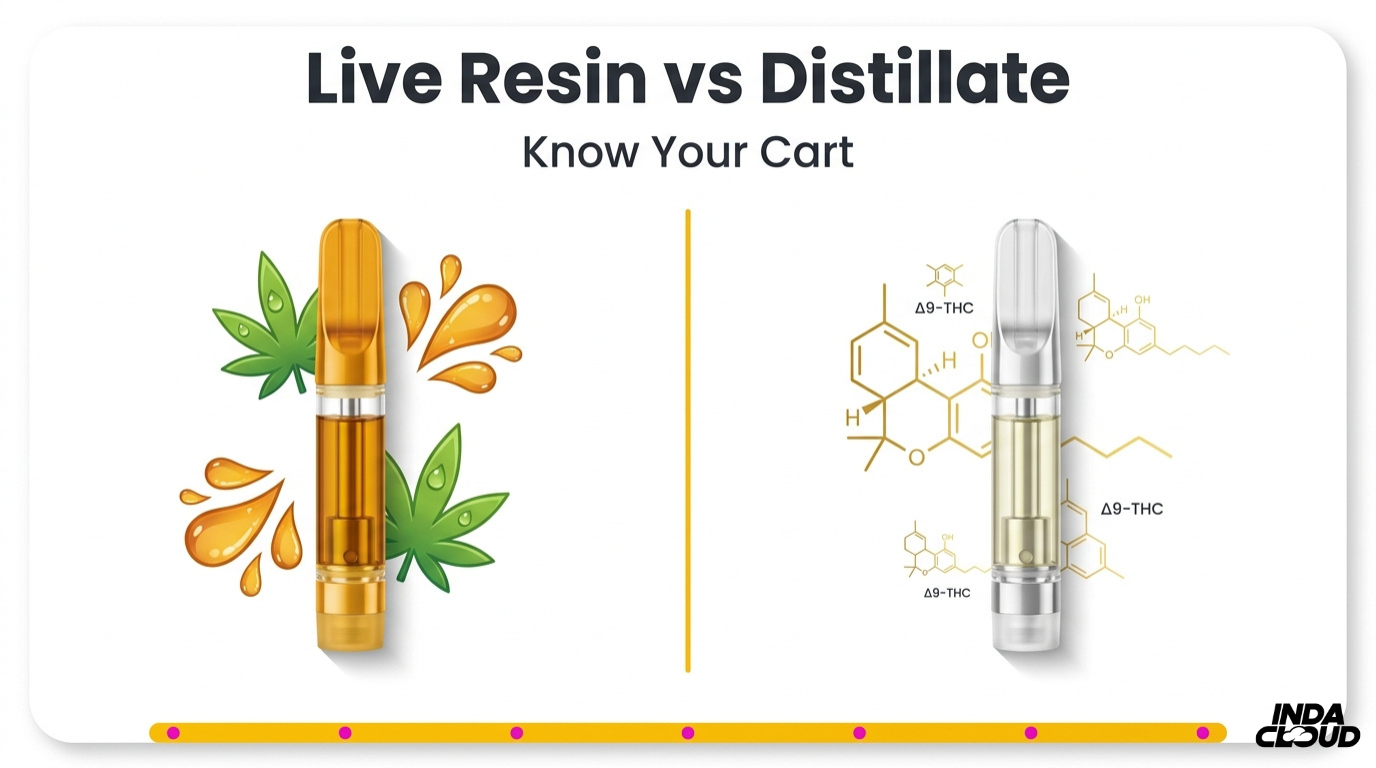
A live resin cart contains full-spectrum extract made from flash-frozen cannabis that preserves the plant’s original terpenes and cannabinoids, while a distillate cart contains highly refined oil stripped down to near-pure THC concentrations as high as 99%.
This guide covers extraction and composition, potency and the entourage effect, flavor differences, effects and pricing, user experience levels, cart quality and safety, and strain-specific performance across both formats.
Live resin is extracted at subcritical temperatures immediately after harvest, preserving 60% to 80% of the plant’s original terpene profile. Distillate undergoes high-heat refinement that isolates THC while removing nearly all other plant compounds, with terpenes often reintroduced artificially afterward.
Live resin carts typically range from 70% to 90% THC, while distillate reaches 85% to 99%. Despite lower raw numbers, live resin often feels stronger because retained cannabinoids, terpenes, and flavonoids interact synergistically through the entourage effect, producing a more layered and longer-lasting high.
Each cart type delivers a distinct experience. Live resin provides complex, strain-specific flavor and a well-rounded high with gradual onset. Distillate delivers a clean, direct, THC-focused effect that is predictable and consistent session to session.
Pricing reflects production complexity. Distillate cartridges cost significantly less per gram, making them practical for daily use on a budget. Live resin commands a premium due to cryogenic equipment, specialized extraction, and lower yields.
Strain type, user experience level, and third-party lab testing all influence which cart fits best. Beginners often start with distillate for its simplicity, while experienced users gravitate toward live resin for depth. Verified COAs remain essential for both formats to confirm potency and screen for contaminants like heavy metals and residual solvents.
A live resin cart is a vape cartridge filled with full-spectrum cannabis extract made from fresh-frozen plant material. This section covers how live resin is extracted, which compounds it preserves, and why its flavor stands apart.
Live resin is extracted from fresh cannabis plants through a process that begins immediately at harvest. Instead of drying or curing the flower, producers flash-freeze freshly harvested cannabis to approximately -20 to -40 degrees Celsius using cryogenic freezers or dry ice. This rapid temperature drop prevents the degradation of volatile terpenes that would otherwise evaporate during traditional curing.
Once frozen, the plant material undergoes hydrocarbon extraction in a closed-loop system. The result is a concentrate with terpene concentrations generally ranging from 4% to 12%, significantly higher than the 0% to 5% typically found in distillate. This preservation-first approach is what separates live resin from nearly every other extraction method on the market.
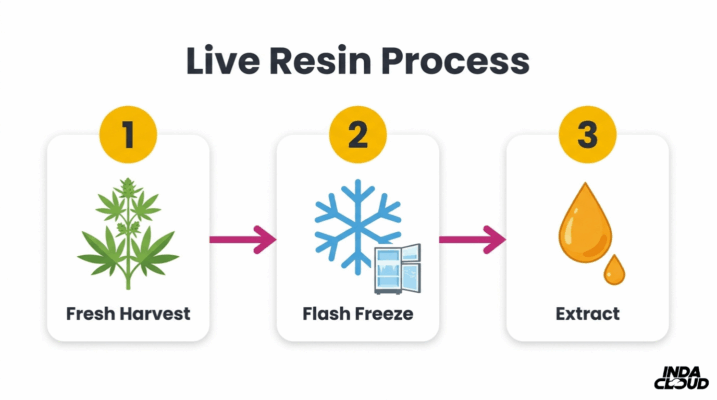
The cannabinoids and terpenes preserved in live resin include the plant’s original spectrum of THC, CBD, CBG, CBN, and minor cannabinoids alongside terpenes such as myrcene, limonene, pinene, and linalool. Because flash-freezing captures the plant’s chemical profile at peak freshness, these compounds remain intact rather than being stripped away.
According to a 2025 review published through the National Institutes of Health, the “entourage effect” hypothesis suggests that the therapeutic potential of cannabis is enhanced by the synergistic interaction between cannabinoids, terpenes, and flavonoids rather than isolated THC or CBD alone. For users who want more than raw potency, this full-spectrum preservation makes live resin uniquely valuable.
Live resin has a stronger flavor profile because its extraction process preserves 60% to 80% of the plant’s original terpene content, whereas distillation retains only 10% to 30% of those natural compounds. That difference is immediately noticeable on the palate; each strain tastes closer to the living plant.
Flavor matters more than many users realize. According to Abstrax Tech, nearly 60% of vape users choose products based on flavor profile. Whole-plant products like live resin also produce stronger, longer-lasting psychoactive effects compared to isolated cannabinoid formulations, which means flavor and experience reinforce each other.
Understanding what sets live resin apart helps clarify how distillate carts take a fundamentally different approach.
A distillate cart is a vape cartridge filled with highly refined cannabis oil that has been stripped down to nearly pure THC. The sections below cover how distillation works, why distillate achieves such high purity, and whether terpenes are reintroduced.
Distillate is refined through the distillation process by using heat and vacuum pressure to separate individual cannabinoids from crude cannabis extract. The two most common methods are short-path and wiped-film distillation, both of which exploit differences in boiling points to isolate THC from other plant compounds. According to Sunmed, this process produces a highly refined cannabis oil that can reach cannabinoid concentrations as high as 99% by isolating specific compounds like THC. Crude oil first undergoes winterization to remove fats and waxes, followed by decarboxylation, before entering the distillation apparatus. Each pass through the system increases purity, yielding a translucent, golden oil with minimal residual plant material.
Distillate is considered a pure THC concentrate because the distillation process systematically removes terpenes, flavonoids, minor cannabinoids, and plant lipids, leaving behind an oil that is overwhelmingly THC by weight. Distillate cartridges often reach concentrations of 85% to 99% THC, far exceeding most other extract types. This level of refinement means the final product is nearly odorless and flavorless on its own, which makes it incredibly versatile as a base ingredient. For users who want the strongest possible THC delivery per puff without additional plant compounds, distillate remains one of the most efficient options on the market.
Yes, terpenes are commonly added back into distillate carts to restore flavor and aroma that the refining process removes. Manufacturers use either cannabis-derived terpenes, extracted separately from cannabis plants, or botanical terpenes sourced from non-cannabis plants like lavender or citrus. Before reintroduction, distillate typically contains between 0% and 5% terpene content. The strain-specific flavor profiles listed on distillate cart packaging usually reflect these reintroduced terpene blends rather than compounds naturally preserved during extraction. While added terpenes improve taste, they do not fully replicate the complex chemical synergy found in full-spectrum extracts, making the experience noticeably different from carts that retain their original terpene profile.
Understanding how distillate is made clarifies what sets it apart when compared directly to live resin.
Live resin and distillate carts differ in potency through both raw THC concentration and the way cannabinoids interact during consumption. The following subsections cover each cart type’s typical potency range and whether the entourage effect amplifies perceived strength.
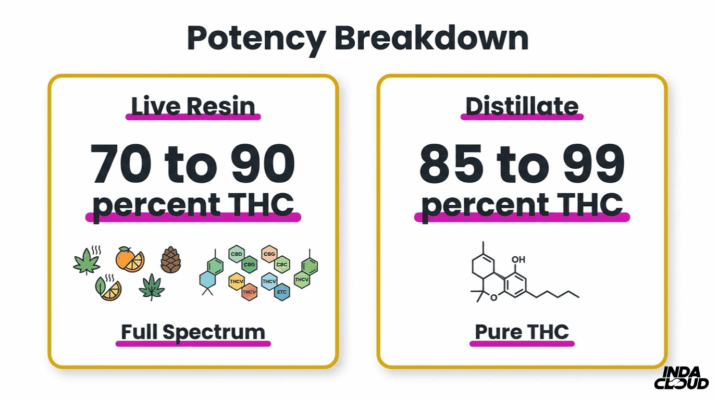
A live resin cart is potent enough for most users to feel strong, full-spectrum effects, with THC percentages typically ranging from 70% to 90%. Although that number sits below distillate on paper, the retained terpenes and minor cannabinoids create a layered high that many consumers describe as more complete. According to Market Report Analytics, the global live resin cartridge market is projected to reach approximately $5 billion by 2025, reflecting growing consumer demand for this full-spectrum potency profile. For users who value depth of effect over sheer THC concentration, live resin consistently delivers.
A distillate cart is highly potent for most users, with THC concentrations commonly reaching 85% to 99%. This makes distillate the strongest option by raw cannabinoid percentage. Because the distillation process strips away terpenes, flavonoids, and minor cannabinoids, the resulting oil is an almost pure THC isolate. The experience tends to produce a direct, single-note high that hits quickly. For users seeking maximum THC per puff without the complexity of a full-spectrum profile, distillate carts remain the most efficient delivery method available.
The entourage effect does make live resin feel stronger for many users, even when its THC percentage is lower than distillate. This hypothesis, supported by research published through the National Institutes of Health, suggests that cannabinoids, terpenes, and flavonoids work synergistically to enhance therapeutic and psychoactive outcomes beyond what isolated THC achieves alone. A study highlighted by Cannabis Now found that whole-plant cannabis products, such as live resin, produced stronger psychoactive effects that lasted longer than products containing isolated cannabinoids. This synergy is precisely why experienced users often prefer a 75% THC live resin cart over a 95% THC distillate; perceived potency and raw potency are not the same thing.
With potency differences clarified, flavor is the next major factor separating these two cart types.
Live resin and distillate carts compare in flavor primarily through their terpene content. Live resin delivers complex, strain-specific taste, while distillate offers a milder, often artificially flavored experience. The following sections break down what each cart type tastes like.
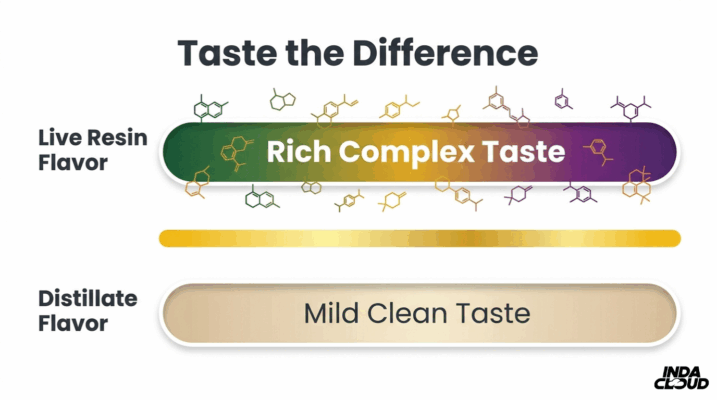
A live resin cart tastes like the original cannabis strain it was extracted from, delivering rich, layered flavor notes that range from citrus and pine to earthy and floral. This complexity comes from the extraction process itself. According to Future4200, hydrocarbon extraction for live resin utilizes solvents like butane or propane in a closed-loop system at subcritical temperatures (typically -40°C to -65°C), selectively capturing resin glands while leaving behind plant waxes and chlorophyll.
Because volatile terpenes survive this cold extraction, each hit carries distinct flavor characteristics tied to the specific cultivar. Strains like Blue Dream may produce sweet berry notes, while OG Kush leans toward fuel and spice. For anyone who values authentic cannabis flavor, live resin carts consistently deliver the most true-to-plant experience available in a vape format.
A distillate cart tastes clean and mild, often with a subtle sweetness that lacks the complexity found in full-spectrum extracts. The high-heat distillation process strips nearly all native terpenes from the oil, leaving behind a nearly flavorless, highly concentrated THC base.
To compensate, manufacturers reintroduce terpenes, either botanical blends sourced from non-cannabis plants or cannabis-derived terpenes added post-processing. These reintroduced profiles can mimic familiar strain flavors, though the result tends to feel one-dimensional compared to naturally preserved terpene profiles. Some lower-quality carts may also contain fillers like propylene glycol or vegetable glycerin, which can further dull or alter the taste.
For users who prefer a neutral, consistent flavor without strong herbal notes, distillate carts work well. However, those chasing authentic strain-specific taste will find the difference noticeable. Understanding these flavor distinctions helps clarify how each cart type affects the overall vaping experience.
The effects of live resin and distillate carts differ primarily in depth and character. Live resin delivers a fuller, more layered experience, while distillate provides a more direct, THC-focused effect. The following sections break down the relaxation feel and overall high quality for each type.
A live resin cart feels for relaxation like a gradual, full-body ease that builds naturally rather than hitting all at once. Because live resin preserves the plant’s original terpene and cannabinoid profile, the relaxation effect carries more nuance. Myrcene, linalool, and beta-caryophyllene work alongside THC to create calming sensations that many users describe as closer to the feeling of smoking whole flowers. The onset tends to feel smoother, with a gentle transition into a relaxed state rather than an abrupt shift. For anyone who values a layered wind-down experience, live resin consistently delivers a more textured form of relaxation that isolated THC alone cannot replicate.
A distillate cart feels for relaxation like a clean, straightforward calm driven almost entirely by concentrated THC. Since distillation strips away most terpenes and minor cannabinoids, the effect profile is narrower. Users typically notice a fast-onset head and body relaxation without the complex flavor or shifting sensations that accompany full-spectrum products. This makes distillate a predictable option; each session feels consistent because the active compound is essentially pure THC. However, some users find the relaxation feels somewhat one-dimensional compared to live resin. For those who prefer simplicity and a reliable calming effect without layered complexity, distillate carts deliver exactly that.
Live resin provides a more well-rounded high than distillate. According to a study highlighted by Cannabis Now, whole-plant cannabis products like live resin produce stronger psychoactive effects that last longer than products containing isolated cannabinoids. This fuller experience stems from the entourage effect, where terpenes, minor cannabinoids, and flavonoids interact synergistically with THC. The result is a high with emotional depth, physical relaxation, and sensory richness that shifts subtly over time. Distillate, by contrast, delivers potent but linear effects centered on THC alone. For users seeking complexity and a high that engages multiple dimensions, live resin is the stronger choice.
Understanding how each cart type feels helps clarify which price point and quality tier best fits your needs.
Live resin and distillate carts compare in price with a significant gap; distillate costs considerably less per gram. The sections below explain why live resin carries a premium and whether distillate offers better value for budget-conscious shoppers.
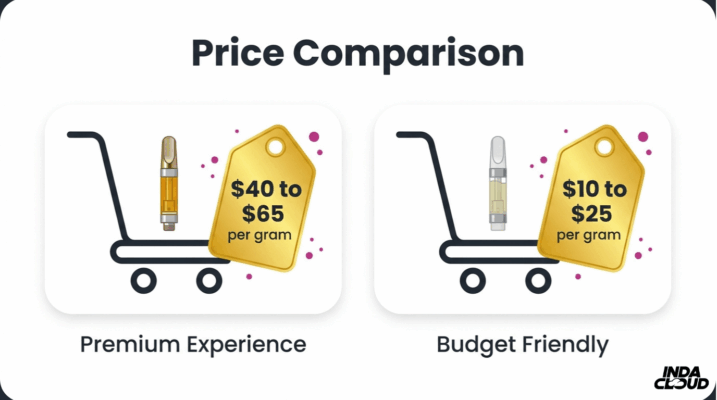
Live resin carts are typically more expensive because of higher production costs at every stage. Flash-freezing fresh cannabis immediately after harvest requires cryogenic equipment and careful temperature control. Hydrocarbon extraction at subcritical temperatures adds specialized labor and safety infrastructure that distillate production avoids.
Distillate’s simpler, scalable refinement process drives its lower retail price and wider availability. According to a 2023 North American vape market report from Cannabis Business Times, distillate sales grew 23.5% year-over-year compared to just 3.9% for live resin, reflecting how volume-driven demand keeps distillate pricing competitive.
That production gap is the single biggest factor behind the price difference. For consumers who value preserved terpenes and a full-spectrum profile, the premium often feels justified.
Distillate carts are a better value for budget shoppers who prioritize affordability and high THC concentration over flavor complexity. In competitive state markets, distillate cartridges can cost a fraction of what live resin commands per gram.
Key reasons distillate suits budget-conscious buyers:
That said, shoppers willing to spend more on live resin gain a richer terpene profile and a more well-rounded experience. The best choice depends on whether raw potency per dollar or overall flavor and effect quality matters most to you.
With pricing considerations clear, understanding cart quality and lab testing helps ensure every dollar is well spent.
Distillate carts are generally better for beginners. Their mild, consistent flavor and predictable THC delivery make the first vaping experience straightforward rather than overwhelming. Distillate’s simplified cannabinoid profile produces a clean, focused high without the layered intensity that full-spectrum extracts can introduce.
Because distillate undergoes extensive refinement, each hit delivers a nearly identical dose. That consistency helps new users gauge their tolerance more accurately. The neutral taste also pairs well with added botanical terpenes, so beginners can explore fruity or sweet flavor options without encountering the earthy, resinous notes some find harsh at first.
Live resin carts are not off-limits for beginners, but the entourage effect created by preserved terpenes and minor cannabinoids can feel more complex. Starting with smaller draws on a live resin cart allows a new user to ease into that fuller experience. For most first-time vapers, however, a lab-tested distillate cart offers the simplest path to understanding personal dosing preferences before graduating to richer profiles.
Live resin carts are generally better for experienced users who want a complex, full-spectrum experience that reflects the original cannabis plant. Experienced consumers tend to prioritize terpene richness, strain-specific effects, and the entourage effect over raw THC percentage alone.
Seasoned users often develop a refined palate for cannabis flavor and can distinguish subtle differences between strains. Live resin preserves 60% to 80% of the plant’s original terpene profile, according to Mellow Fellow, delivering layered flavor and nuanced effects that experienced consumers appreciate. Distillate carts, while potent at 85% to 99% THC, strip away much of this complexity during refinement.
That said, experienced users seeking maximum cannabinoid concentration for specific purposes still find distillate valuable. The best approach for most seasoned consumers is keeping both options available: live resin for sessions where flavor, depth, and a well-rounded high matter, and distillate for straightforward potency on a budget.
Understanding cart quality becomes even more important at this level of consumption, which starts with proper lab testing standards.
You should look for verified third-party lab results, clean hardware, and transparent ingredient lists when evaluating cart quality. The sections below cover why independent testing matters and how to identify low-quality products.
Third-party lab testing matters for vape carts because it provides an independent verification of safety, potency, and purity that no brand should self-certify. These labs screen for contaminants that pose serious health risks when inhaled.
According to CloudLIMS, state cannabis regulations typically require testing for the “big four” heavy metals: lead, arsenic, cadmium, and mercury to ensure consumer safety in vape products. Beyond metals, reputable labs also test for:
Always check that a brand publishes current Certificates of Analysis (COAs) with batch-specific results. Any company unwilling to share lab reports is not worth your trust.
You can spot low-quality carts on the market by watching for several consistent warning signs. Unusually low prices, missing lab results, and vague ingredient labels are the most reliable red flags.
Key indicators of a substandard cart include:
For most consumers, prioritizing licensed, lab-tested brands over unverified street market options is the single most important safety decision when buying any vape cart. Understanding these quality markers helps you choose the right cart type with confidence.
The strain type matters when choosing a cart because the extraction method determines how much of the original strain character survives. Sativa, indica, and hybrid strains each behave differently in live resin versus distillate formats.
A sativa live resin cart differs from a sativa distillate by preserving the full terpene and cannabinoid profile of the original sativa plant. Live resin cartridges typically feature THC percentages ranging from 70% to 90%, while distillate cartridges often reach higher concentrations of 85% to 99% THC due to the removal of other plant constituents. That higher THC number in distillate comes at a cost: the energizing terpenes that define sativa strains, like limonene and pinene, are largely stripped away during refinement.
According to Elevated Exotics, retail prices for distillate cartridges in competitive markets like Michigan often fall between $10 and $25 per gram, whereas live resin cartridges typically range from $40 to $65 per gram. For sativa lovers who value that uplifting, cerebral experience, the price difference reflects a genuinely different product.
An indica live resin cart differs from an indica distillate by retaining the sedating terpenes, such as myrcene and linalool, that give indica strains their relaxing character. Distillate processing removes most of these compounds, leaving behind a high-THC oil that feels generically potent rather than distinctly indica. Botanical terpenes are sometimes reintroduced, but reblended profiles rarely replicate the complexity of naturally preserved ones.
For users seeking deep physical relaxation and a strain-specific body high, indica live resin delivers a noticeably fuller experience. An indica distillate cart still provides strong THC effects; however, without the original terpene matrix, the nuanced sedation typical of indica cultivars is diminished.
Hybrid strains perform best in live resin carts because their balanced terpene and cannabinoid ratios are preserved through flash-freezing and low-temperature extraction. The interplay between uplifting and relaxing compounds that defines a hybrid cultivar depends on the full chemical profile remaining intact.
In distillate form, hybrid strains lose much of this balance. The refined oil delivers high THC potency, but the carefully bred equilibrium between sativa-leaning and indica-leaning traits is largely erased. Reintroduced terpenes can approximate a hybrid flavor, yet the layered effects tend to flatten into a one-dimensional high. For consumers who specifically choose hybrids for their versatile, middle-ground experience, live resin is the format that honors the breeder’s intent.
Knowing how strain type interacts with extraction helps narrow down which cart fits your preferences and lifestyle.
You should choose between live resin and distillate carts based on what matters most to you: flavor, potency, effects, or price. The following sub-sections break down each priority to guide your decision.
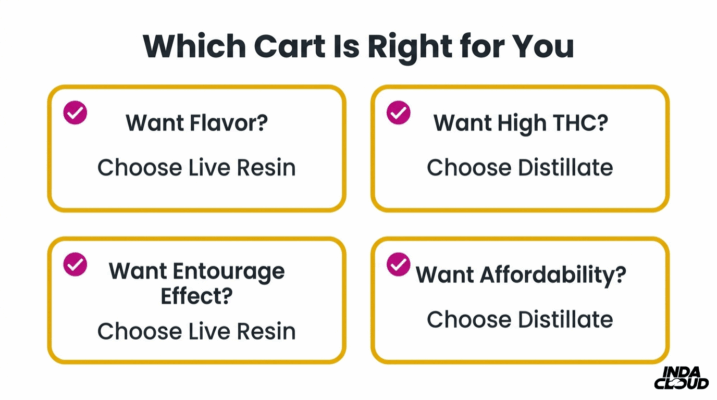
You should pick a live resin cart if you prioritize flavor and terpenes. Live resin preserves 60% to 80% of the original plant’s terpene profile, compared to just 10% to 30% retained through distillation, according to terpene retention data from Mellow Fellow. That difference translates directly into richer, more complex flavor with every draw.
Terpene concentrations in live resin products generally range from 4% to 12%, while distillate typically contains 0% to 5% before terpenes are reintroduced. For anyone who values authentic strain-specific taste over raw cannabinoid strength, live resin is the clear choice.
You should pick a distillate cart if you prioritize high THC potency. Distillate cartridges reach cannabinoid concentrations of 85% to 99% THC because the refining process strips away terpenes, flavonoids, and other plant compounds. Live resin carts, by comparison, typically feature THC percentages ranging from 70% to 90%.
That concentration gap makes distillate the strongest option by sheer milligram-per-puff delivery. For users who want maximum THC impact in each session without concern for flavor complexity, distillate consistently delivers. It is worth noting, however, that higher THC numbers on a label do not always mean a more satisfying experience overall.
You should pick a live resin cart if you want the entourage effect. The entourage effect hypothesis, as described in a 2025 review published through the National Institutes of Health, suggests that cannabinoids, terpenes, and flavonoids work synergistically to enhance therapeutic potential beyond what isolated THC achieves alone.
Because live resin retains the full spectrum of these compounds from fresh-frozen cannabis, it delivers the broadest chemical profile in a single cartridge. Distillate, having been stripped down to near-pure THC, lacks the companion molecules needed for this synergy. For a more layered, well-rounded experience, live resin is the stronger fit.
You should pick a distillate cart if you want an affordable everyday cart. Distillate cartridges in competitive markets are often priced between $10 and $25 per gram, while live resin cartridges typically range from $40 to $65 per gram. That price gap reflects the simpler, higher-yield production process behind distillate.
For daily users who go through cartridges quickly, distillate offers reliable potency at a fraction of the cost. The savings add up significantly over weeks and months of regular use, making distillate the practical choice for budget-conscious consumers who still want a consistent THC experience.
With your priorities clear, finding a trustworthy source for lab-tested carts is the final step.
You can find lab-tested hemp-derived vape carts online through retailers like Inda Cloud that prioritize third-party testing, federal compliance, and transparent lab reports.
Yes, IndaCloud’s hemp-derived vape carts can deliver the experience you want, whether you prefer the full-spectrum richness of live resin or the high-potency consistency of distillate. IndaCloud offers a curated selection of THC cartridges and disposable vape pens in strain-specific options across indica, sativa, and hybrid varieties. Every product undergoes comprehensive third-party lab testing and contains less than 0.3% Delta-9 THC, keeping it 100% federally legal under the 2018 Farm Bill. IndaCloud ships directly to customers across the continental United States with discreet packaging and free shipping on qualifying orders. For anyone weighing the live resin vs distillate decision, exploring the full vape collection at indacloud.co is a practical starting point.
The key takeaways about live resin vs distillate carts center on what each format does best:
Choosing between live resin and distillate ultimately comes down to personal priorities: flavor complexity and a well-rounded high, or maximum THC strength at a lower price point. IndaCloud carries both options with full lab transparency to match your preference.
A disposable vape and a 510 cartridge can hold the exact same oil and…
Learn more

What Are D9 Gummies? D9 gummies are edible candies infused with Delta 9 THC,…
Learn more

Delta-9 is gaining popularity and is now legal in many states. Known for its…
Learn more

Cannabis has attracted ongoing interest and research due to its wide variety of cannabinoids,…
Learn more


