


THCA

How Long Does THCA Stay in Your System?
Raw, unheated THCA clears your system in roughly 24 to 48 hours. Once you…
Learn more
You must be 21+ to enter this site
 FREE SHIPPING $89+
 FREE GIFT ON $120+
 100% FEDERALLY LEGAL
 LAB TESTED FOR PURITY
FREE SHIPPING $89+
FREE GIFT ON $120+
100% FEDERALLY LEGAL
LAB TESTED FOR PURITY
FREE SHIPPING $89+
FREE GIFT ON $120+
100% FEDERALLY LEGAL
LAB TESTED FOR PURITY
FREE SHIPPING $89+
FREE GIFT ON $120+
100% FEDERALLY LEGAL
LAB TESTED FOR PURITY
FREE SHIPPING $89+
FREE GIFT ON $120+
100% FEDERALLY LEGAL
LAB TESTED FOR PURITY
FREE SHIPPING $89+
FREE GIFT ON $120+
100% FEDERALLY LEGAL
LAB TESTED FOR PURITY
FREE SHIPPING $89+
FREE GIFT ON $120+
100% FEDERALLY LEGAL
LAB TESTED FOR PURITY
FREE SHIPPING $89+
FREE GIFT ON $120+
100% FEDERALLY LEGAL
LAB TESTED FOR PURITY
LAB TESTED FOR PURITY
FREE SHIPPING $89+
FREE GIFT ON $120+
100% FEDERALLY LEGAL
LAB TESTED FOR PURITY
FREE SHIPPING $89+
FREE GIFT ON $120+
100% FEDERALLY LEGAL
LAB TESTED FOR PURITY
FREE SHIPPING $89+
FREE GIFT ON $120+
100% FEDERALLY LEGAL
LAB TESTED FOR PURITY
FREE SHIPPING $89+
FREE GIFT ON $120+
100% FEDERALLY LEGAL
LAB TESTED FOR PURITY
FREE SHIPPING $89+
FREE GIFT ON $120+
100% FEDERALLY LEGAL
LAB TESTED FOR PURITY
FREE SHIPPING $89+
FREE GIFT ON $120+
100% FEDERALLY LEGAL
LAB TESTED FOR PURITY
FREE SHIPPING $89+
FREE GIFT ON $120+
100% FEDERALLY LEGAL
LAB TESTED FOR PURITY

THCA (tetrahydrocannabinolic acid) is a non-psychoactive cannabinoid found in raw cannabis that converts to THC through heat or digestion, producing the exact metabolite (THC-COOH) that standard drug tests detect. Yes, THCA can cause a positive drug test result.
This guide covers the science behind THCA-to-THC conversion, how each type of drug test responds to THCA use, detection timelines based on usage frequency, the physiological factors that extend or shorten detection windows, and how to choose hemp products with drug testing in mind.
THCA loses its carboxylic acid group through decarboxylation when smoked, vaped, or heated, becoming active Delta-9 THC. Even raw consumption triggers minor conversion; gastric acid decarboxylates roughly 3-5% of THCA over two hours. Once THC forms, the liver metabolizes it into THC-COOH, the identical metabolite produced by traditional marijuana use.
Urine, blood, saliva, and hair follicle tests all detect THCA-derived metabolites, though sensitivity and detection windows vary. Urine immunoassays screen at a 50 ng/mL cutoff and cannot distinguish THCA-sourced THC-COOH from any other cannabis source. Hair follicle tests extend the lookback period to 90 days, while saliva tests use a confirmatory threshold as low as 2 ng/mL for parent THC.
Detection timelines range from 3 to 7 days for occasional users to over 30 days for chronic, heavy consumers. Body fat percentage, consumption method, dosage, and individual metabolism speed each shift these windows significantly. Cannabinoids accumulate in adipose tissue and release gradually, meaning higher body fat extends clearance time.
Federal hemp legality offers no protection against a positive result. Products compliant with the 2018 Farm Bill can still contain high THCA concentrations that convert to detectable THC. Verified third-party lab reports with exact cannabinoid profiles remain the most reliable tool for assessing personal risk before any scheduled screening.
THCA is the naturally occurring acidic precursor to THC found in raw cannabis. Understanding the chemical relationship between these two cannabinoids explains why THCA use can trigger a positive drug test.
THCA (tetrahydrocannabinolic acid) is a non-psychoactive cannabinoid produced by living cannabis plants. According to data from the National Center for Biotechnology Information, THCA has the chemical formula C22H30O4 and a molecular weight of 358.47 g/mol, characterized by a carboxylic acid group that distinguishes it from neutral THC. This extra carboxyl group is what prevents THCA from binding effectively to CB1 receptors in the brain, which means it cannot produce the intoxicating “high” associated with Delta-9 THC.
The relationship between THCA and THC centers on a chemical process called decarboxylation. When exposed to heat through smoking, vaping, or cooking, that carboxyl group detaches from the THCA molecule, converting it into psychoactive THC. Even without direct heat application, this conversion can occur gradually through light exposure, aging, or the acidic environment of the stomach. Once THC forms in the body, the liver metabolizes it into THC-COOH (11-nor-9-carboxy-THC), which is the exact metabolite that standard drug tests are designed to detect.
This is why the distinction between THCA and THC matters less than most people assume when it comes to drug screening. A product labeled as “THCA” may be federally legal under current hemp regulations, yet the body processes it through the same metabolic pathway that produces detectable THC metabolites. For anyone facing a drug test, the practical reality is straightforward: THCA converts to THC, and THC produces the metabolites that trigger a positive result.
With THCA’s chemical identity and its conversion pathway established, the next section examines exactly how this transformation happens inside your body.
THCA converts to THC in your body through decarboxylation, a chemical reaction triggered primarily by heat and, to a lesser degree, by stomach acid. The following sections explain each conversion pathway and how THC metabolites form afterward.
THCA (tetrahydrocannabinolic acid) carries a carboxylic acid group that makes it structurally distinct from neutral THC. When that acid group is removed through an elimination reaction, the molecule becomes Delta-9 THC. According to a 2025 preprint published on Preprints.org, this decarboxylation reaction requires approximately 25 to 30 kcal/mol of activation energy, which heat provides most efficiently. Smoking, vaping, or baking cannabis at temperatures between 220°F and 245°F for 30 to 45 minutes triggers near-complete conversion. Even without external heat, gastric acidity at pH 1.5 to 3.5 can initiate a minor conversion; simulated gastric fluid at pH 2.0 and 37°C produces only about 3 to 5% decarboxylation over two hours. This means eating raw THCA flower still converts a small fraction into active THC inside the stomach.
Once THC enters the bloodstream, the liver processes it through cytochrome P450 enzymes, specifically CYP2C9, CYP3A4, and CYP2C19. These enzymes first oxidize THC into 11-hydroxy-THC, an active metabolite, and then further break it down into THC-COOH (11-nor-9-carboxy-THC). THC-COOH is the primary inactive metabolite that standard urine drug screenings target. Separately, THCA that reaches the liver without decarboxylating follows its own metabolic route, producing 11-OH-THCA and conjugated forms like THCA-glucuronide. However, because even small amounts of THCA can convert to THC before or during metabolism, THC-COOH may still appear in test results.
For anyone concerned about drug testing, the key takeaway is straightforward: whether THCA converts through a lighter flame or through partial stomach acid breakdown, the end result is the same detectable metabolite. Understanding these specific drug test types and their sensitivity levels clarifies exactly why THCA triggers a positive result.
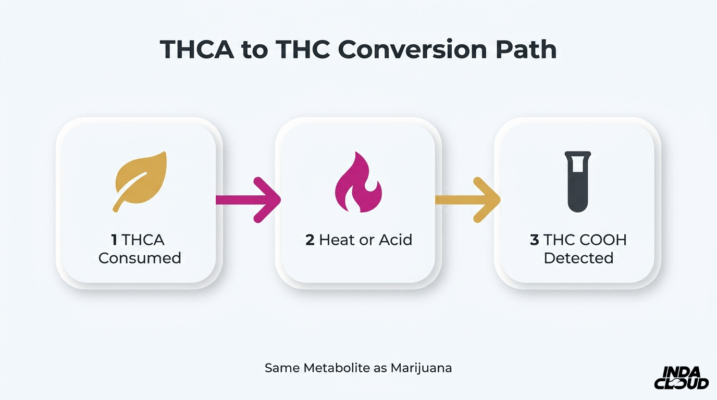
THCA shows up on a drug test because the body converts it into the same THC metabolite that standard screenings target. The key factors involve decarboxylation, liver metabolism, and immunoassay cross-reactivity.
THCA converts to THC through decarboxylation, a chemical process triggered by heat during smoking or vaping. Once THC enters the bloodstream, the liver metabolizes it through cytochrome P450 enzymes (CYP2C9, CYP3A4, and CYP2C19) into intermediate metabolites and ultimately into THC-COOH. According to a study published in PMC by the National Institutes of Health, THC-COOH (11-nor-9-carboxy-THC) is the primary inactive metabolite detected in standard urine drug screenings, resulting from the oxidation of THC that can be formed from THCA via decarboxylation before or during metabolism.
Even when THCA is consumed raw without direct heat exposure, minor conversion still occurs inside the body. In simulated gastric fluid at pH 2.0 and 37°C, THCA undergoes approximately 3-5% partial decarboxylation over a two-hour period. While that percentage seems small, repeated doses can accumulate enough THC-COOH to cross detection thresholds.
The testing technology itself compounds the problem. Immunoassay-based urine drug screens, the most common initial method used in workplace testing, are designed for speed and affordability. However, these assays rely on antibody binding that does not distinguish between THC, THCA, and structurally similar cannabinoid metabolites. This cross-reactivity means that even residual amounts of THC-COOH produced from THCA consumption can trigger a positive initial result.
Confirmatory testing using GC-MS or LC-MS/MS is more precise, yet it specifically quantifies THC-COOH concentration against established cutoff levels. Since THCA use generates this exact metabolite through metabolic conversion, confirmatory results will reflect THCA-derived THC just as they would THC from any other cannabis source. The test cannot determine whether the THC-COOH originated from a federally legal THCA product or from traditional marijuana.
For anyone using THCA products, this biological and analytical reality is the core risk. Understanding that drug tests target downstream metabolites, not the original compound consumed, helps explain why even legal hemp-derived THCA can produce a positive result.
The types of drug tests that can detect THCA use include urine, blood, saliva, and hair follicle tests. Each method differs in detection window, cutoff threshold, and sensitivity to THC metabolites.
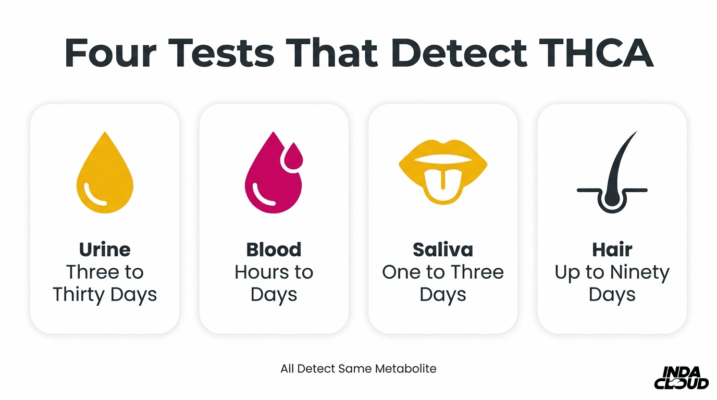
Yes, THCA shows up on a urine test because the body converts THCA into THC, which is then metabolized into THC-COOH, the primary metabolite these screens target. According to a 2023 study published in the Journal of Analytical Toxicology, immunoassay-based urine drug screens are the most common initial testing method due to their speed and low cost, though they are subject to cross-reactivity and may require confirmatory testing via mass spectrometry.
The standard SAMHSA cutoff levels for urine screening are:
Because urine tests detect downstream metabolites rather than the original cannabinoid consumed, they cannot distinguish between THCA flower, Delta-9 THC edibles, or other cannabis products. For anyone facing workplace screening, this makes urine testing the most likely method to produce a positive result from THCA use.
Yes, THCA shows up on a blood test, though indirectly. Blood tests detect active THC and its metabolites circulating in the bloodstream. Once THCA converts to THC through decarboxylation, the resulting compounds enter the blood and become detectable.
Blood testing offers a narrower detection window than urine, typically capturing recent use within hours to a few days. This method is more commonly used in impairment-related investigations, such as traffic stops, rather than standard employment screening. While less frequently encountered in workplace settings, a blood test triggered by THCA consumption will still register THC or THC-COOH if conversion has occurred. The shorter detection window does not make this test safer to rely on if you have consumed THCA products recently.
Yes, THCA shows up on a saliva test when the consumed product has undergone decarboxylation, producing THC detectable in oral fluid. Saliva tests screen for the parent compound THC rather than the metabolite THC-COOH. According to Resilient Return, oral fluid drug testing for federal workplace programs utilizes a confirmatory cutoff level of 2 ng/mL for THC.
This low threshold makes saliva testing particularly sensitive to recent consumption. Detection windows for oral fluid are generally shorter, spanning 24 to 72 hours after use. Smoking or vaping THCA, which involves direct heat decarboxylation, poses the highest risk since THC residue deposits directly in the oral cavity. Saliva tests are gaining traction in workplace and roadside testing programs due to their ease of administration.
Yes, THCA shows up on a hair follicle test through the detection of THC metabolites deposited in the hair shaft via the bloodstream. Hair follicle testing has the longest detection window of any standard drug test, reaching back up to 90 days. According to Quest Diagnostics, hair testing for marijuana metabolites uses a screening cutoff of 1.0 pg/mg and a confirmatory cutoff of 0.1 pg/mg.
This method captures a long-term usage pattern rather than a single recent session, which makes it especially challenging for regular THCA consumers. Although hair tests are less common than urine screens, employers in safety-sensitive industries frequently use them. Given the extended lookback period, hair follicle testing represents the hardest test to clear after sustained THCA use.
With detection methods varying widely in sensitivity and timeframe, understanding how long THCA stays in your system becomes the next critical factor.
THCA stays in your system for as little as 3 days or as long as 30+ days, depending on usage frequency. The sections below break down detection windows for infrequent, regular, and daily heavy users.
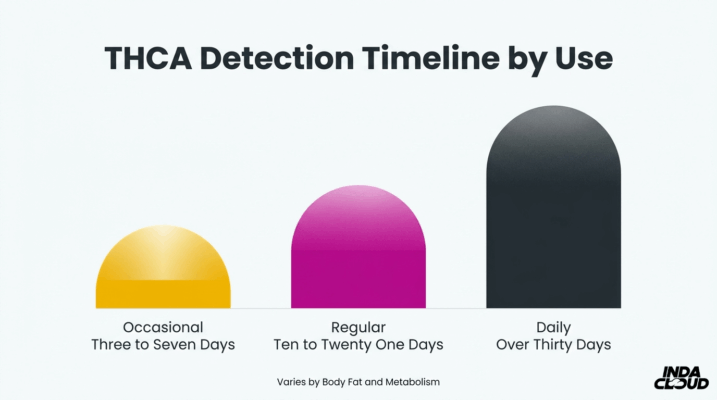
THCA stays detectable for infrequent users for approximately 3 to 7 days after last use. Once THCA converts to THC through heating or partial metabolic decarboxylation, the liver produces THC-COOH, the metabolite targeted by standard drug screens. Because infrequent users accumulate fewer cannabinoid metabolites in adipose tissue, clearance happens relatively quickly. According to Recovered.org, the detection window for THC metabolites in urine ranges from 3 to 7 days for occasional users. Even within this short window, however, individual factors like hydration, body composition, and metabolism speed can shift results by a day or two in either direction.
THCA stays detectable for regular users for approximately 10 to 21 days after last use. Consistent consumption, such as several times per week, causes THC-COOH to build up in body fat over time. Because cannabinoids are highly lipophilic and stored in adipose tissue, repeated exposure creates a reservoir that releases metabolites gradually during elimination. According to SureHire, the elimination half-life of cannabinoids is significantly correlated with a person’s Body Mass Index. Regular users with higher body fat percentages often fall toward the longer end of this detection range, making the 21-day mark a realistic timeline for many.
THCA stays detectable for daily heavy users for over 30 days after last use. Chronic, heavy consumption saturates fat stores with lipophilic cannabinoid metabolites, and THC-COOH releases slowly back into the bloodstream over weeks. According to Recovered.org, the detection window for THC metabolites extends beyond 30 days for chronic, heavy users. Hair follicle tests can push this window even further, reaching back up to 90 days. For anyone facing a scheduled drug test, this extended timeline makes daily heavy THCA use one of the riskiest consumption patterns to manage.
Understanding these detection timelines helps, but several physiological factors also play a role in determining exact clearance speeds.
Several physiological and behavioral factors affect how long THCA remains detectable on a drug test. Body fat percentage, consumption method, dosage and potency, and metabolism speed each play a distinct role in determining detection windows.
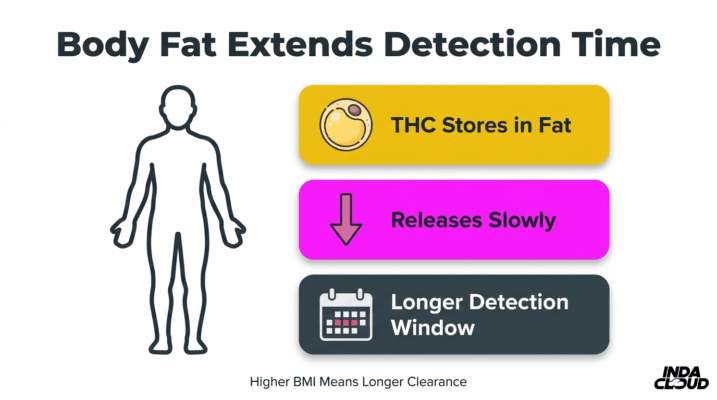
Yes, body fat percentage influences THCA detection time significantly. Cannabinoids are highly lipophilic, meaning they bind to and accumulate in adipose tissue throughout the body. According to SureHire, the elimination half-life of cannabinoids is significantly correlated with a person’s Body Mass Index (BMI). Individuals with higher body fat percentages store more THC metabolites in their fat cells, which are then released slowly back into the bloodstream over time. This gradual release extends the window during which THC-COOH remains detectable in urine. Even after someone stops consuming THCA products, stored metabolites can continue triggering positive results for weeks in individuals with elevated body fat levels.
Yes, consumption method changes how long THCA is detectable because each route delivers cannabinoids at different rates and concentrations. Bioavailability varies substantially by administration route:
Inhaled methods produce a sharp metabolite spike that clears relatively quickly in occasional users. Edibles, while delivering less THC per milligram consumed, extend the metabolic processing window because the liver handles absorption gradually. For anyone planning around a drug test, the method of consumption matters just as much as the amount used.
Yes, dosage and potency affect THCA detection windows directly. Higher doses introduce more THC into the body, which produces greater quantities of THC-COOH for the kidneys to excrete. Concentrated THCA products, such as high-potency vapes or extracts, amplify this effect because they deliver more cannabinoid material per session. Frequent high-dose use compounds the problem; as metabolites accumulate in fat tissue faster than the body can eliminate them, the detection window stretches considerably. The difference between occasional low-dose use and daily high-potency consumption can mean the difference between a 3-day and a 30-day-plus detection window.
Yes, metabolism speed affects THCA drug test results because faster metabolic rates process and eliminate THC-COOH more efficiently. The liver metabolizes THC using cytochrome P450 enzymes, specifically CYP2C9, CYP3A4, and CYP2C19, which convert active compounds into excretable metabolites. Individual variation in these enzyme activities, influenced by genetics, age, hydration, and physical activity level, creates meaningful differences in clearance times. A younger, physically active person with a fast metabolism typically eliminates metabolites sooner than someone who is older or sedentary. Understanding your own metabolic baseline is one of the most practical ways to estimate personal detection risk when using THCA products.
Yes, you can fail a drug test from raw or unheated THCA. Even without heating, your body converts small amounts of THCA into THC through gastric acid and liver metabolism, producing the same THC-COOH metabolite that drug tests detect.
The risk comes from two biological pathways. First, according to a 2025 preprint by Keith Floyd, simulated gastric fluid at pH 2.0 and 37°C converts approximately 3-5% of THCA into THC over a two-hour period. While this percentage seems small, repeated doses accumulate. Second, the liver metabolizes THCA through cytochrome P450 enzymes, producing metabolites that can overlap with THC metabolic byproducts.
Immunoassay-based urine screens compound this problem because they are prone to cross-reactivity. These tests detect structural similarities between cannabinoid metabolites rather than distinguishing THCA-specific pathways from THC-derived ones. With a standard screening cutoff of 50 ng/mL, even minor internal conversion from regular raw THCA consumption could push results above the threshold over time.
For anyone facing workplace or legal drug testing, treating raw THCA products as a guaranteed “safe” option is a mistake. The biological overlap between THCA and THC metabolism means no consumption method fully eliminates detection risk, making it essential to understand how different drug tests identify THCA use.
No, THCA is not treated differently than Delta-9 THC on drug tests in any practical sense. Standard drug screens target THC-COOH, a metabolite produced by both compounds, making the original cannabinoid source irrelevant to the result.
The core reason is metabolic. THC-COOH (11-nor-9-carboxy-THC) is the primary inactive metabolite detected in standard urine drug screenings, resulting from the oxidation of THC, which can be formed from THCA via decarboxylation before or during metabolism, according to a study published by the National Institutes of Health (PMC). Once THCA converts to THC through heat exposure or partial gastric decarboxylation, the body processes it through the same hepatic pathway that regular Delta-9 THC follows. The end product is identical.
Immunoassay-based screens, the most common initial testing method, use antibodies calibrated to detect THC metabolites. These antibodies cannot distinguish whether the THC-COOH originated from smoking Delta-9 flower, vaping a THCA cartridge, or consuming a THCA edible that decarboxylated during digestion. Cross-reactivity in these tests means even structurally similar cannabinoids may trigger a positive result.
Confirmatory testing via GC-MS or LC-MS/MS offers greater specificity, yet it still targets THC-COOH at a 15 ng/mL cutoff under SAMHSA guidelines. No standard workplace, federal, or DOT drug test includes a separate panel for THCA as a distinct analyte. The testing infrastructure simply was not designed to care about the precursor; it cares about the metabolic endpoint.
This is a critical distinction many THCA consumers overlook. The legal status of a hemp-derived THCA product has no bearing on how a drug test interprets the metabolites it produces. For anyone facing upcoming screening, treating THCA use exactly as Delta-9 THC use is the only safe approach. Understanding the specific testing methods involved helps clarify how each type of drug screen handles detection.
The difference between THCA and THC drug testing lies in what each substance targets at the molecular level, how testing panels detect metabolites, and which cutoff thresholds determine a positive result. Standard drug tests do not distinguish between THCA-derived and THC-derived metabolites because both produce THC-COOH in the body.
THCA has the chemical formula C22H30O4, characterized by a carboxylic acid group that distinguishes it from neutral THC, according to the National Center for Biotechnology Information. Despite this structural difference, the body processes both compounds into overlapping metabolic endpoints. Once THCA undergoes decarboxylation (whether through heat, vaping, or partial gastric conversion), it becomes Delta-9 THC, which the liver then oxidizes into THC-COOH.
THC-COOH is the primary inactive metabolite detected in standard urine drug screenings, as noted in a 2013 PMC review published by the National Institutes of Health. This single metabolite is the target for immunoassay panels, meaning the test cannot trace whether the original compound was THCA flower, a THC edible, or a Delta-9 vape. The result is binary: THC-COOH above the cutoff registers as positive.
The practical distinction matters most at the testing methodology level. Immunoassay-based urine drug screens use antibodies calibrated to THC-COOH and structurally similar compounds. These antibodies exhibit cross-reactivity, which means THCA metabolites can trigger the same response as THC metabolites. Only advanced confirmatory methods like GC-MS or LC-MS/MS can differentiate specific cannabinoid profiles, yet even these confirmatory panels typically report THC-COOH concentration rather than identifying the original precursor compound.
SAMHSA sets the initial urine screening cutoff at 50 ng/mL, with confirmatory testing at 15 ng/mL. Whether that THC-COOH originated from THCA or THC is irrelevant to the result. For anyone using THCA products before a scheduled test, this distinction between the two compounds offers no practical protection.
Understanding this testing reality is essential for making informed decisions about hemp product use when drug screening is a possibility.
Federally legal hemp products are not safe to use before a drug test if your goal is to pass. Despite their legal status, these products can produce the same metabolites that standard drug screens detect.
The core issue is straightforward: legality and detectability are two entirely separate questions. The 2018 Farm Bill defines hemp as cannabis containing no more than 0.3% Delta-9 THC on a dry-weight basis, according to a Congressional Research Service report. That threshold was designed to regulate agricultural commerce, not to guarantee a negative drug test result. A product can be fully compliant with federal law and still introduce enough THC or THC-precursors into your system to trigger a positive screening.
High-THCA hemp flower is the clearest example of this disconnect. A product may contain less than 0.3% Delta-9 THC yet carry 20% or more THCA by weight. The moment that flower is smoked, vaped, or heated in any way, THCA converts to active THC through decarboxylation. Your body then metabolizes that THC into THC-COOH, the exact metabolite immunoassay panels are calibrated to detect. Even oral consumption introduces some risk, since THCA undergoes minor partial decarboxylation of approximately 3-5% in gastric fluid over a two-hour period.
The legal landscape is also shifting. Public Law 119-37, approved on November 12, 2025, introduces new federal restrictions on hemp-derived cannabinoids like THCA, with implementation scheduled for late 2026. This signals that regulators are closing the gap between what was technically legal and what poses real-world consequences for consumers facing workplace screening.
Several key factors determine whether a federally legal hemp product will cause a failed test:
For anyone facing a drug test, the only genuinely safe hemp products are those verified to contain zero THC and zero THCA through independent laboratory analysis. Broad-spectrum CBD isolates typically meet this standard, while full-spectrum products and any THCA flower, vape, or concentrate do not. In my professional assessment, treating “federally legal” as synonymous with “drug-test safe” is one of the most common and costly mistakes consumers make in this market.
Understanding which hemp products carry drug test risk leads directly to a practical question: how to choose products with testing in mind.
No, you cannot reliably pass a drug test while using THCA products. Because THCA converts to THC through heat, digestion, and metabolism, your body produces the same THC-COOH metabolite that standard drug screens detect. Even products marketed as “non-psychoactive” or “legal hemp” can generate enough THC metabolites to trigger a positive result.
The risk is not theoretical. According to a 2026 report from Drug Testing Cup, workplace drug testing positivity rates in the United States are estimated between 4% and 5% of the general workforce, and cannabis remains the most commonly detected substance. With immunoassay screens unable to distinguish between THC sourced from marijuana and THC converted from THCA, the origin of the cannabinoid is irrelevant to the test outcome.
Several factors make passing especially unpredictable:
The safest approach for anyone facing a drug test is complete abstinence from all THCA and THC products, regardless of their legal classification. Federal legality under the 2018 Farm Bill does not protect employees from testing positive, and most employers do not differentiate between hemp-derived and marijuana-derived THC metabolites. Understanding what you consume starts with verified lab testing and transparent cannabinoid profiles.
You can choose hemp products with drug testing in mind by prioritizing third-party lab-tested options with verified cannabinoid profiles. The sections below cover how Inda Cloud’s testing standards support informed decisions and the essential takeaways about THCA and drug tests.
Yes, Inda Cloud’s lab-tested hemp products can help you know exactly what you’re consuming. Inda Cloud requires all products to be tested by third-party DEA-certified laboratories, ensuring accurate cannabinoid profiling for every batch. This testing confirms precise Delta-9 THC, THCA, and other cannabinoid concentrations, so consumers can evaluate their risk before a drug test.
Certificates of Analysis (COAs) are available directly on the Inda Cloud website, listing potency results in a transparent, verifiable format. Reviewing these reports before purchasing allows you to identify total THC content and make informed choices. For anyone subject to workplace screening, selecting products backed by independent lab verification is one of the most practical steps available. Transparency at this level separates responsible brands from those leaving consumers to guess.
The key takeaways about THCA and drug tests center on one core fact: THCA converts to THC, and THC produces the metabolite that drug tests detect. Standard urine immunoassays screen for THC-COOH at SAMHSA’s 50 ng/mL initial cutoff, and they do not distinguish between THC sources.
Critical points to remember:
No hemp-derived THCA product can guarantee a negative drug test. Choosing lab-tested products from transparent brands like Inda Cloud gives you the data needed to make informed decisions about consumption timing and risk.
Raw, unheated THCA clears your system in roughly 24 to 48 hours. Once you…
Learn more
THCP binds cannabinoid receptors roughly 33 times harder than THC in lab testing. THCA,…
Learn more

Popcorn buds are small, whole flower pulled out of a harvest and sorted by…
Learn more
THCA flower keeps best in an airtight glass jar held at 58 to 62%…
Learn more
