


Delta 8

Delta 8 vs Delta 9: Complete Comparison
Let’s dive into the worlds of delta 8 and delta 9 THC. Delta 9…
Learn more
You must be 21+ to enter this site
 FREE SHIPPING $89+
 FREE GIFT ON $120+
 100% FEDERALLY LEGAL
 LAB TESTED FOR PURITY
FREE SHIPPING $89+
FREE GIFT ON $120+
100% FEDERALLY LEGAL
LAB TESTED FOR PURITY
FREE SHIPPING $89+
FREE GIFT ON $120+
100% FEDERALLY LEGAL
LAB TESTED FOR PURITY
FREE SHIPPING $89+
FREE GIFT ON $120+
100% FEDERALLY LEGAL
LAB TESTED FOR PURITY
FREE SHIPPING $89+
FREE GIFT ON $120+
100% FEDERALLY LEGAL
LAB TESTED FOR PURITY
FREE SHIPPING $89+
FREE GIFT ON $120+
100% FEDERALLY LEGAL
LAB TESTED FOR PURITY
FREE SHIPPING $89+
FREE GIFT ON $120+
100% FEDERALLY LEGAL
LAB TESTED FOR PURITY
FREE SHIPPING $89+
FREE GIFT ON $120+
100% FEDERALLY LEGAL
LAB TESTED FOR PURITY
LAB TESTED FOR PURITY
FREE SHIPPING $89+
FREE GIFT ON $120+
100% FEDERALLY LEGAL
LAB TESTED FOR PURITY
FREE SHIPPING $89+
FREE GIFT ON $120+
100% FEDERALLY LEGAL
LAB TESTED FOR PURITY
FREE SHIPPING $89+
FREE GIFT ON $120+
100% FEDERALLY LEGAL
LAB TESTED FOR PURITY
FREE SHIPPING $89+
FREE GIFT ON $120+
100% FEDERALLY LEGAL
LAB TESTED FOR PURITY
FREE SHIPPING $89+
FREE GIFT ON $120+
100% FEDERALLY LEGAL
LAB TESTED FOR PURITY
FREE SHIPPING $89+
FREE GIFT ON $120+
100% FEDERALLY LEGAL
LAB TESTED FOR PURITY
FREE SHIPPING $89+
FREE GIFT ON $120+
100% FEDERALLY LEGAL
LAB TESTED FOR PURITY

Delta 8 expiration is the gradual chemical degradation that causes delta 8 THC products to lose potency, flavor, and safety over time. Delta 8 THC does expire; oxidation, heat, and light break down its molecular structure, converting it into less active compounds like cannabinol (CBN).
This guide covers what drives delta 8 shelf life, how long specific product types last, how to spot expired products and stay safe, optimal storage practices, and how lab testing and label literacy protect your purchase.
Delta 8’s chemical stability, extraction purity, and product formulation collectively determine how fast degradation occurs. The molecule itself is notably resilient, yet carrier oils, sugars, moisture content, and residual byproducts from manufacturing each introduce variables that shorten or extend usable life.
Shelf life varies significantly by format. Distillate and tinctures can remain stable for up to two years under proper conditions, while pre-rolls may decline within three to six months due to increased surface area and minimal environmental protection. Gummies, vapes, and flower each fall at different points along this spectrum.
Expired delta 8 reveals itself through darkened color, cloudy consistency, faded or musty aroma, and weakened effects. Consuming degraded products carries real risks, from unpredictable potency to microbial contamination including mold species capable of producing mycotoxins.
Cool, dark, airtight storage is the single most effective preservation strategy. Freezing at −20°C prevents measurable cannabinoid loss over time, while light exposure and heat accelerate terpene evaporation and potency decline dramatically.
Third-party lab testing, batch codes, and expiration dates rooted in stability data separate trustworthy products from unreliable ones. Brands that publish current, batch-matched certificates of analysis give consumers verifiable confidence in freshness and purity.
Delta 8 expiration refers to the gradual chemical degradation that causes delta 8 THC products to lose potency, flavor, and safety over time. Yes, delta 8 THC does expire. Like all cannabinoids, delta 8 is an organic compound subject to oxidation, a process where exposure to oxygen, heat, and light breaks down its molecular structure. According to a study published in PubMed, 7-alpha-hydroxy-delta(8)-THC can be oxidized to corresponding ketones via a gem-diol pathway, confirming that delta 8 undergoes active chemical transformation over time. This degradation does not happen overnight, but it is inevitable. No delta 8 product remains potent indefinitely, which makes understanding shelf life essential for anyone buying cannabinoid products.
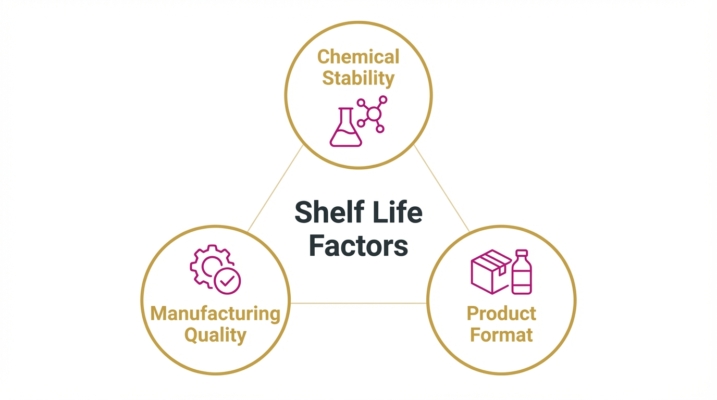
The shelf life of Delta 8 THC depends on its inherent chemical stability, the extraction and manufacturing methods used during production, and the final product formulation. Each factor plays a distinct role in how quickly degradation occurs.
The chemical stability of Delta 8 THC affects shelf life by determining how resistant the molecule is to degradation over time. Delta 8 THC is remarkably stable at the molecular level. According to a study published through the National Library of Medicine (PMC), Δ8-THC was detected in a burial tomb in Jerusalem dating back to the fourth century B.C., indicating exceptional long-term molecular resilience.
Stability in cannabis products refers to a product’s ability to retain its chemical, physical, microbiological, and biopharmaceutical properties within specified limits throughout its shelf life. Because Delta 8’s double bond sits on the eighth carbon chain rather than the ninth, it resists oxidation more effectively than Delta 9 THC. This molecular advantage gives Delta 8 products a natural head start in longevity when stored properly.
Extraction and manufacturing methods influence expiration by determining the purity and contaminant profile of the final Delta 8 product. Supercritical CO2 extraction, preferred for medicinal and pharmaceutical applications because it is non-toxic and easily removed from extracts, tends to produce cleaner concentrates with fewer residual solvents. Cleaner extracts degrade more slowly because there are fewer reactive impurities accelerating chemical breakdown.
Acid-catalyzed conversion processes, commonly used to synthesize Delta 8 from CBD, can leave behind byproducts if not properly purified. These residual compounds may interact with the cannabinoid over time, shortening usable shelf life. Rigorous post-processing purification and distillation steps directly extend how long a Delta 8 product remains potent and safe.
Product formulation impacts how long Delta 8 lasts by introducing variables like carrier oils, added ingredients, and moisture content that each degrade at different rates. A Delta 8 distillate stored in its pure form will generally outlast a gummy or tincture because edibles contain sugars, gelatin, and water that invite microbial growth and chemical interaction.
Carrier oils also matter. Oil-based tinctures using medium-chain triglycerides (MCT oil) or olive oil can maintain cannabinoid stability for roughly 60 days before measurable degradation begins. Products with higher moisture content or organic additives, such as natural flavorings, tend to expire faster. Choosing formulations with fewer perishable ingredients is one of the most practical ways to maximize Delta 8 product longevity.
With these foundational factors established, specific shelf life timelines vary by product type.
Different types of Delta 8 products last anywhere from six months to over two years, depending on the product format and formulation. The sections below cover shelf life expectations for gummies, vapes, tinctures, flower, pre-rolls, and distillate.
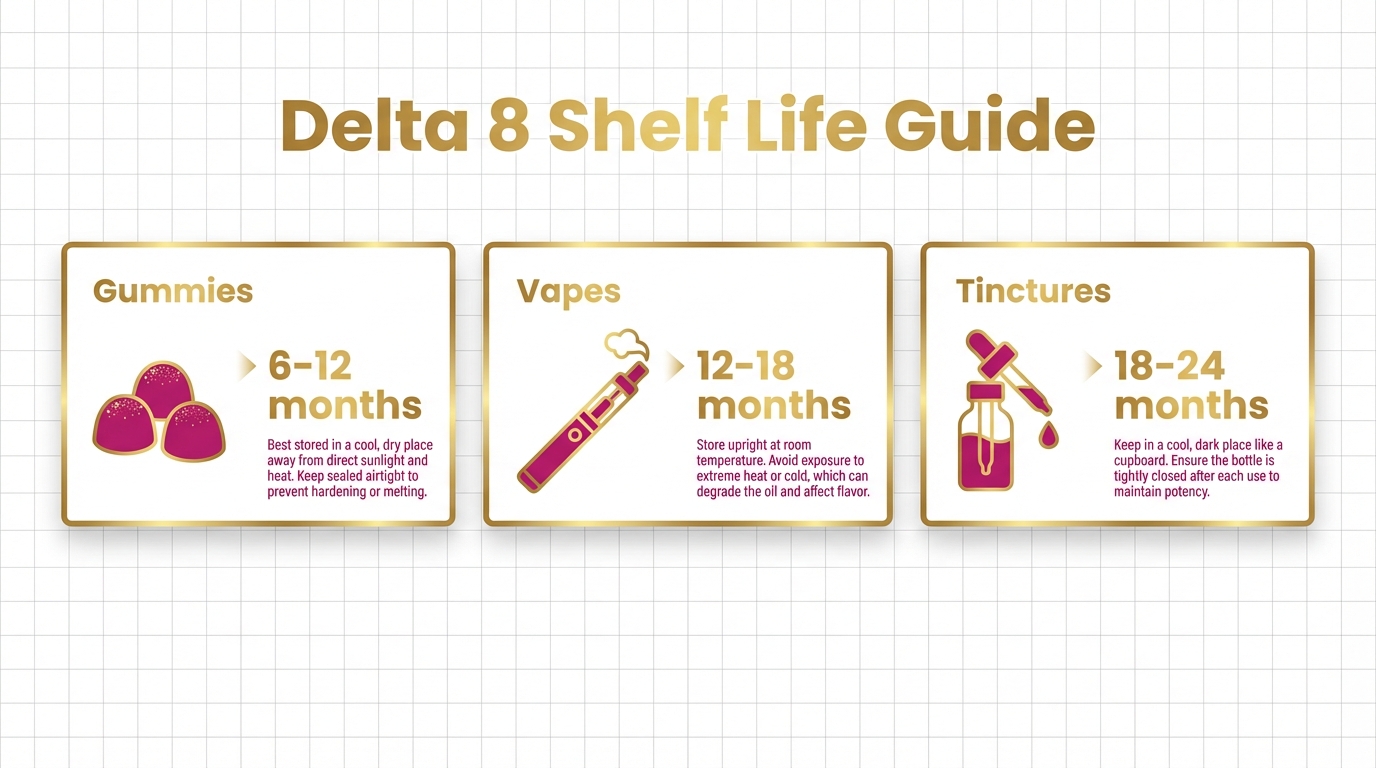
Delta 8 gummies and edibles last approximately 6 to 12 months when stored properly. Sugar-based edibles like gummies tend to retain cannabinoid potency longer than baked goods because their low moisture content discourages microbial growth. Ingredients such as gelatin, pectin, and added preservatives also influence how quickly the product degrades. Baked edibles containing fats and dairy typically expire faster, often within three to six months. Always check the packaging date and store edibles in a cool, dark place with the container sealed tightly. For anyone buying in bulk, rotating stock by purchase date helps ensure consistent potency with every dose.
Delta 8 vape cartridges last roughly 12 to 18 months unopened. The distillate inside the cartridge is a concentrated extract, which gives it inherent stability when sealed from air. Once opened and attached to a battery, exposure to oxygen and heat from repeated use accelerates terpene loss and cannabinoid oxidation. According to a study published in the Journal of Fluid Flow, Heat and Mass Transfer, light exposure at 1,200 lux for 24 hours leads to 99% terpene loss, and terpene degradation reaches 92.5% at 50°C. Storing cartridges upright in a drawer or case, away from direct sunlight and high temperatures, preserves both flavor and potency significantly longer.
Delta 8 tincture and oil last approximately 12 to 24 months when stored correctly. The carrier oil plays a meaningful role in overall stability. A 2020 study published in Molecules found no significant differences between pharmaceutical-grade olive oil and MCT oil as carriers, with both maintaining good cannabinoid stability for the first 60 days of storage. Tinctures packaged in dark glass dropper bottles resist light degradation better than clear containers. Keeping the bottle sealed between uses and stored in a cool pantry or refrigerator minimizes oxidation. Of all Delta 8 formats, tinctures often deliver the longest reliable shelf life because the oil matrix protects the cannabinoid from environmental exposure.
Delta 8 flower lasts approximately 6 to 12 months under proper storage conditions. Because flower is a plant-based product, it is more vulnerable to moisture, mold, and terpene evaporation than concentrates or edibles. According to ARES Scientific, industry-standard moisture content for cured cannabis typically falls between 10% and 15%, and maintaining this range is critical for preventing both mold growth and excessive dryness. ASTM International recommends water activity between 0.55 and 0.65 for safe cannabis flower storage. Flower stored in airtight glass jars with humidity control packs in a cool, dark environment retains its aroma, flavor, and cannabinoid profile far longer than flower left in original plastic packaging.
Delta 8 pre-rolls last roughly 3 to 6 months before noticeable quality decline. Pre-rolls degrade faster than loose flower because the grinding process increases surface area, which exposes more plant material to air and light. The paper wrapping provides minimal environmental protection compared to a sealed glass container. Terpenes volatilize more quickly from ground cannabis, meaning flavor and aroma diminish first, followed by gradual potency loss. For best results, store pre-rolls inside their original sealed tube or transfer them to a small airtight container kept at room temperature away from sunlight. Buying pre-rolls in quantities you can consume within a few weeks is the most practical approach to freshness.
Delta 8 distillate lasts approximately 18 to 24 months, making it one of the longest-lasting Delta 8 product formats. A PubMed study concluded that carefully prepared cannabis extracts are reasonably stable for one to two years if stored in the dark at room temperature. Distillate’s extended shelf life stems from its high purity; the refinement process strips away plant waxes, lipids, and chlorophyll that accelerate degradation in less processed forms. Sealed syringes or jars stored in cool, dark conditions maintain consistency well beyond a year. Even with this resilience, distillate will eventually oxidize and thicken, so checking color and viscosity before use remains a good habit.
Knowing each product’s shelf life helps you plan purchases, but recognizing when Delta 8 has actually gone bad matters just as much.
You can tell if Delta 8 has expired by inspecting its appearance, smell, taste, and effects. The subsections below cover visual changes, aroma and flavor shifts, and potency loss.
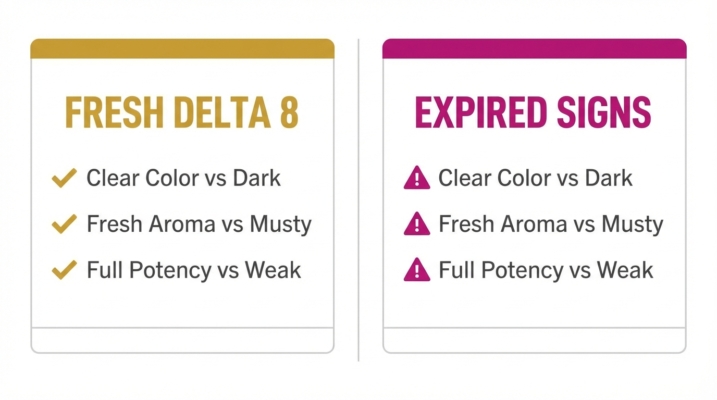
Expired Delta 8 looks noticeably different from a fresh product. Oils and tinctures that were once clear or light amber often darken to a deep brown or murky tone as cannabinoids oxidize. Vape distillate may turn cloudy or develop visible separation, with thicker sediment settling at the bottom of the cartridge. Gummies and edibles can become discolored, overly sticky, or develop a hardened, crystallized surface. In flower products, watch for white, grey, or green fuzzy patches; according to a 2019 study published in PMC, cannabis inflorescences can harbor mold species such as Penicillium, Botrytis cinerea, and Fusarium. Any visible mold means the product should be discarded immediately.
Expired Delta 8 smells and tastes distinctly off compared to a fresh product. Fresh Delta 8 carries a noticeable terpene profile, ranging from citrusy and piney to earthy depending on the strain. When those terpenes degrade, the aroma fades or shifts toward something stale, musty, or slightly sour. Mono-terpenes are especially prone to this loss; a study published in PMC (2024) found that sesqui-terpenes resist degradation better than mono-terpenes over extended storage. On the palate, expired vape oil often tastes harsh or burnt, while edibles may develop a rancid, cardboard-like flavor from degraded carrier oils. If a product tastes nothing like it did when first opened, degradation has likely progressed significantly.
Yes, expired Delta 8 loses its potency over time. As Delta 8 THC oxidizes, it gradually converts into less psychoactive byproducts such as cannabinol (CBN). According to a 2025 study published in Nature, THC stored at room temperature degraded by an average of 25.5% after two years. This means the effects you expect, whether relaxation or mild euphoria, become noticeably weaker. Edibles with degraded carrier oils may also absorb less efficiently. A product that once delivered consistent results but now feels flat has likely passed its effective shelf life. For anyone serious about getting full value from their purchase, potency loss alone is reason enough to replace aging Delta 8 products.
Recognizing these warning signs helps you decide whether a product is still worth using or better off replaced.
Using expired Delta 8 products is not recommended. While consuming a slightly past-date product may not cause immediate harm, degraded Delta 8 carries risks that range from reduced potency to potential microbial contamination. According to the U.S. Food and Drug Administration, Delta-8 THC products have not been evaluated or approved by the FDA for safe use in any context. This lack of regulatory oversight means expired products receive even less scrutiny than fresh ones.
The primary concerns with expired Delta 8 fall into three categories:
For anyone with a compromised immune system, the risks are more serious. A 2016 analysis of U.S. insurance records from 53,217 individuals found that cannabis users with susceptible conditions were 3.5 times more likely to develop a fungal infection than non-users, with aspergillosis accounting for 43% of those infections. Expired products stored in warm, humid conditions are especially prone to harboring these harmful organisms.
If a Delta 8 product shows any signs of expiration, such as off-putting smell, discoloration, or unusual texture, the safest choice is to discard it. No potential benefit justifies the uncertainty of consuming a degraded, unregulated product. Proper storage habits remain the most practical way to avoid this situation entirely.
You should store Delta 8 products in a cool, dark, airtight environment to extend shelf life. The sections below cover how temperature, light, air exposure, and refrigeration each affect Delta 8 stability.
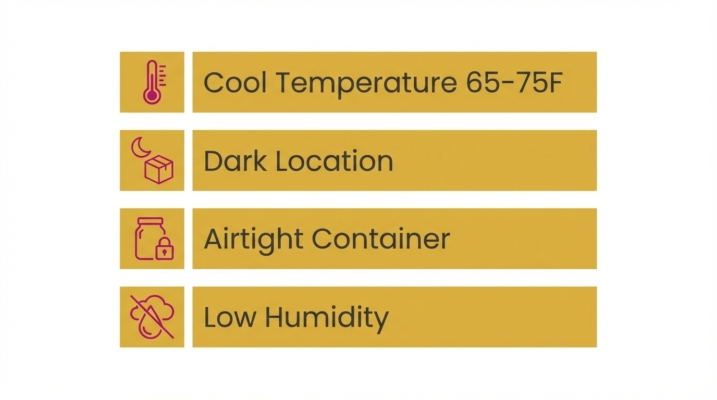
Temperature affects Delta 8 storage by accelerating chemical degradation when heat is present. Heat triggers decarboxylation and cannabinoid breakdown; according to a study published in MDPI (Molecules), psychoactive metabolites such as delta 9-THC and CBD are activated through decarboxylation by heat treatments, with degradation further favored by extended storage time and alkaline conditions.
Consistent room temperature storage still carries risk over long periods. Keeping Delta 8 products in a stable, cool environment below 25°C (77°F) slows this process considerably. Even brief exposure to high heat, such as leaving a vape cartridge in a hot car, can initiate irreversible potency loss. For anyone building a long-term supply, temperature control is the single most impactful storage variable to manage.
Yes, light exposure degrades Delta 8 THC by driving oxidation and terpene loss. Oxidation from light converts Δ9-THC into cannabinol (CBN) and can form Δ8-THC as a degradation byproduct, altering the product’s cannabinoid profile.
Terpenes are even more vulnerable. According to a study published in the Journal of Fluid Flow, Heat and Mass Transfer, light exposure at 1,200 lux for 24 hours leads to 99% terpene loss, while terpene degradation reaches 92.5% at 50°C. This means flavor, aroma, and entourage effect diminish rapidly under bright or sustained light.
Store all Delta 8 products in opaque containers or dark cabinets. Amber glass jars block UV wavelengths effectively, making them one of the most practical storage upgrades for preserving both potency and terpene integrity.
IndaCloud ships all products with fast 48-hour dispatch times and discreet packaging designed to protect contents from light exposure during transit, helping ensure products arrive in optimal condition for proper home storage.
Air exposure causes Delta 8 to expire faster by introducing oxygen that drives oxidation reactions. When Delta 8 THC contacts ambient oxygen, it gradually converts into less potent cannabinoids, including CBN. This process diminishes both psychoactive effects and overall product quality.
Humidity in ambient air compounds the problem. Excess moisture encourages microbial growth, while overly dry conditions can degrade flower and edible textures. Minimizing air contact is straightforward:
Airtight storage is the simplest, lowest-cost method to slow oxidation and preserve Delta 8 freshness.
Yes, you should refrigerate or freeze Delta 8 products for long-term storage. According to a study published in Forensic Science International, THC and CBN contents in cannabis products significantly depend on storage time unless samples are stored at −20°C, indicating that freezing is the best condition to prevent cannabinoid reduction over time.
Refrigeration (2–8°C) suits most product types for medium-term storage. Freezing works best for distillates, tinctures, and sealed edibles intended for extended preservation. However, a few precautions apply:
For everyday-use products, a cool, dark cabinet is sufficient. Reserve refrigeration and freezing for stockpiled items you will not open for weeks or months. With proper storage conditions in place, understanding how Delta 8 degrades over time adds another layer of product awareness.
Yes, delta 8 does degrade into other cannabinoids over time. Oxidation, heat, and light exposure gradually convert delta 8 THC into less potent compounds, primarily cannabinol (CBN). This degradation process has regulatory implications, especially as the hemp-derived cannabinoid market continues to expand rapidly.
Delta 8 THC follows a well-documented oxidation pathway shared by most tetrahydrocannabinols. When exposed to oxygen and UV light over extended periods, delta 8 slowly converts into CBN, a cannabinoid with significantly reduced psychoactive effects. This same process affects delta 9 THC, which also oxidizes into CBN while sometimes producing trace amounts of delta 8 as an intermediate byproduct.
The practical consequence is straightforward: as your delta 8 product ages, its potency diminishes because the active cannabinoid is being chemically transformed. While CBN is not considered harmful, it does not deliver the same experience consumers expect from fresh delta 8 products. Temperature, air exposure, and light intensity all accelerate this conversion.
From a regulatory standpoint, this degradation matters more than many consumers realize. According to Cannabis Business Times, the U.S. market for delta 8 THC and other hemp-derived cannabinoids grew from $200.5 million in 2020 to $2.77 billion in 2023, a 1,283% increase. With that kind of market growth, the volume of products sitting on shelves, in warehouses, or in consumers’ homes at any given time is substantial. Degradation during storage can shift a product’s cannabinoid profile in ways that affect both its efficacy and its compliance status.
The 2018 Farm Bill defines legal hemp as Cannabis sativa L. with a delta 9 THC concentration of not more than 0.3 percent on a dry weight basis. Because cannabinoid degradation can alter the ratio of compounds in a product over time, proper storage is not just a quality concern; it is a compliance consideration. Understanding that delta 8 actively transforms into other cannabinoids reinforces why proper storage and timely use are essential for getting the most from any hemp-derived product.
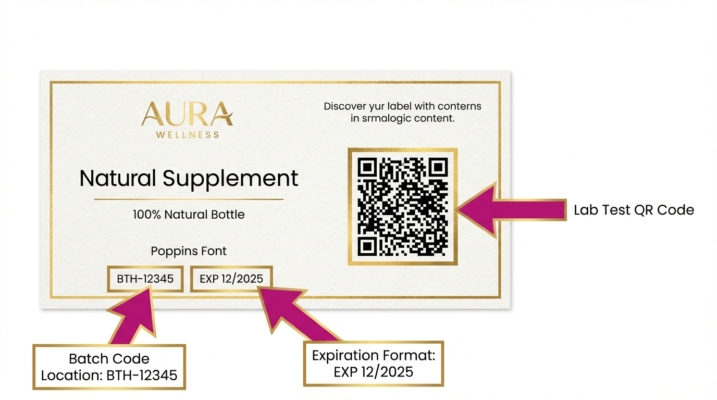
You read expiration dates and batch codes on Delta 8 by locating the printed date format and alphanumeric batch identifier on the product label. These two data points reveal when the product expires and link it to specific lab testing results.
Expiration dates on Delta 8 products typically appear as MM/DD/YYYY or MM/YYYY, printed on the bottom of packaging, on cartridge boxes, or near the barcode. Manufacturers establish these dates through stability testing. According to Minnesota’s Office of Cannabis Management, stability must be tested to determine the expiration date for each product, with additional required testing for contaminants including residual solvents, heavy metals, pesticide residue, and mycotoxins.
Batch codes are alphanumeric strings that trace a product back to its production run. Under 9 NYCRR Part 130, a cannabis product batch is defined as a uniquely defined quantity of cannabis product that is uniform in processing, manufacture, and packaging within a concurrent time frame. When you find the batch code on your Delta 8 product, you can cross-reference it with the certificate of analysis (COA) on the brand’s website to verify potency, purity, and contaminant screening results.
Key label elements to check include:
If a Delta 8 product lacks a visible expiration date or batch code, treat that as a red flag. Reputable brands always provide both, because these identifiers are the consumer’s only verifiable link between the product in hand and independent lab testing data. Understanding label literacy and batch traceability helps ensure every Delta 8 purchase meets safety and freshness standards.
Third-party lab testing matters for Delta 8 freshness because it provides independent verification of potency, purity, and shelf life that manufacturers cannot credibly self-certify. Without it, consumers have no reliable way to confirm whether a product is still safe or effective.
Certificates of analysis verify Delta 8 potency and purity by documenting independent laboratory measurements of cannabinoid concentrations, contaminant levels, and byproduct profiles for each product batch. A COA confirms whether the labeled Delta 8 THC percentage matches the actual content and screens for harmful substances.
Key data points on a reliable COA include:
According to a 2022 study published in MDPI Molecules, tested Delta 8 products contained several impurities in concentrations far beyond what was declared on their certificates of analysis. This finding underscores why consumers should always review COAs from accredited, independent laboratories rather than trusting label claims alone.
Consumers should avoid Delta 8 without lab reports because unverified products carry significant risks of contamination, mislabeled potency, and undisclosed byproducts from chemical synthesis. The Delta 8 market remains largely unregulated at the federal level, making independent testing the only meaningful quality safeguard.
A 2021 study published in ACS Chemical Research in Toxicology found that novel Delta 8 THC vaporizers contained unlabeled adulterants, unintended byproducts of chemical synthesis, and heavy metals. Products sold without accessible lab reports offer no way to rule out these dangers.
The absence of a COA should be treated as a disqualifying factor when choosing any Delta 8 product. In a market that has grown from $200.5 million in 2020 to $2.77 billion in 2023, the sheer volume of new products entering shelves makes independent verification more critical than ever.
IndaCloud addresses this transparency gap by making third-party lab results readily accessible for every product batch, allowing customers to verify potency and purity before purchase. This level of verification is particularly valuable in a rapidly expanding market where quality standards vary widely between suppliers.
Lab testing connects to Delta 8 expiration accuracy by providing the stability data needed to set reliable shelf life dates. Without laboratory-confirmed degradation rates, expiration dates on Delta 8 packaging are essentially guesses.
Stability testing measures how cannabinoid potency, terpene content, and contaminant levels change over defined time intervals under controlled conditions. To comply with Minnesota Statutes, section 342.61, stability must be tested to determine the expiration date for each product, with additional required screening for residual solvents, microbiological contaminants, heavy metals, pesticide residue, and mycotoxins.
This type of rigorous, batch-specific testing is what separates a meaningful expiration date from a marketing placeholder. For consumers concerned about freshness, the most actionable step is choosing brands that publish current, batch-matched COAs rather than relying on printed dates alone. Understanding how lab testing validates expiration claims helps consumers identify truly fresh Delta 8 products online.
Fresh lab-tested delta 8 products are available online from brands that prioritize third-party testing, proper storage, and transparent labeling. Below, Inda Cloud’s approach to quality is explored alongside key takeaways on delta 8 shelf life.
Yes, IndaCloud’s hemp-derived delta 8 products can help you avoid expired cannabinoids through rigorous quality controls. IndaCloud subjects every batch to comprehensive third-party lab testing, verifying potency, purity, and the absence of harmful byproducts before products reach customers. This matters because cannabinoid degradation is a real concern in a rapidly growing market. According to Cannabis Business Times, the U.S. delta 8 THC market surged 1,283% in just three years, reaching $2.77 billion by 2023. With that explosive growth comes inconsistent quality across brands.
IndaCloud addresses freshness through several practices:
For consumers concerned about potency loss from light or heat exposure, IndaCloud’s direct-to-consumer model eliminates prolonged shelf sitting common in retail environments. Choosing a brand with this level of oversight is one of the most practical ways to ensure your delta 8 hasn’t degraded before it arrives.
The key takeaways about delta 8 expiration and product shelf life center on storage, testing, and label accuracy. Delta 8 THC does expire, and its potency diminishes over time when exposed to heat, light, and air. Proper storage in cool, dark, airtight conditions remains the most effective way to preserve cannabinoid integrity.
Here are the essential points to remember:
One critical concern across the industry involves label accuracy. A study published in MDPI’s Molecules journal found that tested delta 8 products contained impurities in concentrations far beyond what their certificates of analysis declared. This reinforces why third-party verification from a trusted source matters more than manufacturer claims alone. When freshness and safety are priorities, choosing transparent, lab-tested brands like IndaCloud provides the strongest safeguard against degraded or mislabeled cannabinoids.
Let’s dive into the worlds of delta 8 and delta 9 THC. Delta 9…
Learn more
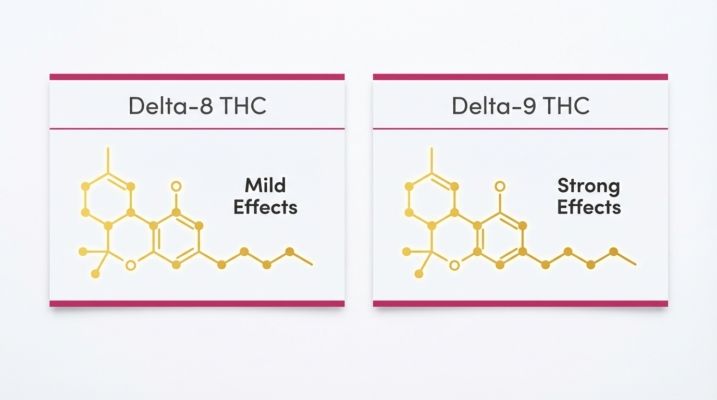
Delta-8 THC is a naturally occurring cannabinoid found in cannabis plants that produces milder…
Learn more
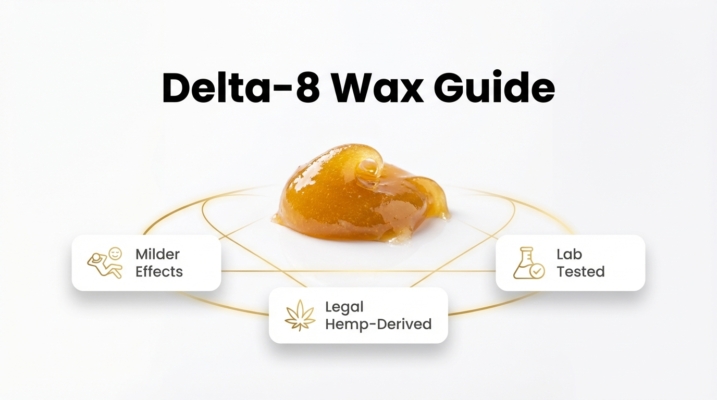
Delta-8 THC wax is a concentrated cannabis extract containing high levels of delta-8-tetrahydrocannabinol in…
Learn more
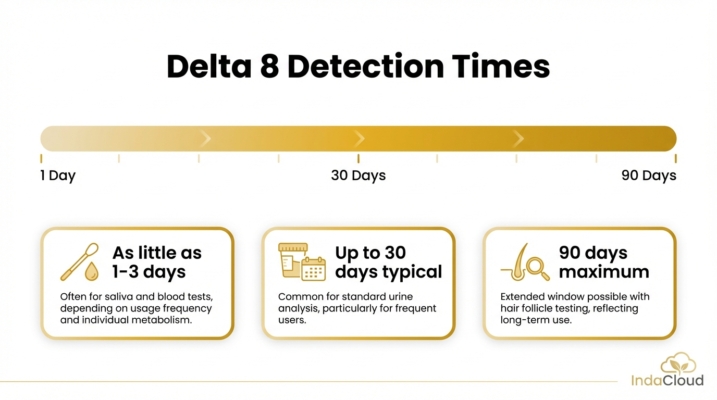
Delta-8 THC is a hemp-derived cannabinoid that stays in your system for as little…
Learn more
