



Blogs

Are THC Gummies Legal? A 2026 State-by-State Guide
Yes, THC gummies are legal to buy in most of the United States right…
Learn more
You must be 21+ to enter this site
 FREE SHIPPING $89+
 FREE GIFT ON $120+
 100% FEDERALLY LEGAL
 LAB TESTED FOR PURITY
FREE SHIPPING $89+
FREE GIFT ON $120+
100% FEDERALLY LEGAL
LAB TESTED FOR PURITY
FREE SHIPPING $89+
FREE GIFT ON $120+
100% FEDERALLY LEGAL
LAB TESTED FOR PURITY
FREE SHIPPING $89+
FREE GIFT ON $120+
100% FEDERALLY LEGAL
LAB TESTED FOR PURITY
FREE SHIPPING $89+
FREE GIFT ON $120+
100% FEDERALLY LEGAL
LAB TESTED FOR PURITY
FREE SHIPPING $89+
FREE GIFT ON $120+
100% FEDERALLY LEGAL
LAB TESTED FOR PURITY
FREE SHIPPING $89+
FREE GIFT ON $120+
100% FEDERALLY LEGAL
LAB TESTED FOR PURITY
FREE SHIPPING $89+
FREE GIFT ON $120+
100% FEDERALLY LEGAL
LAB TESTED FOR PURITY
LAB TESTED FOR PURITY
FREE SHIPPING $89+
FREE GIFT ON $120+
100% FEDERALLY LEGAL
LAB TESTED FOR PURITY
FREE SHIPPING $89+
FREE GIFT ON $120+
100% FEDERALLY LEGAL
LAB TESTED FOR PURITY
FREE SHIPPING $89+
FREE GIFT ON $120+
100% FEDERALLY LEGAL
LAB TESTED FOR PURITY
FREE SHIPPING $89+
FREE GIFT ON $120+
100% FEDERALLY LEGAL
LAB TESTED FOR PURITY
FREE SHIPPING $89+
FREE GIFT ON $120+
100% FEDERALLY LEGAL
LAB TESTED FOR PURITY
FREE SHIPPING $89+
FREE GIFT ON $120+
100% FEDERALLY LEGAL
LAB TESTED FOR PURITY
FREE SHIPPING $89+
FREE GIFT ON $120+
100% FEDERALLY LEGAL
LAB TESTED FOR PURITY

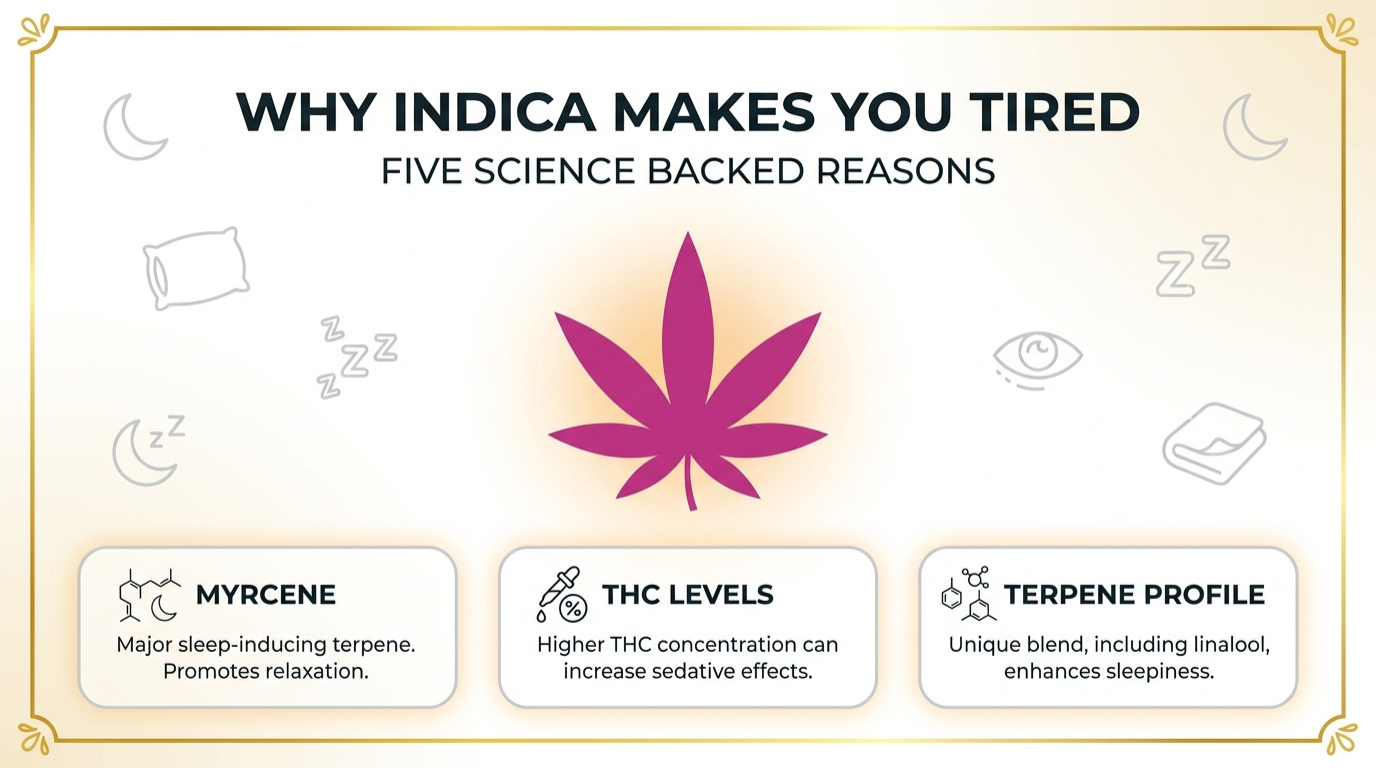
Indica is a cannabis classification traditionally linked to physically relaxing, sleep-promoting effects driven by its unique combination of cannabinoids and terpenes. This guide covers indica’s botanical background and strain distinctions, the five core mechanisms behind its sedating effects, how your body physically responds to consumption, variables that influence whether sedation actually occurs, and practical guidance for safe use and product selection.
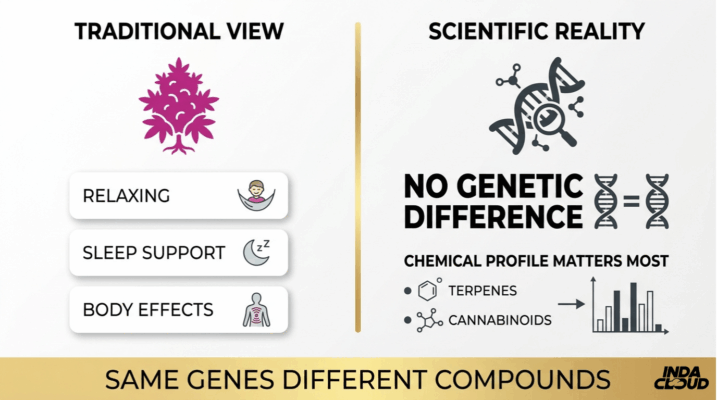
Indica strains trace their origins to the Hindu Kush region, and consumers have long associated them with nighttime relaxation. However, modern genetics reveal no verifiable DNA difference between indica and sativa. The sedating reputation stems from chemical profile rather than genetic category, with indica-labeled products consistently featuring higher concentrations of sleep-promoting compounds like myrcene, THC, and supportive terpenes.
Five factors work together to produce indica’s tiredness: myrcene crosses the blood-brain barrier and boosts GABA, serotonin, and melatonin levels; elevated THC shifts sleep architecture toward deeper slow-wave stages; the broader terpene profile creates a synergistic entourage effect; CBD content lowers anxiety that blocks sleep onset; and direct CB1 receptor activation in the basal ganglia, hippocampus, and cerebellum modulates the sleep-wake cycle.
Indica does not always cause sedation. Dose, tolerance, and time of consumption all shape the outcome. Lower doses may produce mild relaxation without drowsiness, while evening use amplifies sleepiness by aligning with the body’s natural circadian rhythm.
For those exploring indica’s relaxation potential, the article also compares indica against sativa for sleep, identifies who should avoid sedating strains, and highlights where to find lab-tested, federally compliant products.
Indica is a classification of cannabis traditionally associated with shorter, bushier plants that produce physically relaxing effects. The distinction between indica and other strains involves botanical origins, perceived effects, and an evolving scientific debate about whether these categories hold genetic validity.
Indica cannabis traces its roots to the Hindu Kush mountain region, where cooler climates shaped its compact growth pattern and broad, dark-green leaves. Consumers and practitioners have long used the indica label to identify strains that promote calmness, body relaxation, and sleep. Sativa strains, by contrast, are typically linked to uplifting, cerebral effects and taller plant structures originating from warmer equatorial regions.
However, the science behind these categories is more complicated than the labels suggest. According to research cited by Bedrocan, it is genetically impossible to prove whether a cannabis plant is an indica or a sativa, as no difference exists in the genes. This means the traditional classification system relies more on observable traits and consumer-reported effects than on verifiable genetic distinctions.
Despite this genetic overlap, real-world differences in how people experience indica strains persist. A study published in the Journal of Medical Internet Research found that predominant indica strains reduced insomnia symptomology more effectively than CBD strains and predominant sativa strains, with an estimated mean difference of 0.59 compared to CBD strains. These perceived effects likely stem from each strain’s unique chemical profile, particularly its combination of cannabinoids and terpenes, rather than from a fundamental genetic divide.
For consumers shopping hemp-derived products, the legal landscape also matters. The 2018 Farm Bill removed hemp from the Controlled Substances Act, distinguishing it from other cannabis compounds previously placed in Schedule 1. This federal distinction opened the door for legal hemp-derived indica products containing less than 0.3% Delta-9 THC.
In practical terms, the indica label remains a useful shorthand. While genetics may not support a hard boundary between indica and sativa, the terpene and cannabinoid combinations found in strains marketed as indica consistently produce the relaxing, sleep-promoting effects consumers expect. Understanding why those effects occur requires a closer look at the specific compounds driving indica’s sedating reputation.
Indica makes you tired because of five key factors working together: myrcene’s sedating properties, higher THC levels, a relaxation-inducing terpene profile, CBD content that enhances sleepiness, and direct effects on the endocannabinoid system.
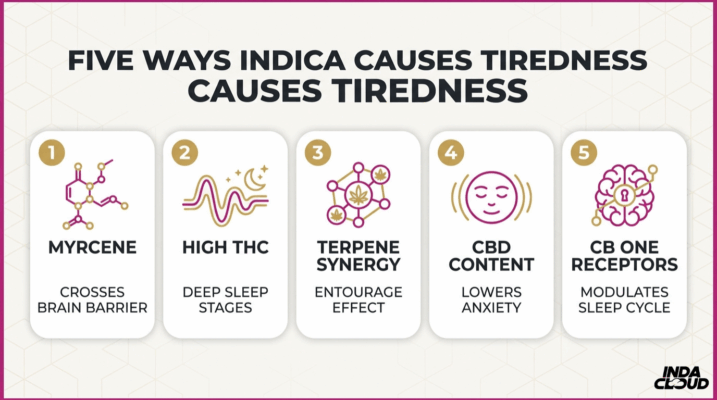
Myrcene contributes to indica’s sedating effects by acting as a powerful natural sedative that promotes the classic “couch-lock” sensation. According to a 2021 review in Frontiers in Nutrition, cannabis strains containing high concentrations of myrcene (above 0.5%) are likely to induce sedative qualities classically attributed to indica strains. This terpene’s high lipophilicity allows it to readily cross the blood-brain barrier, where it interacts directly with central nervous system targets involved in sleep regulation. Research in animal models has also shown that myrcene increases neurotransmitter levels of GABA, serotonin, and melatonin in the hypothalamus, all of which play critical roles in initiating and maintaining sleep.
Higher THC levels in indica promote drowsiness by altering sleep architecture in ways that favor deeper rest. THC is most closely linked to reductions in REM sleep and increases in deep, slow-wave sleep, according to research published by The Sleep Doctor. Slow-wave sleep is the most physically restorative sleep stage, which explains why higher-THC indica strains leave users feeling heavy and sedated. Because indica-dominant cultivars often carry elevated THC concentrations compared to many sativa-leaning options, this drowsiness-promoting effect tends to be more pronounced. For anyone seeking a sleep aid, this shift toward deeper sleep stages is precisely what makes THC-rich indica strains so effective at nighttime.
Indica’s terpene profile induces relaxation through a synergistic blend of compounds that amplify each other’s calming effects. Myrcene dominates most cannabis profiles, often comprising 20 to 50 percent of a strain’s total terpene content. However, it does not work alone. Additional terpenes such as linalool and beta-caryophyllene contribute anti-anxiety and anti-inflammatory properties that deepen the overall relaxation response. This synergy between compounds is known as the entourage effect, where cannabinoids, terpenes, flavonoids, and other phytochemicals work together to produce a greater effect than any single compound could achieve on its own. The combined terpene profile, rather than any one molecule, is what gives indica its distinctly calming character.
Indica’s CBD content enhances sleepiness by reducing anxiety and promoting a calmer mental state that makes falling asleep easier. A 2019 case series published in The Permanente Journal found that anxiety scores decreased within the first month in 79.2% of patients, while sleep scores improved in 66.7% of patients treated with CBD. Unlike THC, CBD does not directly induce sedation at typical doses. Instead, it lowers the psychological barriers to sleep, such as racing thoughts and tension. When CBD works alongside THC and terpenes in an indica strain, the combined effect creates a more complete pathway to restful sleep than any single cannabinoid provides alone.
Indica affects your endocannabinoid system by binding to CB1 receptors concentrated in brain regions that regulate sleep, mood, and motor function. The basal ganglia, hippocampus, and cerebellum exhibit the highest levels of CB1 receptor expression, and activation of these receptors plays a well-established role in modulating the sleep-wake cycle. THC mimics the body’s own endocannabinoids, particularly anandamide, slotting into CB1 receptor sites and shifting neural activity toward sedation. The role of CB2 receptors in sleep modulation, while less understood, remains an active area of investigation. This direct interaction with the endocannabinoid system is the foundational mechanism that makes indica’s other sleep-promoting compounds more effective, setting the stage for how your body physically responds to consumption.
When you consume indica, your body activates a chain of physiological responses through the endocannabinoid system. These responses affect your brain, muscles, and cardiovascular system.
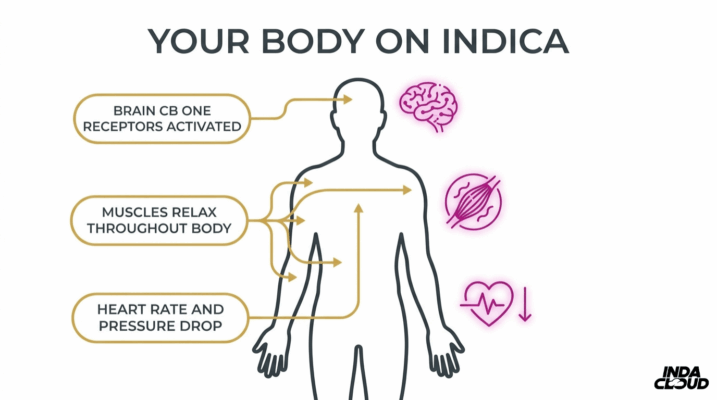
Indica interacts with CB1 receptors in the brain by delivering THC and terpenes that bind to or modulate these receptor sites concentrated in the basal ganglia, hippocampus, and cerebellum. THC mimics the body’s natural endocannabinoids, attaching directly to CB1 receptors and altering neurotransmitter release patterns that regulate mood, pain perception, and wakefulness.
Myrcene, the dominant terpene in most indica profiles, amplifies this process. According to a 2021 review published in Molecules, myrcene’s central nervous system effects are likely facilitated by its high lipophilicity and ability to readily cross the blood-brain barrier, enabling it to reach and interact with various CNS targets. This rapid penetration helps explain why indica’s sedating effects often feel swift and pronounced.
Indica causes muscle relaxation throughout the body because its cannabinoids and terpenes reduce excitatory signaling in motor pathways. When THC activates CB1 receptors along the spinal cord and peripheral nervous system, it suppresses the release of neurotransmitters responsible for muscle contraction and tension.
Myrcene contributes additional analgesic and muscle-relaxant properties. Its interaction with GABAergic pathways promotes inhibitory signaling, which calms overactive muscle fibers. For anyone dealing with physical tension after a long day, this combination of cannabinoid and terpene activity is what produces that characteristic full-body heaviness associated with indica consumption. The effect is systemic rather than localized, which is why relaxation tends to spread from head to limbs.
Indica lowers your heart rate and blood pressure through a biphasic cardiovascular response. Initially, THC may cause a brief spike in heart rate as it activates CB1 receptors in cardiovascular tissue. Within minutes, however, vasodilation takes over as smooth muscle in blood vessel walls relaxes, widening arterial pathways and reducing vascular resistance.
This drop in blood pressure triggers a compensatory decrease in heart rate, producing the calm, heavy sensation many users report. Terpenes like myrcene and linalool, commonly present in indica profiles, reinforce this effect by promoting parasympathetic nervous system activity. The result is a shift toward a resting physiological state, which partly explains why indica consumption pairs naturally with evening use and wind-down routines.
Understanding these cardiovascular mechanisms helps clarify whether indica’s sedation suits your individual health profile.
Indica does not always make you tired. The sedating effects depend on factors like dose, individual tolerance, and timing of consumption. The following subsections explore how each variable shapes your experience.
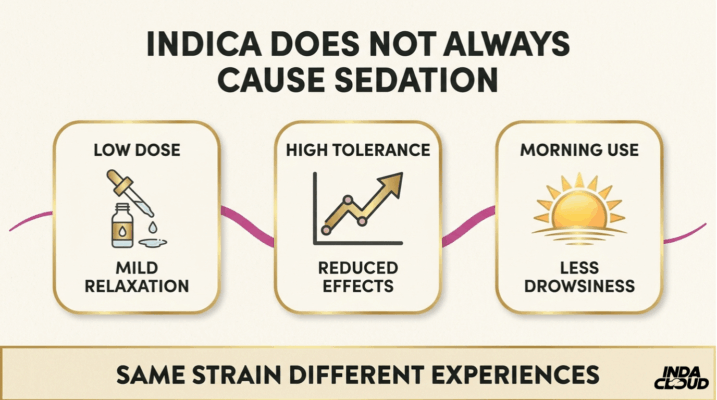
Yes, indica strains can be energizing at lower doses. Sedation from indica is closely tied to myrcene concentration and how much you consume. According to a 2021 review in Frontiers in Nutrition, cannabis strains containing high concentrations of myrcene (above 0.5%) are likely to induce the sedative “couch-lock effect” classically attributed to indica varieties. At lower doses, however, the myrcene threshold may not be reached in sufficient quantity to trigger full sedation. Many users report that a small amount of an indica-dominant strain produces mild relaxation and gentle mood elevation without heavy drowsiness. This dose-dependent relationship is one of the most practical levers consumers can adjust. For anyone exploring indica products, starting low and increasing gradually remains the most reliable way to find the balance between calm and alertness.
Yes, your tolerance level changes how tired indica makes you. Regular cannabis consumers develop cannabinoid tolerance over time, meaning the same dose produces progressively weaker sedation. CB1 receptors in the brain downregulate with repeated THC exposure, reducing the intensity of effects like drowsiness and muscle relaxation. A dose that puts a new user to sleep may feel mild and functional for a seasoned consumer. Tolerance builds at different rates depending on frequency, dosage, and individual metabolism. Occasional users typically experience stronger sedation from the same indica product compared to daily consumers. Taking periodic breaks can reset sensitivity, restoring the full spectrum of effects.
Yes, the time of day you consume indica can affect tiredness. Your body’s circadian rhythm influences how cannabinoids interact with the endocannabinoid system, which naturally fluctuates throughout the day. Consuming indica in the evening, when your body is already winding down and melatonin production is rising, amplifies sedating effects. The same strain used in the morning, when cortisol levels peak and alertness is naturally high, may feel less sedating and more calming without full drowsiness. This is why many experienced consumers reserve indica for nighttime use while choosing other options earlier in the day. Aligning consumption with your natural sleep-wake cycle helps you control whether indica promotes relaxation or outright sleepiness.
Understanding these variables helps you choose the right indica product for any situation.
The best indica uses for sleep and relaxation center on evening wind-down routines, managing occasional sleeplessness, easing physical tension, and creating a calmer mental state before bed. These applications leverage indica’s sedating terpene and cannabinoid profile to support rest.
Indica-dominant strains are most commonly chosen for nighttime consumption, when their relaxing properties align with the body’s natural drive toward sleep. For people who struggle to quiet a racing mind at the end of the day, indica’s combination of myrcene-rich terpenes and THC can help transition the body into a restful state. Physical discomfort that disrupts sleep, such as muscle tension or general soreness, is another area where indica’s body-focused effects prove particularly useful.
According to a strain selection guide from The Green Medicine Shop, predominant indica strains demonstrated a possible advantage over sativa and exclusively CBD strains in reducing insomnia symptomology, with an estimated mean difference of 0.59 compared to CBD strains. This suggests that for people specifically targeting sleep quality, indica-labeled products offer a measurable edge.
Common indica uses for sleep and relaxation include:
For anyone exploring these applications, starting with a low dose and observing individual response remains the most practical approach. Indica’s sedating reputation holds true for many users, but personal chemistry and tolerance always play a role in the experience.
Understanding these practical uses sets the stage for comparing indica directly against sativa for sleep.
Indica is generally better for sleep than sativa, though the distinction depends more on chemical profile than strain label alone. Below, the key differences in user perception, genetic reality, and practical selection are explored.
Participants in a study published in the Journal of Cannabis Research reported a greater preference to use indica in the evening and sativa in the morning and afternoon. Those same participants were more likely to perceive indica strains as effective for pain management and sleep, while sativa strains were perceived as effective for improving energy and mood. This consumer pattern aligns with indica’s typically higher myrcene content and sedating terpene profiles.
However, the scientific picture is more nuanced than traditional labels suggest. According to research highlighted by National Geographic, mounting scientific evidence suggests that indica and sativa labels are largely meaningless, with no significant chemical or genetic differences consistently separating the two. What matters most is the specific cannabinoid and terpene composition of a given product, not whether the package reads “indica” or “sativa.”
For practical sleep support, look for products with these characteristics:
The indica label remains a useful starting point because strains marketed as indica tend to feature these sleep-promoting compounds more consistently. Still, individual response varies based on tolerance, dosage, and body chemistry. Choosing based on verified terpene and cannabinoid data, rather than relying solely on strain classification, produces more reliable results for sleep.
With sleep-specific strain selection in mind, certain individuals should consider whether indica’s sedating effects are appropriate for them.
Certain individuals should avoid using indica for its sedating effects, including pregnant or lactating persons, those on sedative medications, people with respiratory conditions, and individuals operating heavy machinery.
For those who fall into any of these categories, consulting a healthcare provider before using any cannabis product is essential. Understanding your personal risk factors helps ensure indica’s sedating properties support your wellness rather than compromise it.
You can manage indica’s tiredness side effects by adjusting dosage, timing your consumption strategically, and selecting strains with balanced terpene and cannabinoid profiles. Starting with a lower dose reduces the intensity of sedation, while consuming indica exclusively in the evening aligns its effects with your natural sleep-wake cycle. Choosing strains with moderate myrcene content, rather than those exceeding the 0.5% threshold linked to heavy sedation, also helps control drowsiness. Staying hydrated and pairing consumption with light physical activity can counteract lingering grogginess. For those who enjoy indica’s relaxation benefits but want to avoid excessive fatigue during daytime hours, microdosing offers a practical middle ground that preserves calm without full sedation.
Quality indica products for relaxation are available through licensed dispensaries, online hemp retailers, and direct-to-consumer brands that offer lab-tested, federally legal options. The following sections cover how IndaCloud’s hemp-derived lineup supports relaxation and summarize the key reasons indica produces tiredness.

Yes, IndaCloud’s hemp-derived products can help with relaxation. IndaCloud offers a curated lineup of federally legal cannabinoid products specifically organized by desired effect, including options designed for unwinding and sleep. All products contain less than 0.3% Δ9-THC, comply with the 2018 Farm Bill, and undergo third-party testing for potency and purity.
IndaCloud’s relaxation-focused offerings include:
Backed by a team of over 35 cannabis experts and trusted by more than 250,000 verified customers, IndaCloud ships discreetly across the continental United States with free shipping on orders over $89. For anyone exploring indica’s relaxation potential, a lab-tested, legally compliant product is the safest starting point.
The key takeaways about why indica makes you tired center on five interconnected factors. Myrcene, the dominant terpene in most indica profiles, crosses the blood-brain barrier and promotes sedation. Higher THC concentrations increase slow-wave sleep while reducing REM sleep. The broader terpene profile, including linalool and beta-caryophyllene, amplifies relaxation through the entourage effect. CBD content modulates anxiety, which indirectly supports sleepiness. Finally, indica’s compounds activate CB1 receptors concentrated in the basal ganglia, hippocampus, and cerebellum, directly influencing the sleep-wake cycle.
Individual responses vary based on tolerance, dosage, and time of consumption. Choosing lab-tested products with transparent terpene and cannabinoid profiles ensures a more predictable relaxation experience.
Yes, THC gummies are legal to buy in most of the United States right…
Learn more

Raw, unheated THCA clears your system in roughly 24 to 48 hours. Once you…
Learn more

Yes, edibles show up on drug tests. Standard panels detect THC edibles exactly the…
Learn more

Green Wednesday is the Wednesday before Thanksgiving, the cannabis industry’s second-biggest shopping day of…
Learn more
