FREE SHIPPING $89+
 FREE GIFTS ALL ORDERS $120+
 100% FEDERALLY LEGAL
  LAB TESTED FOR PURITY


Delta-8 THC and Delta-9 THC are two cannabinoids that share the same molecular formula (C21H30O2) but differ by a single double bond position on the carbon chain, producing distinct psychoactive intensities and legal classifications.
This guide covers their chemical structures and production methods, how their effects and side effects compare, the legal landscape surrounding each cannabinoid, drug testing implications, and how to choose the right product safely.
Delta-8 and Delta-9 differ by one bond placement: the eighth versus ninth carbon position. This small structural shift changes receptor binding, which is why Delta-8 requires chemical conversion from hemp-derived CBD while Delta-9 is extracted directly from cannabis in natural abundance.
Delta-8 produces roughly half the psychoactive potency of Delta-9, delivering milder euphoria and functional clarity. Delta-9 binds more aggressively to CB1 receptors, creating stronger pain relief, deeper relaxation, and more pronounced cognitive shifts that experienced users prefer.
Delta-8’s milder profile translates to fewer reports of paranoia and anxiety, while Delta-9 carries higher dose-dependent risk for both. Safety concerns extend beyond side effects; unregulated Delta-8 manufacturing can introduce contaminants from the chemical synthesis process.
Delta-9 remains a Schedule I controlled substance federally, while hemp-derived Delta-8 occupies a legal gray area under the 2018 Farm Bill. Multiple states have restricted or banned Delta-8, and neither cannabinoid offers an advantage in drug screening since both produce similar metabolites that trigger positive results.
Product format, third-party lab testing, and individual tolerance all factor into choosing between them. This guide breaks down each consideration to help you select the cannabinoid and product type that fits your needs with confidence.
What Is Delta-8 THC and What Is Delta-9 THC?
Delta-8 THC and Delta-9 THC are two cannabinoids found in the cannabis plant that share the same molecular formula but differ in molecular structure. The sections below cover each compound’s chemical makeup and the structural distinction that separates them.
What Is the Chemical Structure of Delta-8 THC?
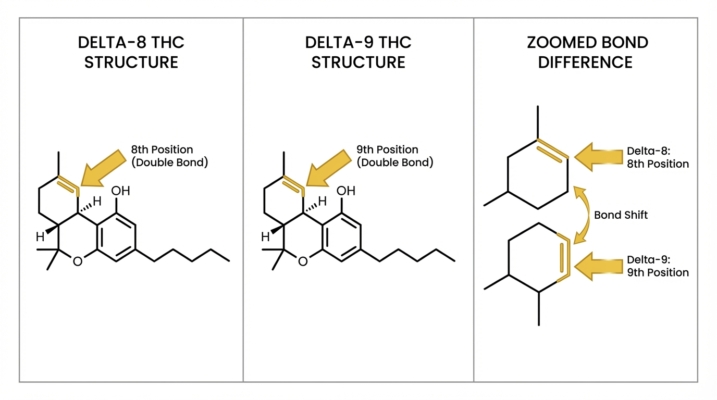
The chemical structure of Delta-8 THC features the molecular formula C21H30O2, with a double bond located at the eighth carbon position in its cyclohexene ring. Although this cannabinoid occurs naturally in hemp, the natural amount of Delta-8 THC in hemp is very low. According to the U.S. Food and Drug Administration, additional chemicals are needed to convert other cannabinoids in hemp, like CBD, into Delta-8 THC through synthetic conversion. This process can leave potentially harmful by-products in the final product, depending on the composition of the starting raw material and the chemicals used during synthesis. Because most commercial Delta-8 is synthetically derived rather than directly extracted, its chemical profile often reflects the conversion process as much as the cannabinoid itself.
What Is the Chemical Structure of Delta-9 THC?
The chemical structure of Delta-9 THC shares the same molecular formula as Delta-8, C21H30O2, but places its double bond at the ninth carbon position in the cyclohexene ring. Delta-9 THC is the primary psychoactive compound in the cannabis plant and occurs in much higher natural concentrations than Delta-8. This abundance makes Delta-9 straightforward to extract directly from cannabis flower without requiring chemical conversion. Its ninth-position double bond influences how the molecule interacts with CB1 receptors in the brain, contributing to the stronger psychoactive response most users associate with traditional cannabis.
How Does the Double Bond Position Differ Between Them?
The double bond position differs between Delta-8 and Delta-9 THC by a single carbon placement on the cyclohexene ring. According to the U.S. Food and Drug Administration, both cannabinoids share the same chemical formula (C21H30O2), but Delta-8 has its double bond at the 8th carbon position while Delta-9 has its double bond at the 9th carbon position. This seemingly minor shift alters each molecule’s three-dimensional shape, which changes how it fits into cannabinoid receptors. The result is a measurable difference in binding affinity and psychoactive intensity, making this single bond position the root cause of the distinct effects users experience with each compound.
Understanding this structural foundation helps clarify the differences in production, potency, and effects explored throughout the rest of this guide.
How Are Delta-8 and Delta-9 THC Produced?
Delta-8 and delta-9 THC are produced through fundamentally different processes. Delta-8 requires chemical conversion from hemp-derived CBD, while delta-9 occurs naturally in abundance within the cannabis plant.
How Is Delta-8 THC Derived From Hemp?
Delta-8 THC is derived from hemp through a chemical synthesis process that converts hemp-derived cannabidiol (CBD) into delta-8 THC using acid catalysts or other chemical reagents. Because the natural amount of delta-8 in hemp is extremely low, direct extraction is not commercially viable.
The 2018 Farm Bill created the legal framework that made this process possible. According to the U.S. Food and Drug Administration, the Farm Bill removed hemp, defined as Cannabis sativa L. with no more than 0.3% delta-9 THC on a dry weight basis, from the Controlled Substances Act. This distinction matters because delta-8 is not a federally controlled substance when sourced from compliant hemp, but it becomes one if synthesized from non-hemp sources or if delta-9 content exceeds the legal threshold.
How Is Delta-9 THC Naturally Produced in Cannabis?
Delta-9 THC is naturally produced in cannabis through the plant’s own biosynthetic pathways. Unlike delta-8, it requires no chemical conversion. According to researchers at the University at Buffalo, delta-9 is more potent than delta-8 and accounts for most of the THC that occurs naturally in the cannabis plant, making it easy to extract. This natural abundance is why delta-9 remains the most widely consumed form of THC. For consumers comparing the two cannabinoids, this production difference has real implications for product purity and consistency.
Understanding how each cannabinoid is produced helps clarify why their legal treatment and safety profiles differ so significantly.
What Are the Effects of Delta-8 vs Delta-9 THC?
The effects of Delta-8 vs Delta-9 THC differ primarily in intensity, onset timing, and overall experience. Below, each factor is explored across subjective high, potency, and duration.
What Does a Delta-8 THC High Feel Like?
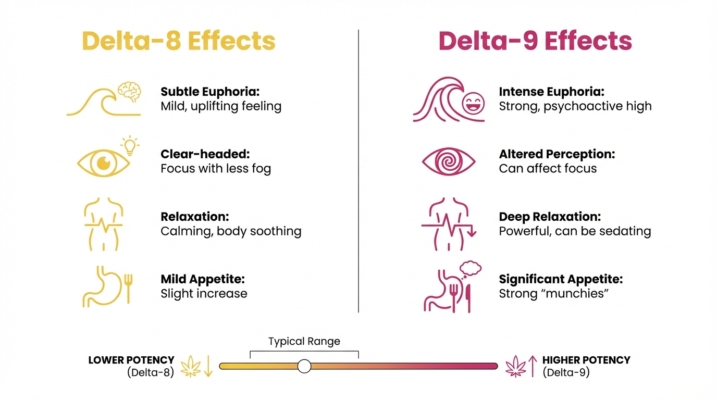
A Delta-8 THC high feels like a milder, more clear-headed version of traditional cannabis euphoria. Users commonly report gentle relaxation, mild mood elevation, and subtle pain relief without the heavy cognitive fog that stronger cannabinoids can produce. Because the psychoactive intensity stays moderate, many people find they can still carry on conversations, complete tasks, and move through their day without significant impairment. This functional quality is what draws users who want calming effects without being overwhelmed. For anyone exploring cannabinoids for the first time, Delta-8 often serves as a more approachable entry point.
What Does a Delta-9 THC High Feel Like?
A Delta-9 THC high feels noticeably stronger and more immersive than its Delta-8 counterpart. Delta-9 produces pronounced euphoria, heightened sensory perception, and deeper body relaxation. Creative thinking and altered time perception are common at moderate doses. At higher doses, however, the intensity can become uncomfortable for some users, sometimes triggering racing thoughts or couch-lock sedation. This potency makes Delta-9 the preferred choice for experienced consumers seeking a full-spectrum cannabis experience. The trade-off is reduced functional clarity compared to Delta-8, so situational awareness matters when choosing between them.
How Does the Potency of Delta-8 Compare to Delta-9?
The potency of Delta-8 compared to Delta-9 is significantly lower. According to research from the University at Buffalo, Delta-8 THC is approximately half as potent as Delta-9 THC. This reduced potency stems from how each cannabinoid binds to CB1 receptors in the brain; Delta-8’s slightly different molecular geometry creates a weaker receptor interaction. In practical terms, a user would need roughly twice the amount of Delta-8 to reach a comparable intensity level. This half-potency profile is precisely why Delta-8 appeals to those who want controlled, measured effects rather than an overwhelming experience.
How Do the Onset and Duration Differ Between Them?
The onset and duration differ between Delta-8 and Delta-9 based largely on consumption method. Inhalation through vaping or smoking typically produces effects within minutes for both cannabinoids, while edibles require 30 to 90 minutes as they pass through digestion. Delta-9 generally peaks faster and with greater intensity, whereas Delta-8’s onset tends to feel more gradual and gentle. Duration follows a similar pattern: inhaled effects for both usually last one to three hours, and edible effects can extend four to eight hours. Delta-8 highs often taper off more smoothly, which many users prefer for sustained, comfortable sessions.
Understanding how these effects compare helps determine which cannabinoid aligns with your tolerance and lifestyle needs.
What Are the Side Effects of Delta-8 vs Delta-9 THC?
The side effects of Delta-8 vs Delta-9 THC differ primarily in intensity. Delta-8 produces milder adverse reactions, while Delta-9 carries a higher risk of anxiety and cognitive impairment. The following sections break down common side effects for each cannabinoid and compare their anxiety profiles.
What Side Effects Are Common With Delta-8 THC?
The side effects common with Delta-8 THC are generally milder than those associated with traditional cannabis. A University at Buffalo survey found that Delta-8 experiences were characterized predominantly by relaxation, pain relief, and euphoria, with most participants reporting they could still perform normal daily activities without paranoia, anxiety, or increased appetite.
However, adverse reactions do occur, particularly with improper dosing or unintentional ingestion. Reported side effects include:
- Dry mouth and red eyes
- Dizziness and confusion
- Drowsiness or sedation
- Nausea and vomiting in high doses
- Hallucinations and tremor in severe cases
Safety concerns are especially significant for younger populations. According to the National Institute on Drug Abuse, adolescent cannabis use is associated with adverse effects on learning, memory, and attention, along with changes in brain development and increased risk of psychiatric disorders such as depression and psychosis.
What Side Effects Are Common With Delta-9 THC?
The side effects common with Delta-9 THC tend to be more pronounced due to its stronger binding affinity at CB1 receptors. Because Delta-9 is roughly twice as potent as Delta-8, its adverse reactions scale accordingly.
Frequently reported side effects include:
- Heightened anxiety and paranoia
- Impaired short-term memory and concentration
- Increased heart rate
- Dry mouth and red eyes
- Coordination difficulties and delayed reaction time
- Appetite changes (commonly known as “the munchies”)
At higher doses, Delta-9 can trigger panic attacks, perceptual distortions, and temporary psychosis in susceptible individuals. These effects are dose-dependent; starting with a low amount and increasing gradually remains the most practical approach to minimizing adverse reactions.
Which Cannabinoid Is More Likely to Cause Anxiety?
Delta-9 THC is more likely to cause anxiety than Delta-8 THC. The University at Buffalo survey of over 500 Delta-8 users found that participants’ experiences of paranoia and anxiety while using Delta-8 were rated between “not at all” and “a little” on average. Delta-9, by contrast, is widely associated with dose-dependent anxiety and paranoia, particularly in new or sensitive users.
This difference likely stems from Delta-8’s reduced potency at CB1 receptors, which produces a less intense psychoactive response. For anyone prone to THC-related anxiety, Delta-8 represents a meaningfully lower-risk starting point. Understanding these anxiety profiles helps determine which product types best align with individual tolerance levels.
Is Delta-8 THC Legal Compared to Delta-9 THC?
Delta-8 THC occupies a legal gray area compared to delta-9 THC, which remains a federally controlled substance. The sections below cover federal law for each cannabinoid and which states have restricted delta-8.
What Does Federal Law Say About Delta-8 THC?
Federal law does not explicitly classify hemp-derived delta-8 THC as a controlled substance. The 2018 Farm Bill legalized hemp and its derivatives containing no more than 0.3% delta-9 THC on a dry weight basis. Because delta-8 THC can be synthesized from hemp-derived CBD, many manufacturers argue it falls within this legal framework.
However, the regulatory picture is far from settled. According to the Marijuana Policy Project, delta-8 becomes a federally controlled substance when synthesized or when delta-9 THC content exceeds the legal threshold. The FDA has not approved delta-8 products for safe use, and there is no federal minimum age requirement to purchase them. These products may be sold online, in gas stations, and in convenience stores with virtually no oversight. For consumers, this means federal legality hinges entirely on the source material and production method.
What Does Federal Law Say About Delta-9 THC?
Federal law classifies delta-9 THC as a Schedule I controlled substance under the Controlled Substances Act. This classification applies to marijuana-derived delta-9 THC regardless of concentration. Possession, distribution, and manufacture carry federal penalties.
The one exception involves hemp-derived delta-9 THC products containing no more than 0.3% delta-9 THC by dry weight, which the 2018 Farm Bill technically permits. Some edible manufacturers use this threshold to create products with measurable delta-9 content that remain federally compliant when calculated against total product weight. For a practical breakdown of how this dry weight calculation applies to specific edible formats, our guide on delta 9 gummies legality covers the full legal mechanics. Despite this workaround, most delta-9 THC products sold at dispensaries contain concentrations well above 0.3%, keeping them firmly under Schedule I restrictions. The distinction between hemp-derived and marijuana-derived delta-9 is critical, yet it remains one of the most misunderstood aspects of cannabinoid law.
Which States Have Restricted or Banned Delta-8 THC?
Multiple states have restricted or banned delta-8 THC, driven largely by safety concerns and the absence of federal regulation. According to the 2023 Monitoring the Future survey funded by the National Institutes of Health, approximately 11% of 12th-grade students reported past-year delta-8 THC use, highlighting accessibility issues that have prompted legislative action.
Key factors motivating state-level bans include:
- Manufacturing may occur in uncontrolled or unsanitary settings, introducing unsafe contaminants into finished products.
- Of poison control center cases involving delta-8 exposure, 70% required health care facility evaluation, with 8% resulting in critical care admission.
- Pediatric patients accounted for 45% of those requiring health care facility evaluation.
States including New York, Colorado, Oregon, and several others have enacted restrictions ranging from outright bans to strict regulatory frameworks. The patchwork nature of state laws means consumers must verify local regulations before purchasing. Understanding drug testing implications is equally important for delta-8 and delta-9 users alike.
Will Delta-8 and Delta-9 THC Show Up on a Drug Test?
Yes, both delta-8 and delta-9 THC will show up on a drug test. Standard screening panels detect THC metabolites without distinguishing between the two cannabinoids, making any recent use a potential risk before testing.
Both compounds break down into structurally similar metabolites in the body. The primary metabolite flagged in urine screening is carboxy tetrahydrocannabinol (THC-COOH). Because delta-8 produces its own version of this metabolite, it triggers the same immunoassay response that delta-9 does.
According to Quest Diagnostics, delta-8 interferes with testing for delta-9 in both presumptive and definitive urine drug tests. This means even confirmatory methods, which are designed to verify initial results, cannot reliably separate delta-8 from delta-9 use. For anyone facing workplace, athletic, or legal drug screening, consuming either cannabinoid carries equivalent detection risk.
Detection windows vary based on frequency of use, body composition, and consumption method. Occasional users may test positive for several days, while heavy or daily users could produce positive results for weeks. For a full breakdown of detection timelines by product type and usage frequency, see our guide on delta-9 THC drug test detection windows. Neither cannabinoid offers an advantage when it comes to avoiding detection.
Understanding how drug tests handle these cannabinoids matters, but knowing how delta-8 and delta-9 interact with the body explains why their metabolites overlap in the first place.
How Do Delta-8 and Delta-9 THC Interact With the Body?
Delta-8 and delta-9 THC interact with the body by binding to cannabinoid receptors in the endocannabinoid system, primarily the CB1 receptor. The sections below explain how each cannabinoid engages CB1 receptors differently.
How Does Delta-8 Bind to CB1 Receptors?
Delta-8 binds to CB1 receptors with a lower binding affinity than delta-9, which accounts for its milder psychoactive effects. The double bond at the eighth carbon position slightly alters the molecule’s shape, reducing how tightly it locks into the CB1 receptor’s active site. This weaker interaction still activates the receptor, producing relaxation and mild euphoria, but with less intensity. Because both cannabinoids are metabolized into similar compounds, standard drug screens often cannot distinguish between them. According to Mayo Clinic Laboratories, the presence of delta-8 and/or delta-9 carboxy-THC (THC-COOH) in urine is a strong indicator of cannabis use, with delta-8 carboxy-THC serving as the main urinary metabolite for delta-8.
How Does Delta-9 Bind to CB1 Receptors?
Delta-9 binds to CB1 receptors with strong affinity, producing the full psychoactive effects most people associate with cannabis. Its double bond at the ninth carbon position creates a molecular geometry that fits snugly into the CB1 receptor binding pocket, triggering a robust signaling cascade in the central nervous system. This high binding efficiency is why delta-9 delivers more pronounced euphoria, altered sensory perception, and stronger appetite stimulation compared to delta-8. For those new to cannabinoids, this stronger receptor activation is worth considering when choosing between products. Understanding how each compound engages the endocannabinoid system helps clarify why their effects, and their potential benefits, differ so significantly.
What Are the Potential Benefits of Delta-8 vs Delta-9?
The potential benefits of Delta-8 vs Delta-9 differ primarily in intensity and functional suitability. Delta-8 offers milder, more manageable effects, while Delta-9 provides stronger therapeutic and psychoactive potential.
What Potential Benefits Does Delta-8 THC Offer?
Delta-8 THC offers potential benefits centered on relaxation, mild euphoria, and functional clarity. According to a University at Buffalo survey, experiences with Delta-8 were characterized predominantly by relaxation, pain relief, and euphoria, with most participants reporting they could still perform normal daily activities. This ability to remain functional while experiencing subtle psychoactive effects makes Delta-8 particularly appealing for daytime situations or tasks requiring focus.
The milder potency profile also means fewer unwanted reactions. Users reported minimal paranoia or anxiety, which are common complaints with stronger cannabinoids. For anyone seeking a gentle introduction to THC’s potential benefits without an overwhelming high, Delta-8 represents a practical starting point.
What Potential Benefits Does Delta-9 THC Offer?
Delta-9 THC offers potential benefits that include stronger pain relief, more pronounced euphoria, and greater therapeutic versatility. For those accessing these benefits legally, hemp derived delta-9 THC delivers the same therapeutic profile within federally compliant concentration limits. As the primary psychoactive cannabinoid in cannabis, Delta-9 binds more efficiently to CB1 receptors, producing more intense effects suited for managing significant discomfort or stimulating appetite.
Some studies cited by the National Institutes of Health have shown cannabinoids to be safe in helping mitigate certain cancer-associated complications, including chemotherapy-induced nausea and vomiting. This stronger pharmacological profile gives Delta-9 an edge for users who need more robust relief that milder cannabinoids cannot provide. The trade-off is a higher likelihood of intense psychoactive effects, which experienced users often prefer but newcomers may find challenging.
Understanding these distinct benefit profiles helps determine which cannabinoid aligns with your needs and tolerance level.
Who Should Choose Delta-8 Over Delta-9 THC?
Delta-8 THC suits beginners, low-tolerance users, and those seeking functional effects with less intensity. Delta-9 THC fits experienced users who want stronger psychoactive results. The sections below break down ideal candidates by tolerance level and time of day.
Is Delta-8 Better for Beginners or Low-Tolerance Users?
Delta-8 is better for beginners or low-tolerance users because it delivers milder psychoactive effects with fewer adverse reactions. Its approximately half potency compared to delta-9 makes overconsumption less likely for new users still learning their limits.
According to a survey of over 500 delta-8 users conducted at the University at Buffalo, participants’ experiences of paranoia and anxiety while using delta-8 THC averaged between “not at all” and “a little.” This lower anxiety profile makes delta-8 a practical starting point for anyone sensitive to THC or prone to nervousness with cannabis. Many beginners also find they can maintain daily routines without impairment, which builds confidence before exploring stronger cannabinoids.
Is Delta-9 Better for Experienced Cannabinoid Users?
Delta-9 is better for experienced cannabinoid users who have developed tolerance and seek more pronounced effects. Because delta-9 binds more aggressively to CB1 receptors, it produces stronger euphoria, deeper body relaxation, and more noticeable cognitive shifts.
Seasoned users often find delta-8’s milder profile underwhelming once tolerance builds. Delta-9 delivers the full-spectrum intensity that experienced consumers expect, particularly for:
- Deep physical relaxation after high-stress days
- Pronounced euphoric and creative mental states
- Stronger appetite stimulation
- More immersive sensory experiences
For anyone already comfortable managing THC’s psychoactive window, delta-9 provides the potency that matches established tolerance levels.
Which Is Better for Daytime vs Nighttime Use?
Delta-8 is generally better for daytime use, while delta-9 is often better suited for nighttime. Delta-8’s lighter cognitive load allows most users to stay productive and handle routine tasks without significant impairment. Its relaxation effects remain present but tend not to produce the heavy sedation or mental fog that disrupts focus.
Delta-9’s stronger psychoactive intensity pairs more naturally with evening wind-down routines, when deep relaxation and sedation become desirable rather than disruptive. That said, low-dose delta-9 edibles can work during the day for experienced users, while higher-dose delta-8 may still cause drowsiness at night. Matching cannabinoid choice to your schedule helps maximize benefits while minimizing interference with daily responsibilities.
What Product Types Are Available for Each Cannabinoid?
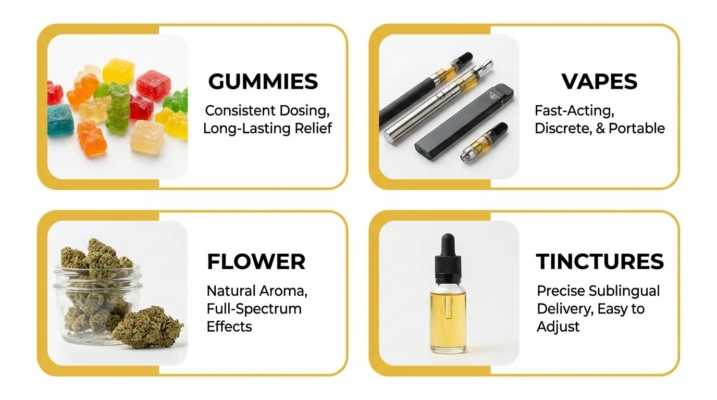
The product types available for each cannabinoid span edibles, vapes, flower, pre-rolls, concentrates, and topicals. Delta-8 THC and Delta-9 THC are both available across these formats, though consumption preferences and availability differ between them.
According to a Columbia University Mailman School of Public Health study, vaping concentrated formulations was the most common Delta-8 THC consumption method at 41.2% among past 30-day cannabis users. Edibles represent another dominant format; a University at Buffalo survey found about two-thirds of Delta-8 respondents consumed it through edibles such as gummies. Anyone weighing this format can review our detailed guide on D9 gummies, covering dosing, onset timing, and how the effects compare to inhalation. For consumers exploring these formats, IndaCloud offers a complete range including lab-tested gummies, vape cartridges, flower, and pre-rolls in both Delta-8 and Delta-9 formulations, with products organized by cannabinoid type, desired effect, and potency level to simplify selection. Delta-9 THC, because it occurs naturally in higher concentrations in the cannabis plant, is more commonly available as smokable flower, pre-rolls, and traditional extracts alongside edibles and vapes.
The most common product formats include:
- Gummies and edibles: Available for both Delta-8 and Delta-9, offering precise dosing and longer-lasting effects.
- Vape cartridges and disposables: Popular for both cannabinoids, providing fast onset through inhalation.
- Flower and pre-rolls: More widely associated with Delta-9 due to natural abundance, though hemp-derived Delta-8 flower (sprayed or infused) also exists.
- Tinctures: Sublingual oils available for both, allowing flexible dosing.
- Concentrates: Waxes, distillates, and dabs offered in both Delta-8 and Delta-9 varieties.
Product format directly influences onset time and experience intensity. Inhalation methods like vapes and flower produce effects within minutes, while edibles can take 30 to 90 minutes. For anyone comparing Delta-8 and Delta-9, choosing the right product format matters as much as choosing the cannabinoid itself. Understanding these delivery methods helps narrow down the best option for your goals and tolerance level.
How Should You Choose Between Delta-8 and Delta-9 Products?
You should choose between delta-8 and delta-9 products by evaluating three factors: product safety, third-party lab testing, and your individual tolerance. The sections below cover how lab-tested sourcing reduces risk and summarize the key differences.
Can Lab-Tested Hemp-Derived Products From Inda Cloud Help?
Yes, lab-tested hemp-derived products from Inda Cloud can help by reducing the contamination and mislabeling risks that plague the broader cannabinoid market. A 2024 analysis published in Frontiers in Pharmacology found that 74% of 202 CBD products deviated from their label claim of potency by at least 10%, and 26% did not even meet the definition for the product type on their packaging. These findings highlight why third-party testing matters.
Inda Cloud addresses this gap by subjecting every batch to comprehensive third-party lab analysis. All products are hemp-derived and contain less than 0.3% delta-9 THC, keeping them 100% federally legal. With results from over 250,000 verified customers, IndaCloud provides accessible delta-8 and delta-9 options, including gummies, vapes, flower, and pre-rolls, backed by transparent lab reports.
What Are the Key Takeaways About Delta-8 vs Delta-9 THC?
The key takeaways about delta-8 vs delta-9 THC center on potency, safety, and sourcing:
- Delta-8 THC is approximately half as potent as delta-9 THC, making it a practical starting point for beginners or those sensitive to anxiety.
- Delta-9 THC delivers stronger psychoactive effects and remains a Schedule I substance under federal law unless derived from compliant hemp.
- Both cannabinoids trigger positive results on standard drug tests.
- Product quality varies dramatically across the market; unregulated manufacturing introduces risks from contaminants, heavy metals, and residual solvents. IndaCloud addresses these quality concerns by subjecting every batch to comprehensive third-party lab testing and providing transparent lab reports with each product, ensuring customers receive consistently safe, accurately labeled hemp-derived cannabinoids.
- Third-party lab testing is the single most reliable way to verify potency accuracy and product safety before purchase.
Choosing the right cannabinoid starts with honest self-assessment, but choosing the right product always starts with verified lab results. Browse IndaCloud’s full range of lab-tested delta 9 products to find gummies, vapes, and pre-rolls with published certificates of analysis.