FREE SHIPPING $89+
 FREE GIFTS ALL ORDERS $120+
 100% FEDERALLY LEGAL
  LAB TESTED FOR PURITY


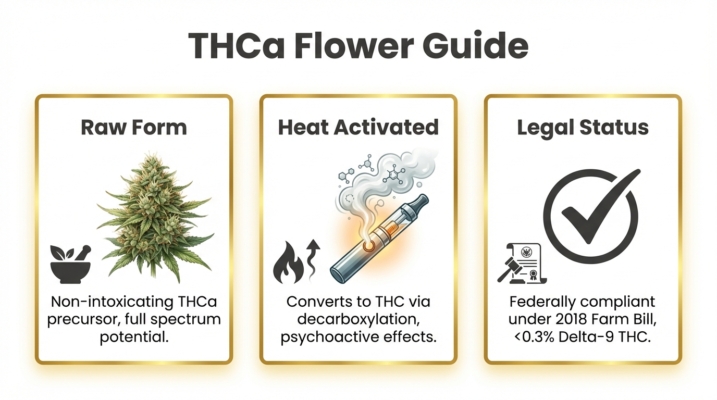
THCA is a non-psychoactive cannabinoid acid found in raw cannabis that occupies a unique position under federal law; the 2018 Farm Bill restricts delta-9 THC specifically, allowing hemp-derived THCA products to be sold legally when they contain no more than 0.3% delta-9 THC on a dry-weight basis.
This guide covers the science behind THCA and its conversion to THC, federal and state legal frameworks, what THCA flower is and how it differs from marijuana, the compound’s effects and drug testing implications, and how to evaluate product quality before buying.
THCA carries the molecular formula C22H30O4, distinguished from THC by an extra carboxylic acid group that prevents it from binding to CB1 brain receptors. Heat removes that group through decarboxylation at 230–250°F, converting THCA into psychoactive delta-9 THC almost instantly when smoked or vaped.
The Farm Bill’s delta-9-only threshold creates a legal gap where flower high in THCA can test as compliant hemp, though the DEA has signaled that THCA’s easy conversion to THC should factor into compliance measurement. No binding regulation has codified that position yet, and state laws add further complexity; some states permit THCA sales openly while others apply total THC calculations that effectively ban these products.
THCA flower is cultivated from selectively bred hemp genetics, harvested at precise maturity windows, and looks identical to traditional marijuana. Preclinical research points to anti-inflammatory and neuroprotective properties, but human clinical data remains limited. Critically, consuming THCA produces the same THC metabolite that standard drug tests detect.
Verifying third-party lab results, reading certificates of analysis, and confirming U.S.-grown hemp sourcing remain the most reliable steps for ensuring both legal compliance and product quality.
What Is THCA and How Does It Differ From THC?
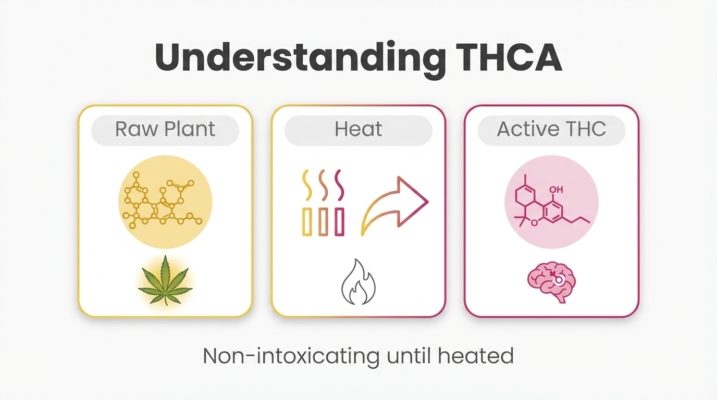
THCA is a naturally occurring cannabinoid acid found in raw cannabis that becomes THC only when exposed to heat. The sections below cover its chemical structure, the decarboxylation process, and the key distinctions between THCA and delta-9 THC.
What Is the Chemical Structure of THCA?
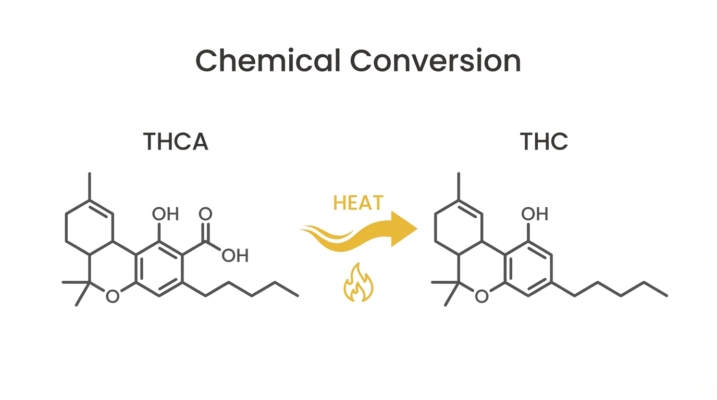
The chemical structure of THCA features the molecular formula C22H30O4, as documented by the National Institutes of Health PubChem database. What distinguishes THCA from THC at the molecular level is an additional carboxylic acid group attached to the cannabinoid’s core ring structure. This extra group prevents THCA from binding effectively to CB1 receptors in the brain, which is why raw cannabis flower does not produce intoxicating effects. Through the process of decarboxylation, heat burns away the carboxylic acid group from THCA, altering the chemical structure until it becomes THC. That single molecular difference determines whether a cannabinoid is psychoactive or not.
How Does THCA Convert to THC Through Decarboxylation?
THCA converts to THC through decarboxylation, a heat-driven chemical reaction that removes its carboxyl group. This conversion occurs at 230–250°F; oven decarboxylation at 240°F for 30–40 minutes yields 70–90% conversion efficiency. Smoking or vaping triggers the same reaction almost instantly.
This conversion carries significant regulatory weight. The USDA’s lab testing guidelines require chemical analysis using post-decarboxylation methods where the total THC concentration considers the potential to convert THCA into THC. Because THCA so readily becomes delta-9 THC when heated, federal agencies cannot ignore it when measuring compliance. For consumers, this means that any THCA flower product will produce psychoactive THC the moment it is smoked, vaped, or cooked.
What Is the Difference Between THCA and Delta-9 THC?
The difference between THCA and delta-9 THC centers on psychoactivity, molecular structure, and how laboratories measure them. THCA is the non-intoxicating precursor; delta-9 THC is the psychoactive compound responsible for the cannabis “high.”
Key distinctions include:
- THCA contains an extra carboxylic acid group that delta-9 THC lacks.
- THCA does not activate CB1 brain receptors, so it produces no intoxication in raw form.
- Delta-9 THC binds directly to CB1 receptors, producing psychoactive effects.
- Federal hemp compliance testing measures delta-9 THC, not THCA, in the plant’s raw state.
According to the National Institute of Standards and Technology, forensic and commercial laboratories rely on well-characterized analytical methods to determine total THC, which is the sum of decarboxylated THCA and delta-9 THC in Cannabis sativa samples. Understanding how total THC is calculated helps clarify why the legal status of THCA products remains a subject of ongoing federal debate.
Why Is THCA Considered Federally Legal Under the 2018 Farm Bill?
THCA is considered federally legal under the 2018 Farm Bill because the law’s hemp definition restricts only delta-9 THC, not THCA. The following subsections explain the 0.3% threshold, THCA’s raw non-psychoactive status, and the DEA’s evolving position.
What Does the Farm Bill’s 0.3% Delta-9 THC Threshold Mean for THCA?
The Farm Bill’s 0.3% delta-9 THC threshold means THCA is not directly restricted by the federal hemp definition. According to the Congressional Research Service, the 2018 Farm Bill defines hemp as any part of the cannabis plant or its derivatives containing no more than 0.3% delta-9 THC on a dry-weight basis. Because this threshold measures only delta-9 THC specifically, THCA content does not count toward the legal limit in its raw, unheated form.
This distinction creates a significant gap. Hemp flower can contain high percentages of THCA while remaining below the 0.3% delta-9 ceiling at the time of testing. For consumers, this means THCA products sourced from compliant hemp can be sold and purchased without violating the federal definition.
How Does THCA’s Non-Psychoactive Raw Form Affect Its Legal Classification?
THCA’s non-psychoactive raw form affects its legal classification by keeping it outside the scope of controlled substance scheduling tied to psychoactive delta-9 THC. In its natural state, THCA carries an extra carboxyl group that prevents it from binding effectively to CB1 receptors in the brain. Without that binding activity, raw THCA does not produce intoxication.
This chemical reality matters legally. Federal hemp compliance testing typically measures delta-9 THC concentration at the point of harvest or sale. Since THCA has not yet converted to delta-9 THC, the flower can test as legally compliant hemp. However, once heat is applied through smoking or cooking, that THCA converts to psychoactive THC, which is why this legal distinction remains heavily debated.
What Role Does the DEA’s Stance Play in THCA’s Federal Legality?
The DEA’s stance plays a pivotal role in THCA’s federal legality because the agency’s interpretation can override or reinforce the Farm Bill’s text. As reported by Marijuana Moment, the DEA has indicated that because THCA so readily converts into delta-9 THC, it cannot be ignored when measuring a product’s compliance with federal law.
This position suggests the DEA views total THC potential, not just delta-9 content at the point of sale, as relevant to legality. If broadly enforced, products high in THCA could fall outside the legal hemp definition regardless of their pre-decarboxylation test results. For now, no formal rulemaking has codified this interpretation into binding regulation, leaving THCA products in a legal gray area that consumers and retailers should monitor closely.
With the federal framework established, individual state laws introduce additional layers that shape where THCA products can legally be sold.
Is THCA Legal in Every State?
THCA is not legal in every state. While federal law permits hemp-derived THCA products containing under 0.3% delta-9 THC, individual states set their own restrictions. The following subsections break down which states allow, ban, or are actively reconsidering THCA’s legal status.
Which States Explicitly Allow THCA Hemp Products?
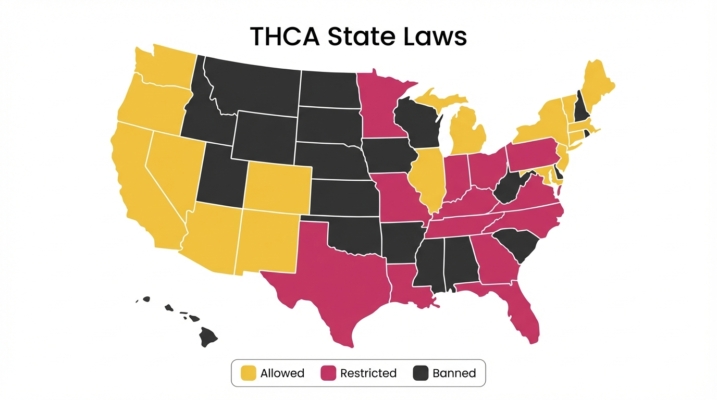
The states that explicitly allow THCA hemp products are those that have adopted the 2018 Farm Bill’s definition of hemp without adding state-level cannabinoid restrictions. States such as California, Florida, Texas, Colorado, and Nevada generally permit the sale and possession of hemp-derived THCA products, provided they contain no more than 0.3% delta-9 THC on a dry-weight basis. According to the Congressional Research Service, the 2018 Farm Bill defines hemp as any part of the cannabis plant or its derivatives containing no more than 0.3% delta-9 THC on a dry-weight basis. Many of these states have established their own hemp programs aligned with USDA guidelines, which enables licensed retailers to sell THCA flower, edibles, and concentrates openly. However, even in permissive states, local county or municipal ordinances can impose additional limits, so consumers should verify regulations in their specific jurisdiction before purchasing.
Which States Have Banned or Restricted THCA?
The states that have banned or restricted THCA include those that define total THC to account for THCA’s conversion potential. States such as Oregon, Idaho, Arkansas, and Rhode Island have enacted laws or regulatory frameworks that either cap total THC (delta-9 THC plus THCA after decarboxylation) or classify all tetrahydrocannabinolic acids as controlled substances. Some states, including Minnesota and Vermont, have imposed restrictions specifically on smokable hemp flower, which directly affects high-THCA products even when delta-9 levels test below 0.3%. For consumers in these states, purchasing or possessing THCA hemp products could carry legal consequences similar to marijuana possession. Because state enforcement agencies interpret “total THC” differently, products that are legal to ship federally may still violate state law upon delivery.
Which States Have Pending Legislation That Could Change THCA’s Status?
The states with pending legislation that could change THCA’s status include several where lawmakers are actively debating how to regulate hemp-derived cannabinoids. States such as Georgia, Indiana, and Kentucky have introduced bills that would redefine legal hemp by incorporating total THC calculations, potentially reclassifying high-THCA products as marijuana. Meanwhile, the federal Farm Bill reauthorization process may reset the baseline for every state; Congress has been weighing provisions that could tighten or clarify THCA’s classification nationwide. State-level regulatory changes can take effect quickly, sometimes with minimal public notice. For anyone buying THCA products online, staying current with both federal reauthorization progress and individual state legislative sessions is essential to avoiding unexpected legal exposure.
With state laws shifting rapidly, understanding how THCA flower itself differs from traditional cannabis adds important context.
What Is THCA Flower and How Is It Different From Regular Cannabis?
THCA flower is hemp-derived cannabis flower that contains high levels of tetrahydrocannabinolic acid (THCA) while meeting the federal 0.3% delta-9 THC threshold. The sections below cover how THCA flower is cultivated, why it resembles marijuana, and how lab testing separates legal hemp flower from illegal cannabis.
How Is THCA Flower Grown and Harvested?
THCA flower is grown and harvested using selective breeding techniques that maximize THCA content while keeping delta-9 THC levels at or below 0.3% on a dry-weight basis. Cultivators achieve this by choosing hemp genetics naturally high in THCA and harvesting at precise maturity windows before significant decarboxylation occurs. Timing is critical; THCA converts to THC at 230–250°F, so any post-harvest exposure to excessive heat degrades compliance. Growers typically hang-dry flower in climate-controlled environments and cure it slowly to preserve the raw cannabinoid profile. This careful process produces flower that is rich in THCA yet legally classifiable as hemp under federal guidelines.
Why Does THCA Flower Look and Smell Like Marijuana?
THCA flower looks and smells like marijuana because both come from the same plant species, Cannabis sativa. The trichomes, terpene profiles, and physical structure of hemp-derived THCA flower are virtually identical to those of high-THC cannabis grown in state-legal dispensaries. Terpenes such as myrcene, limonene, and caryophyllene produce the characteristic aroma shared across all cannabis cultivars, regardless of legal classification. The only meaningful difference is the delta-9 THC concentration at the time of testing. Visually and aromatically, even experienced users cannot reliably distinguish legal THCA flower from traditional marijuana without verified lab results. This similarity is precisely why third-party testing and certificates of analysis matter so much for consumers.
How Do Lab Tests Distinguish Legal THCA Flower From Illegal Cannabis?
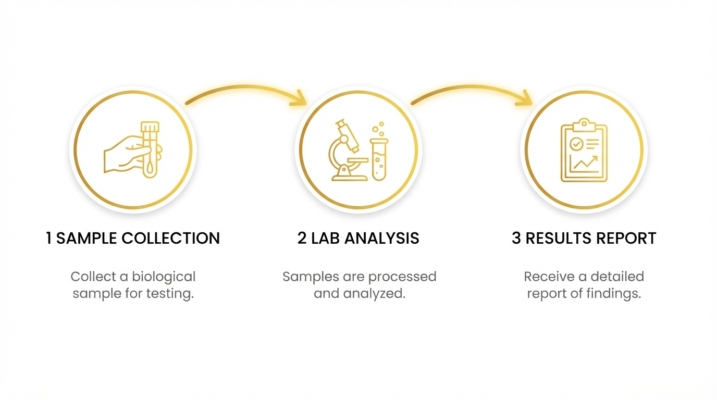
Lab tests distinguish legal THCA flower from illegal cannabis by measuring delta-9 THC concentration on a dry-weight basis. According to NIST research, forensic and commercial laboratories rely on well-characterized analytical methods to determine total THC, calculated as the sum of decarboxylated THCA and delta-9 THC in Cannabis sativa samples. Some state and federal frameworks apply a “total THC” formula that accounts for THCA’s potential conversion, while others test only for delta-9 THC as harvested. This distinction determines whether a given flower sample qualifies as legal hemp.
Key factors labs evaluate include:
- Delta-9 THC percentage against the 0.3% federal threshold.
- Total THC calculation, which adds converted THCA to existing delta-9 levels.
- Terpene and cannabinoid profiles confirming strain identity.
- Contaminant screening for pesticides, heavy metals, and microbials.
Understanding which testing method a state or lab applies is essential, because a sample passing a delta-9-only test could fail under total THC methodology.
Does THCA Get You High When You Smoke or Vape It?
THCA does get you high when you smoke or vape it, because heat converts THCA into psychoactive delta-9 THC. Without heat, raw THCA produces no intoxicating effects.
What Happens When THCA Is Heated Through Smoking?
When THCA is heated through smoking, it undergoes decarboxylation, a chemical reaction that removes the carboxyl group and transforms THCA into delta-9 THC. This conversion occurs rapidly at the high temperatures produced by a lighter flame or vaporizer coil. According to Mellow Fellow, THCA converts to THC at 230–250°F through loss of its carboxyl group, with oven decarboxylation at 240°F for 30–40 minutes yielding 70–90% conversion. Smoking and vaping reach temperatures well above this threshold, so the conversion happens almost instantly. The resulting delta-9 THC binds to CB1 receptors in the brain, producing the characteristic euphoria, relaxation, and altered perception associated with cannabis. For anyone consuming THCA flower through combustion or vaporization, the experience is functionally identical to smoking traditional marijuana.
What Happens When THCA Is Consumed Raw Without Heat?
When THCA is consumed raw without heat, it does not produce a high. THCA in its natural, unheated form retains its carboxyl group, which prevents the molecule from binding effectively to CB1 receptors in the endocannabinoid system. Because CB1 receptor activation is what triggers psychoactive effects, raw THCA is classified as non-intoxicating. Some users juice raw cannabis leaves or add THCA tinctures to smoothies specifically to avoid intoxication while exploring the compound’s potential wellness properties. This distinction between raw and heated consumption is central to understanding why THCA flower can be sold legally as a hemp product yet deliver psychoactive effects once ignited.
Understanding how heat transforms THCA clarifies both its potential benefits and its implications for drug testing.
What Are the Potential Benefits and Effects of THCA?
The potential benefits and effects of THCA span anti-inflammatory, neuroprotective, and anti-nausea properties observed in preclinical research. The following subsections cover what studies have found so far.
What Anti-Inflammatory Properties Has THCA Shown in Research?
THCA has shown anti-inflammatory properties in preclinical studies by interacting with pathways that modulate the body’s inflammatory response. Early laboratory research suggests THCA may inhibit pro-inflammatory enzymes, particularly those in the cyclooxygenase (COX) family involved in pain and swelling.
These findings remain preliminary, with most data coming from cell-culture and animal models rather than large-scale human trials. Still, the consistency of anti-inflammatory signals across multiple preclinical investigations makes THCA one of the more closely watched acidic cannabinoids in ongoing research. For anyone considering cannabinoid wellness products, understanding that these results have not yet been confirmed in clinical human studies is essential.
What Neuroprotective Effects Are Associated With THCA?
The neuroprotective effects associated with THCA involve its potential ability to protect neurons from oxidative stress and mitochondrial dysfunction. According to a study published in the National Institutes of Health (NIH) PMC, the in vivo neuroprotective activity of Δ9-THCA was investigated in mice intoxicated with the mitochondrial toxin 3-nitropropionic acid (3-NPA), a model that mimics neurodegenerative damage.
Researchers observed that THCA acted through PPARγ receptor pathways, which play a role in reducing neuroinflammation. While these animal-model results are promising, clinical trials in humans are needed before drawing definitive conclusions. This early evidence positions THCA as a cannabinoid worth monitoring in neuroscience research.
How Might THCA Help With Nausea and Appetite?
THCA might help with nausea and appetite by interacting with serotonin receptors and endocannabinoid pathways that regulate these functions. Preclinical animal studies have indicated that acidic cannabinoids, including THCA, may suppress nausea responses at doses lower than those required from their decarboxylated counterparts.
For individuals dealing with appetite loss or chronic nausea, this research suggests raw, unheated cannabis preparations could offer a non-intoxicating option. However, human clinical data remains limited, so these effects should be considered preliminary rather than established medical guidance. Understanding how THCA interacts with the body before heating provides useful context for evaluating whether it might trigger a positive drug test result.
Will THCA Make You Fail a Drug Test?
Yes, THCA can make you fail a drug test. Once heated or metabolized, THCA converts to delta-9 THC, producing the same metabolite that standard screenings detect. The sections below explain how urine tests identify THC metabolites and how long THCA remains detectable.
How Do Standard Urine Drug Tests Detect THC Metabolites From THCA?
Standard urine drug tests detect THC metabolites from THCA by screening for 11-nor-delta-9-tetrahydrocannabinol-9-carboxylic acid (9-carboxy-THC). According to the Centers for Disease Control and Prevention, this metabolite of delta-9 THC is the primary marker used in urine-based cannabis screening. Because THCA converts to delta-9 THC through decarboxylation when smoked, vaped, or even partially metabolized, the body processes it into 9-carboxy-THC identically. The test cannot distinguish whether the original source was THCA flower or traditional marijuana. Anyone subject to workplace or legal drug testing should assume that THCA consumption will trigger a positive result.
How Long Does THCA Stay Detectable After Consumption?
THCA stays detectable after consumption for a period that depends on several individual factors:
- Infrequent users may test positive for 3 to 5 days after a single use.
- Moderate users consuming several times per week often show detectable levels for 7 to 14 days.
- Daily or heavy users can remain positive for 30 days or longer.
- Body fat percentage influences detection windows because THC metabolites are fat-soluble and accumulate in adipose tissue.
- Metabolism and hydration also affect how quickly the body clears 9-carboxy-THC.
Consumption method matters as well. Smoking or vaping THCA flower produces rapid, complete conversion to THC, while edibles may extend the metabolic timeline. For anyone facing upcoming drug screening, the safest approach is to discontinue all THCA products well in advance.
How Should You Choose Quality THCA Products?
You should choose quality THCA products by verifying third-party lab results, reading certificates of analysis, and confirming the hemp source. These three factors separate trustworthy products from unreliable ones.
Why Are Third-Party Lab Results Essential for THCA Products?
Third-party lab results are essential for THCA products because independent testing confirms cannabinoid potency, legal compliance, and the absence of contaminants. Labs accredited under ISO/IEC 17025 follow standardized protocols that eliminate the bias inherent in manufacturer self-testing.
Key reasons to require third-party testing include:
- Independent verification confirms the THCA and delta-9 THC percentages listed on the label are accurate.
- Contaminant screening detects pesticides, heavy metals, residual solvents, and microbial impurities.
- Batch-specific results prove each production run meets federal and state safety standards.
Products sold without accessible, current lab reports should be avoided entirely. In a market with minimal federal oversight, third-party testing is the single most reliable trust signal a consumer can evaluate before purchasing.
What Should You Look for on a THCA Certificate of Analysis?
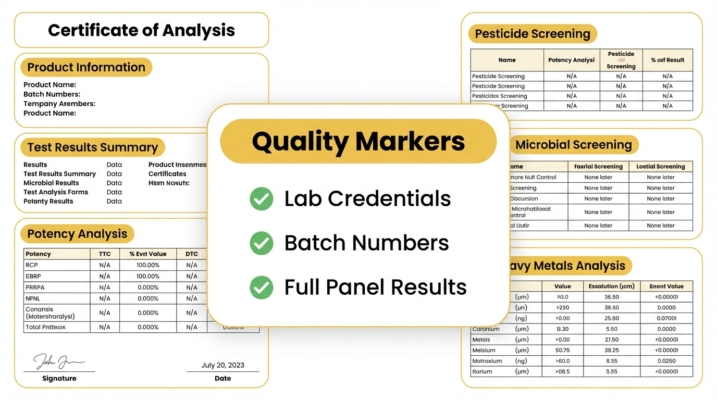
You should look for several critical data points on a THCA certificate of analysis. A legitimate COA provides a complete cannabinoid profile listing THCA, delta-9 THC, CBD, and minor cannabinoids by percentage. According to USDA laboratory testing guidelines, chemical analysis must use post-decarboxylation or similarly reliable methods where total THC concentration accounts for the potential conversion of THCA into THC.
Essential COA elements include:
- The accredited lab’s name, contact information, and certification credentials.
- A batch or lot number matching the product packaging.
- A full cannabinoid breakdown showing individual and total THC levels.
- Pass/fail results for pesticides, heavy metals, and microbial contaminants.
- The testing date, which should be recent and correspond to the current product batch.
Any missing element is a red flag worth taking seriously. IndaCloud provides detailed, batch-specific Certificates of Analysis for every THCA product, ensuring customers have full visibility into cannabinoid potency and safety test results before purchase.
How Does the Hemp Source Affect THCA Product Quality?
The hemp source affects THCA product quality because growing conditions, soil composition, and cultivation practices directly influence cannabinoid profiles and contaminant risk. Hemp grown in nutrient-rich soil under controlled conditions produces more consistent THCA concentrations than crops from unregulated or unknown origins.
The 2018 Farm Bill defines legal hemp as cannabis containing no more than 0.3% delta-9 THC on a dry-weight basis, so compliant sourcing starts at the farm level. Domestically grown hemp cultivated under USDA-regulated programs follows stricter testing protocols than many imported alternatives. IndaCloud sources all of its THCA flower from U.S.-grown hemp cultivated under Farm Bill compliance, with every batch undergoing third-party testing before it reaches customers.
Grand View Research valued the North America hemp-derived cannabidiol market at USD 1.5 billion in 2024, with an expected CAGR of 13.5% through 2030, reflecting rapid growth that makes verifying supply chains even more critical.
Prioritizing U.S.-grown, farm bill-compliant hemp remains one of the most practical steps for ensuring both product quality and legal standing. With sourcing verified, purchasing from a transparent retailer completes the quality equation.
How Can You Buy Federally Legal THCA Flower Online?
You can buy federally legal THCA flower online from hemp retailers that ship compliant products directly to your door. Below, we cover Inda Cloud’s shipping availability and the key takeaways on THCA federal legality.
Can Inda Cloud’s Hemp-Derived THCA Flower Ship to Your State?
Yes, IndaCloud’s hemp-derived THCA flower can ship to most states across the continental United States. Because IndaCloud’s THCA flower contains less than 0.3% delta-9 THC on a dry-weight basis, it meets the federal hemp definition established by the 2018 Farm Bill. Every batch undergoes third-party lab testing, and Certificates of Analysis are available for verification before purchase.
However, some states have enacted their own restrictions on THCA products, so checking your local regulations before ordering is essential. IndaCloud ships orders within 48 hours in nondescript packaging, with free shipping on orders over $89. For anyone navigating an evolving legal landscape, purchasing from a transparent, lab-tested source like IndaCloud reduces compliance risk significantly.
What Are the Key Takeaways About THCA Federal Legality and Usage?
The key takeaways about THCA federal legality and usage are:
- THCA is not delta-9 THC; it is the raw, non-psychoactive precursor found naturally in cannabis plants.
- The 2018 Farm Bill legalized hemp and its derivatives containing no more than 0.3% delta-9 THC on a dry-weight basis, which currently permits high-THCA hemp flower at the federal level.
- THCA converts to psychoactive THC through decarboxylation when exposed to heat, such as smoking or vaping.
- State laws vary considerably; several states have banned or restricted THCA products despite federal legality.
- Standard drug tests detect THC metabolites, so consuming THCA flower (especially when heated) can trigger a positive result.
- Third-party lab testing and Certificates of Analysis remain the most reliable tools for verifying product compliance and quality.
For consumers seeking a federally legal option backed by rigorous testing, IndaCloud offers premium THCA flower with full transparency on sourcing, potency, and lab results.