



Delta 8

Delta 8 vs Delta 9: Complete Comparison
Let’s dive into the worlds of delta 8 and delta 9 THC. Delta 9…
Learn more
You must be 21+ to enter this site
 FREE SHIPPING $89+
 FREE GIFT ON $120+
 100% FEDERALLY LEGAL
 LAB TESTED FOR PURITY
FREE SHIPPING $89+
FREE GIFT ON $120+
100% FEDERALLY LEGAL
LAB TESTED FOR PURITY
FREE SHIPPING $89+
FREE GIFT ON $120+
100% FEDERALLY LEGAL
LAB TESTED FOR PURITY
FREE SHIPPING $89+
FREE GIFT ON $120+
100% FEDERALLY LEGAL
LAB TESTED FOR PURITY
FREE SHIPPING $89+
FREE GIFT ON $120+
100% FEDERALLY LEGAL
LAB TESTED FOR PURITY
FREE SHIPPING $89+
FREE GIFT ON $120+
100% FEDERALLY LEGAL
LAB TESTED FOR PURITY
FREE SHIPPING $89+
FREE GIFT ON $120+
100% FEDERALLY LEGAL
LAB TESTED FOR PURITY
FREE SHIPPING $89+
FREE GIFT ON $120+
100% FEDERALLY LEGAL
LAB TESTED FOR PURITY
LAB TESTED FOR PURITY
FREE SHIPPING $89+
FREE GIFT ON $120+
100% FEDERALLY LEGAL
LAB TESTED FOR PURITY
FREE SHIPPING $89+
FREE GIFT ON $120+
100% FEDERALLY LEGAL
LAB TESTED FOR PURITY
FREE SHIPPING $89+
FREE GIFT ON $120+
100% FEDERALLY LEGAL
LAB TESTED FOR PURITY
FREE SHIPPING $89+
FREE GIFT ON $120+
100% FEDERALLY LEGAL
LAB TESTED FOR PURITY
FREE SHIPPING $89+
FREE GIFT ON $120+
100% FEDERALLY LEGAL
LAB TESTED FOR PURITY
FREE SHIPPING $89+
FREE GIFT ON $120+
100% FEDERALLY LEGAL
LAB TESTED FOR PURITY
FREE SHIPPING $89+
FREE GIFT ON $120+
100% FEDERALLY LEGAL
LAB TESTED FOR PURITY

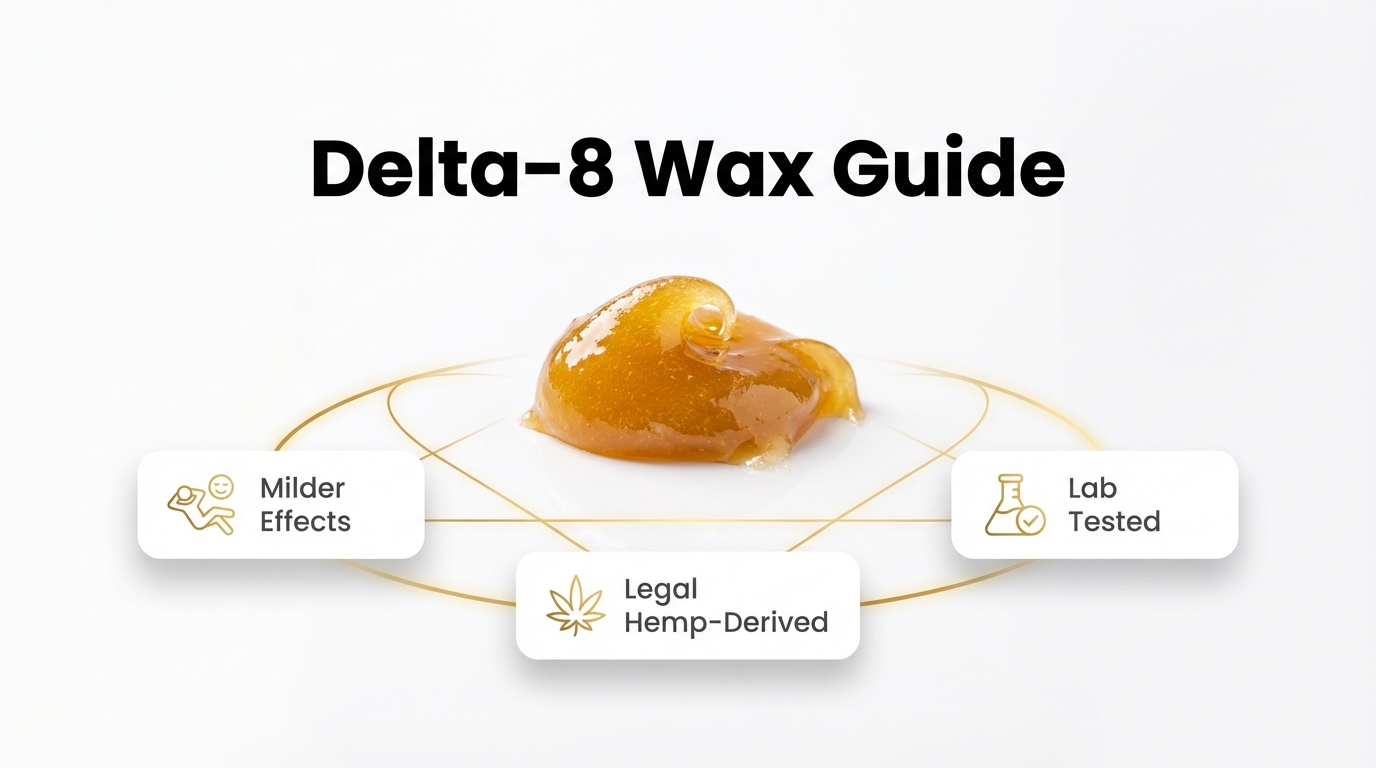
Delta-8 THC wax is a concentrated cannabis extract containing high levels of delta-8-tetrahydrocannabinol in a thick, semi-solid form designed for dabbing or vaporizing. It delivers milder psychoactive effects than delta-9 THC, with lower rates of anxiety and paranoia, making it one of the fastest-growing concentrate formats in the U.S. hemp market.
This guide covers delta-8 wax composition and production, its effects and how they compare to delta-9, practical benefits for relaxation and discomfort, concentrate types and consumption methods, dosing and storage, and the legal and drug testing landscape.
Delta-8 wax retains more terpenes and minor cannabinoids than refined distillate, producing a fuller flavor profile and a more well-rounded experience. The extraction process converts hemp-derived CBD into delta-8 THC through acid-catalyzed cyclization, making third-party lab testing essential for verifying purity.
When dabbed or vaporized, delta-8 wax produces a clear-headed euphoria and deep physical relaxation within minutes, with effects lasting one to three hours. Its lower CB1 receptor affinity means the experience is noticeably less intense than delta-9 wax, which is why many users report switching to delta-8 as a calmer alternative.
Concentrate options range from creamy budder and brittle shatter to terpene-rich live resin, each suited to different dabbing preferences. Beginners benefit from rice-grain-sized dabs, while experienced users adjust based on tolerance.
Hemp-derived delta-8 wax is federally legal under the 2018 Farm Bill, yet at least 14 states restrict or ban its sale. Standard drug tests cannot distinguish delta-8 from delta-9 metabolites, so screening remains a practical concern for all users.
Delta-8 THC wax is a concentrated cannabis extract that contains high levels of delta-8-tetrahydrocannabinol in a thick, waxy form designed for dabbing or vaporizing. The sections below cover how it differs from distillate, its physical characteristics, and its cannabinoid and terpene profile.
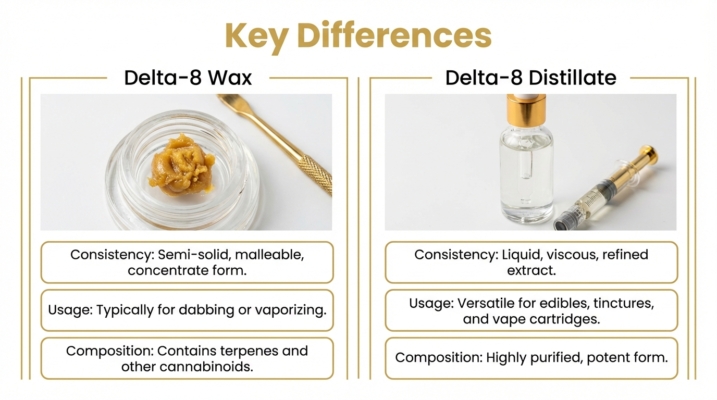
Delta-8 wax differs from delta-8 distillate in texture, composition, and how each concentrate is used. Distillate is a highly refined, translucent oil stripped down to near-pure delta-8-THC, which has a molecular formula of C21H30O2 and a molecular weight of 314.5 g/mol. Wax, by contrast, retains a broader spectrum of plant compounds because it undergoes less refinement.
Key differences include:
For anyone who values flavor complexity and a fuller concentrate experience, wax tends to deliver more character than distillate’s streamlined potency.
IndaCloud offers a curated selection of lab-tested delta-8 concentrates, allowing users to explore different textures and potency levels with confidence in quality and purity.
Delta-8 wax looks like a thick, opaque substance that ranges in color from pale gold to deep amber. Its consistency varies by type; some forms are soft and creamy, while others are dry and crumbly or glassy and brittle. When handled at room temperature, most delta-8 wax feels slightly sticky and pliable, making it easy to scoop with a dab tool.
The aroma depends on the terpene profile preserved during extraction. Earthy, citrus, and pine notes are common. When heated on a dab rig or in a vaporizer, the wax produces a smooth, flavorful vapor that many users find noticeably richer than what standard vape cartridges deliver. This sensory depth is one reason concentrate enthusiasts gravitate toward wax over more refined formats.
The cannabinoids and terpenes found in delta-8 wax depend on the source hemp and the extraction method used. Delta-8-THC is the dominant cannabinoid, but quality wax also contains trace amounts of CBD, CBN, CBG, and CBC. These minor cannabinoids work alongside delta-8 to influence the overall experience.
Common terpenes preserved in delta-8 wax include:
According to Friendly Hemp, CO2 extraction is considered the cleanest method for cannabinoid extraction, using pressurized carbon dioxide to pull cannabinoids and terpenes from plant material in a non-toxic process that leaves no residual solvents. This method helps preserve a wider terpene spectrum compared to harsher solvent-based techniques.
Understanding how delta-8 wax is actually produced reveals why extraction quality matters so much.
Delta-8 wax is made through a multi-step process that converts hemp-derived CBD into delta-8 THC concentrate. The steps below cover extraction, conversion, and quality verification.
The extraction process behind delta-8 wax begins with isolating CBD from hemp plant material, then converting that CBD into delta-8 THC through acid-catalyzed cyclization. This isomerization process uses acidic conditions, heat, and catalysts to rearrange CBD’s molecular structure into delta-8 THC, as documented by the MDPI Molecules Journal in 2024. Once converted, the delta-8 distillate is further refined and purged of residual solvents before being processed into a wax consistency through controlled temperature and pressure techniques. Because delta-8 THC occurs only in trace amounts naturally, this chemical conversion from hemp-derived CBD is what makes commercial-scale production possible. The resulting concentrate is then whipped or manipulated to achieve the final waxy texture consumers expect.
Third-party lab testing matters for delta-8 wax because the conversion process can introduce impurities that are invisible to the consumer. Synthetically derived delta-8 THC may contain residual starting materials, reagents, and side products such as 9β-hydroxy-hexahydrocannabinol (9β-OH-HHC) and its isomer 9α-OH-HHC. Independent laboratories screen for these contaminants alongside pesticides, heavy metals, and residual solvents, providing a certificate of analysis (COA) that confirms both potency and purity. Without this verification, there is no reliable way to know whether a delta-8 wax product is safe for consumption. For anyone shopping for concentrates, always check that a COA from an accredited, independent lab is available before purchasing.
Understanding how delta-8 wax is produced helps clarify why its effects differ from other concentrates.
The effects of delta-8 wax include a clear-headed cerebral high, full-body relaxation, and euphoria with less intensity than delta-9 THC. The sections below break down the head high, body high, onset time, and duration.
The head high from delta-8 wax feels like a mild, clear-headed euphoria with gentle cognitive shifts. According to a 2022 study published in the Journal of Cannabis Research, 68% of delta-8 THC users reported experiencing euphoria, while 74% did not experience anxiety and 83% did not experience paranoia. Users often describe the cerebral effect as functional and manageable, allowing them to stay focused without the racing thoughts or mental fog commonly associated with stronger cannabinoids. That said, moderate cognitive distortions, such as difficulty concentrating and an altered sense of time, are common at higher doses. For anyone looking for a clear yet elevated mental state, delta-8 wax hits a practical sweet spot between sobriety and full intoxication.
The body high from delta-8 wax feels like a wave of deep physical relaxation without heavy sedation. A 2022 study in the Journal of Cannabis Research found that 71% of delta-8 THC users reported significant relaxation and 55% reported pain relief. Most users describe a soothing, full-body calm that eases muscle tension and general discomfort. Unlike stronger concentrates, the physical sensation rarely pins you to the couch unless the dose is particularly high. This makes delta-8 wax a solid option for winding down after a long day while still being able to move around comfortably.
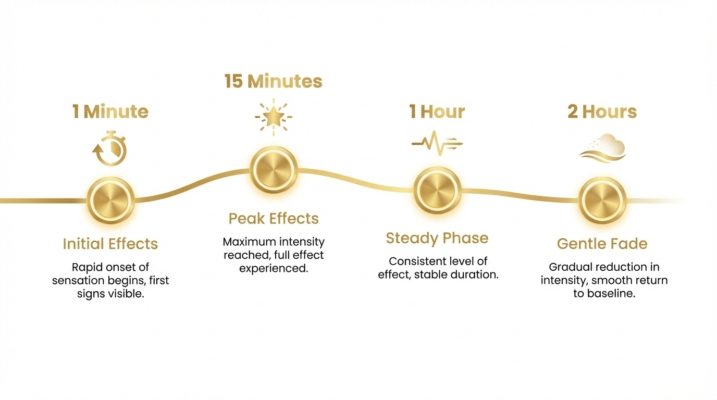
The effects of delta-8 wax kick in almost immediately when dabbed or vaporized, typically within one to five minutes. Because inhalation delivers delta-8 THC directly through the lungs into the bloodstream, onset is significantly faster than with edibles or tinctures. Peak effects usually arrive within 15 to 30 minutes. This rapid onset is one reason vaping concentrated formulations remains the most common consumption method; a 2022 study in the journal Addiction found that 41.2% of past-30-day delta-8 users chose vaping concentrates. Starting with a small dab and waiting before taking more is the safest approach, especially for newer users.
The effects of delta-8 wax last roughly one to three hours when inhaled, though individual factors like tolerance, dose, and metabolism influence duration. On average, participants in a 2022 Journal of Cannabis Research study reported that delta-8 THC effects had a shorter duration than delta-9 THC effects. The peak window is generally the first 30 to 60 minutes, after which the intensity gradually tapers. Residual relaxation or mild mood elevation can linger for an additional hour or two beyond the primary effects. For users who want a shorter, more controllable session, this predictable timeline makes delta-8 wax easier to fit into a daily routine.
IndaCloud’s focus on lifestyle integration means customers can find concentrates tailored to specific moments, whether unwinding after work or enhancing a social evening, backed by transparent lab results and fast, discreet delivery.
With the effects profile covered, the next step is understanding how delta-8 wax compares directly to delta-9 wax.
Delta-8 wax compares to delta-9 wax primarily through differences in intensity, duration, and side effect profiles. The subsections below cover whether delta-8 wax is less intense and whether it causes less anxiety.
Delta-8 wax is less intense than delta-9 wax. Due to its altered molecular structure, delta-8-THC has a lower affinity for the CB1 receptor, which gives it lower psychotropic potency than delta-9-THC. According to a study published in the Journal of Cannabis Research, 36% of participants reported delta-9-THC effects as “much more” intense, 44% said “somewhat more,” and only 15% considered them about the same.
Consumption method also influences the gap between the two. Edibles and tinctures containing delta-8 feel much closer to delta-9 in effects, while vaping or dabbing delta-8 wax produces a noticeably milder experience. For users who want cannabinoid effects without overwhelming intensity, this makes delta-8 wax concentrates a practical starting point.
Delta-8 wax causes less anxiety than delta-9 wax for most users. According to WebMD, delta-8 is often called “marijuana lite” or “diet weed” because common THC side effects like paranoia, anxiety, and drowsiness occur at lower rates compared to delta-9 THC.
This reduced anxiety profile is one of the main reasons users choose delta-8 concentrates over traditional delta-9 options. For anyone who has experienced uncomfortable paranoia or racing thoughts from delta-9 products, delta-8 wax offers a calmer alternative worth exploring. Understanding these side effect differences helps when choosing the right benefits and dosage.
The benefits of using delta-8 wax include relaxation, stress reduction, sleep support, and relief from physical discomfort. Each benefit stems from how delta-8 THC interacts with the body’s cannabinoid receptors at a milder intensity than delta-9 THC.
Yes, delta-8 wax can help with relaxation and stress. Delta-8 THC activates CB1 receptors in the central nervous system, producing calming effects without the intensity often associated with delta-9 THC. According to a study published in the Journal of Cannabis Research, 71% of delta-8-THC users reported experiencing a great deal of relaxation, while 74% did not experience anxiety and 83% did not experience paranoia. These findings suggest delta-8 wax delivers meaningful stress relief with a significantly lower risk of the anxious overstimulation that drives many users away from stronger cannabinoids. For anyone seeking a concentrate that calms without overwhelming, this profile is hard to beat.
Yes, delta-8 wax can support better sleep. The relaxation and mild sedation produced by delta-8 THC’s interaction with CB1 receptors help quiet racing thoughts and ease physical tension before bed. Because wax concentrates deliver cannabinoids rapidly through inhalation, the onset of calming effects typically occurs within minutes. This fast action makes delta-8 wax particularly practical as a nighttime tool compared to slower-acting edibles. Users who find delta-9 THC too stimulating or anxiety-inducing at bedtime often prefer delta-8’s gentler sedative quality. Starting with a small dab and gradually adjusting allows you to find the dose that promotes drowsiness without next-morning grogginess.
Yes, delta-8 wax can help with discomfort and soreness. Delta-8 THC binds to both CB1 and CB2 cannabinoid receptors, which play a role in modulating pain signaling and inflammatory responses throughout the body. The concentrated format of wax delivers a higher cannabinoid dose per inhalation, making it efficient for addressing acute soreness after workouts or persistent physical tension. Rapid onset through dabbing means relief arrives faster than with oral products. In my experience, delta-8 wax occupies a practical middle ground: potent enough to take the edge off real discomfort, yet mild enough to remain functional afterward.
With these potential benefits in mind, choosing the right concentrate type matters just as much as the cannabinoid itself.
The different types of delta-8 wax concentrates are budder, crumble, shatter, sugar wax, and live resin. Each type varies in texture, consistency, and terpene retention, which affects flavor, potency, and how easily it can be handled during dabbing.
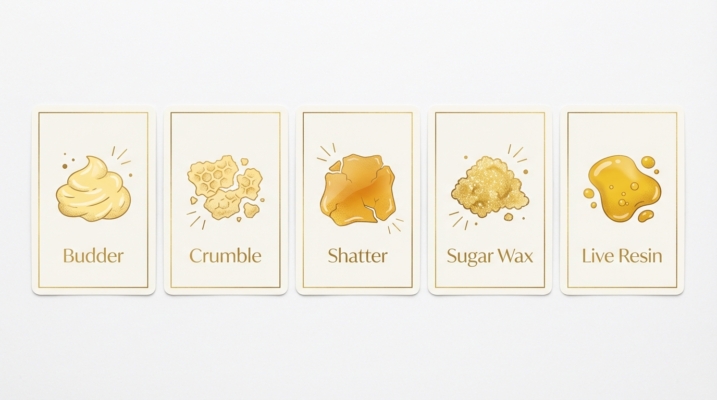
Budder is a delta-8 wax concentrate with a creamy, butter-like consistency. Its smooth texture results from whipping the extract during the purging process, which incorporates air into the concentrate. This makes budder easy to scoop and load onto a dab tool. It typically retains a strong terpene profile, producing rich flavor with each hit. For users who prioritize ease of handling alongside full-bodied taste, budder is often the most forgiving concentrate to start with.
Crumble is a delta-8 wax concentrate with a dry, honeycomb-like texture that breaks apart easily. Produced through a lower-heat purging process, crumble loses more moisture than budder, giving it a crumbly structure. This makes it versatile; users can sprinkle it onto flower, pack it into a vaporizer, or dab it conventionally. Its porous consistency also means crumble dissolves quickly when heated, delivering fast-acting effects. The trade-off is that handling crumble requires a bit more care since small pieces can scatter.
Shatter is a delta-8 wax concentrate with a glass-like, translucent appearance that snaps cleanly when broken. Its rigid structure comes from a slow, undisturbed purging process that allows molecules to settle into a stable, brittle formation. Shatter tends to have a longer shelf life than softer concentrates because its dense structure limits exposure to air and moisture. While potent and visually striking, shatter can be harder to dose precisely since breaking off small, consistent pieces requires a steady hand and proper tools.
Sugar wax is a delta-8 wax concentrate with a grainy, wet-sand texture that resembles crystallized sugar. This consistency develops when cannabinoids naturally nucleate and separate from the terpene-rich liquid during processing. The result is a concentrate that balances high potency with excellent flavor, since the terpene-laden “sauce” surrounding the crystals preserves aromatic compounds effectively. Sugar wax is easy to handle with a dab tool and melts evenly on a heated nail, making it a popular middle ground between the smoothness of budder and the stability of shatter.
Live resin is a delta-8 wax concentrate made from flash-frozen hemp plant material rather than dried and cured flower. Freezing the plant immediately after harvest preserves a broader spectrum of terpenes and minor cannabinoids that would otherwise degrade during drying. This process gives live resin its characteristically bold, aromatic flavor profile. The texture ranges from saucy to slightly granular depending on the batch. Among all delta-8 concentrate types, live resin typically delivers the most complex entourage effect, making it ideal for users who value flavor depth alongside potency.
Understanding these concentrate types helps you choose the right format for your preferred consumption method.
You use delta-8 wax primarily through dabbing, vaporizing, or adding it to flower. Each method offers a different balance of convenience, potency, and flavor.
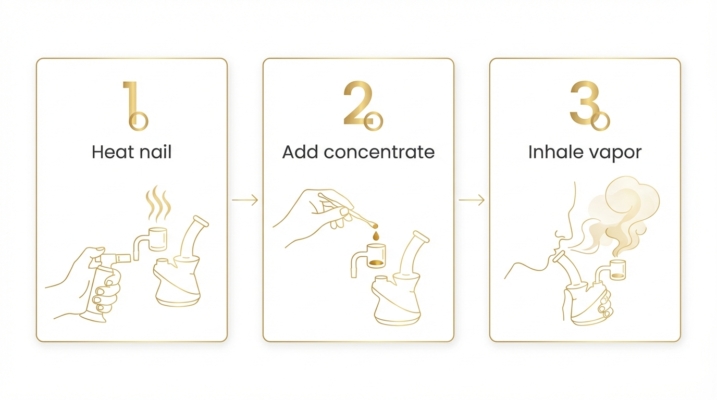
You dab delta-8 wax with a dab rig by heating a nail or banger, applying a small amount of concentrate, and inhaling the resulting vapor. The process involves these steps:
Lower temperatures preserve terpene flavor, while higher temperatures produce thicker, more intense vapor. For anyone new to concentrates, starting with the smallest possible dab is the safest approach since effects are nearly immediate.
You use delta-8 wax with a wax pen or vaporizer by loading concentrate directly into the device’s chamber and activating the heating element. Most wax pens feature a coil or ceramic atomizer designed specifically for concentrates.
To load the pen, use a dab tool to place a small amount of wax onto the coil, avoiding direct finger contact that introduces oils and contaminants. Start at the device’s lowest voltage setting, then increase gradually until you find the right balance of flavor and vapor production. According to a 2022 study published in Addiction, the most common consumption method among delta-8 users was vaping concentrated formulations, reported by 41.2% of past 30-day users. Wax pens offer greater portability and discretion than a full dab rig, making them a practical everyday option.
Yes, you can add delta-8 wax to flower or a joint to increase potency. This method, often called “twaxing,” involves placing small pieces of wax inside a joint or spreading a thin layer along the outside of a rolled joint. You can also top a bowl of ground flower with a dab of wax before lighting it.
Because flower combustion occurs at higher, less controlled temperatures than dabbing, some terpenes and cannabinoids may degrade before inhalation. The result is a stronger session than flower alone, though less efficient than vaporizing the wax directly. For those without a dab rig or wax pen, topping flower remains the most accessible way to experience delta-8 wax.
With your preferred consumption method chosen, proper dosing helps ensure a comfortable experience.
The dosage of delta-8 wax you should start with depends on your tolerance and experience level. Beginners benefit from a conservative approach, while experienced users can adjust upward based on familiarity.
A beginner should take the smallest amount of delta-8 wax possible, typically a rice-grain-sized dab. Delta-8 wax is a concentrate, so even a small portion delivers a potent dose compared to flower or edibles. Starting low allows you to gauge your individual sensitivity before increasing.
Wait at least 10 to 15 minutes after your first inhalation before considering another. Because dabbing produces rapid onset effects, the full intensity becomes clear quickly. Product purity also matters: according to a 2024 analysis published in MDPI Molecules Journal, synthetically derived Δ8-THC products can contain impurities such as 9β-OH-HHC, making lab-tested wax from reputable sources essential for accurate dosing.
Experienced users adjust their delta-8 wax dose by gradually increasing dab size and frequency based on established tolerance. Someone with consistent delta-8 use may find a pea-sized dab provides the desired effect, though individual thresholds vary.
Tolerance builds over time with regular concentrate use. Seasoned consumers often rotate strains or take short tolerance breaks to maintain sensitivity. Keeping a consistent dab temperature also helps control vapor intensity; lower temps preserve terpenes and produce smoother, more predictable effects. For anyone noticing diminished results, a brief pause of even two to three days can meaningfully reset responsiveness.
Understanding your ideal dosage sets the foundation for responsible, enjoyable use and informs whether your product meets legal standards.
Delta-8 wax is legal at the federal level when derived from hemp, but state laws vary significantly. The sections below cover the federal framework, state-level restrictions, and the rising demand that complicates regulation.
The 2018 Farm Bill removed hemp and its derivatives from the Controlled Substances Act, provided they contain no more than 0.3% delta-9 THC on a dry weight basis. Because delta-8 THC can be extracted from compliant hemp, it falls outside federal scheduling under the bill’s plain language. The Ninth Circuit reinforced this position, holding that “the plain and unambiguous text” of the 2018 Farm Bill legalized delta-8 THC products derived from hemp.
However, the legal situation of delta-8 THC in the United States varies from one state to another. At least 14 states have banned or regulated the sale of delta-8, including Alaska, Colorado, Delaware, Idaho, Iowa, Montana, New York, North Dakota, Rhode Island, and Vermont. Consumers should verify current regulations in their specific state before purchasing delta-8 wax, since these laws change frequently.
What makes this regulatory patchwork particularly challenging is the growing demand in states with fewer cannabis options. According to a 2024 National Institute on Drug Abuse report, around 14% of those in states without cannabis legalization reported delta-8 use, compared to 8% in states with legalization. More than 1 in 10 high school seniors nationwide reported using delta-8 THC in the past year, according to survey results published in JAMA. This surge in adoption, especially among younger demographics, is likely to accelerate future state-level restrictions.
For anyone considering delta-8 wax, checking your state’s current stance is not optional; it is the first step before making any purchase. Understanding how drug testing interacts with delta-8 use adds another layer of practical concern.
Yes, delta-8 wax will show up on a drug test. Standard urine screenings detect THC metabolites without distinguishing between delta-8 and delta-9 variants. Understanding how this cross-reactivity works can help you plan accordingly.
Delta-8-THC triggers a positive result on immunoassay urine drug tests for cannabinoids because the body metabolizes it into compounds structurally similar to delta-9-THC metabolites. According to research published in the Journal of Medical Toxicology, delta-8-THC can cross-react as a false positive for carboxy-delta-9-THC glucuronide on confirmatory testing, and further send-out testing specifically for delta-8-THC would be needed to accurately identify these exposures. This means even confirmatory panels may not immediately clarify that the source was delta-8 rather than delta-9.
For anyone subject to workplace, athletic, or legal drug screening, the practical takeaway is straightforward: treat delta-8 wax the same as any THC product when a test is approaching. No commercially available drug test currently separates delta-8 from delta-9 at the initial screening stage, making abstinence the only reliable strategy for passing.
Understanding drug test implications is important, but knowing the potential side effects of delta-8 wax matters just as much.
The potential side effects of delta-8 wax include dry mouth, red eyes, dizziness, short-term memory difficulties, and temporary anxiety or paranoia, though most users report these effects at lower intensity than with delta-9 THC. Because delta-8 wax is a concentrate consumed through dabbing or vaporization, the rapid onset can catch newer users off guard.
A study published in Drug and Alcohol Dependence found that various doses of vaporized Δ8-THC elicited comparable psychoactive effects as vaporized Δ9-THC, with 40 mg Δ8-THC and 20 mg Δ9-THC producing similar results. This means overconsumption is a real risk for anyone who assumes delta-8 wax is too mild to cause discomfort. Starting with a small dab and waiting several minutes before taking more remains the most reliable way to avoid unwanted side effects.
Understanding these risks prepares you to store and preserve your wax correctly.
You should store delta-8 wax properly by keeping it in an airtight container, away from heat, light, and moisture. The following practices protect potency and consistency over time.
Delta-8 wax maintains its texture and cannabinoid profile best in a cool, dark environment. Silicone or glass concentrate containers with tight seals prevent air exposure, which can dry out the wax and degrade terpenes. A refrigerator works well for long-term storage, though you should let the container reach room temperature before opening to avoid condensation.
Avoid storing delta-8 wax near windows, stovetops, or other heat sources. As reported by the MDPI Molecules Journal, Δ8-THC showed no change in content when studied at 80°C, while Δ9-THC was totally decomposed to CBN under the same conditions. This superior thermal stability is reassuring, yet consistent heat still softens wax and causes it to lose its intended consistency.
Key storage practices include:
Even though delta-8 compounds are notably more stable than their delta-9 counterparts, proper storage remains the simplest way to preserve flavor, potency, and texture. Investing a few seconds in correct handling after each session extends the life of your concentrate significantly.
Proper storage sets the foundation; sourcing quality product matters just as much.
You can find quality delta-8 wax you can trust from brands that prioritize third-party lab testing, transparent sourcing, and hemp-derived formulations compliant with federal law. The following sections cover Inda Cloud’s lab-tested concentrates and the key takeaways from this guide.
Yes, Inda Cloud offers lab-tested delta-8 concentrates backed by comprehensive third-party testing and transparent quality standards. Every batch undergoes independent verification for potency, purity, and the absence of harmful contaminants. Inda Cloud sources all products from U.S.-grown hemp and makes detailed lab reports readily available to consumers, a practice that aligns with the brand’s core commitment to transparency and compliance. With a team of over 35 cannabis experts and a verified customer base exceeding 250,000 users, IndaCloud has built its reputation on delivering federally legal, high-quality cannabinoid products shipped directly to your door across the continental United States.
The key takeaways about delta-8 wax center on its unique balance of potency, versatility, and accessibility:
Choosing a trusted source like Inda Cloud ensures every concentrate meets rigorous quality benchmarks before it reaches you.
Let’s dive into the worlds of delta 8 and delta 9 THC. Delta 9…
Learn more
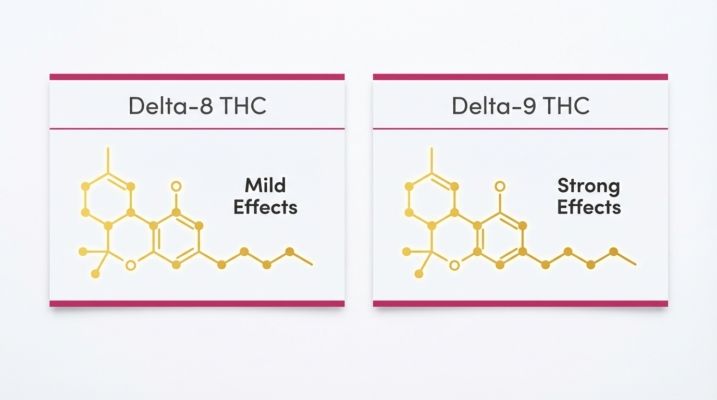
Delta-8 THC is a naturally occurring cannabinoid found in cannabis plants that produces milder…
Learn more
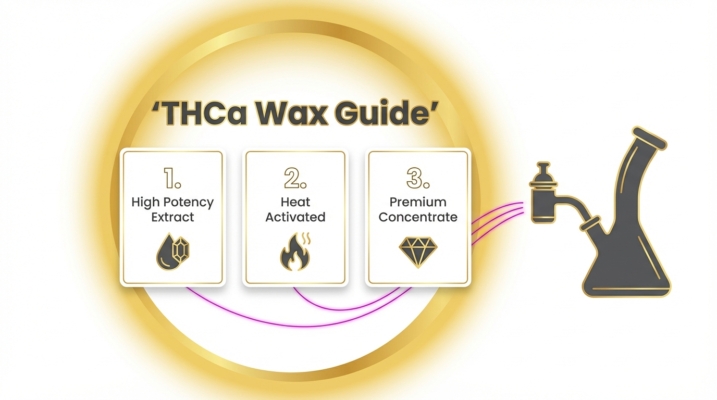
THCa wax is a cannabis concentrate containing high levels of tetrahydrocannabinolic acid in a…
Learn more
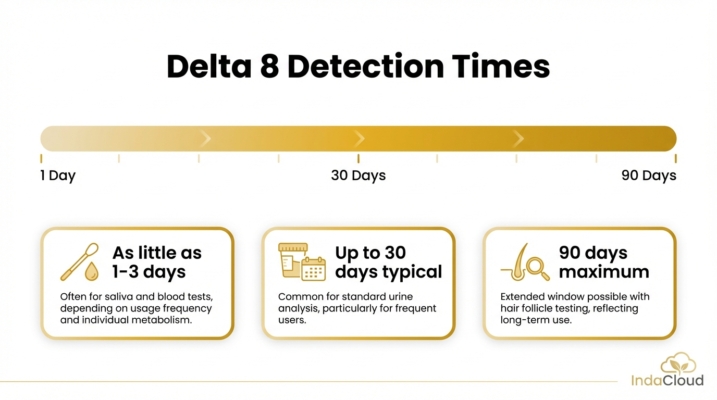
Delta-8 THC is a hemp-derived cannabinoid that stays in your system for as little…
Learn more
