


Blogs

Are THC Gummies Legal? A 2026 State-by-State Guide
Yes, THC gummies are legal to buy in most of the United States right…
Learn more
You must be 21+ to enter this site
 FREE SHIPPING $89+
 FREE GIFT ON $120+
 100% FEDERALLY LEGAL
 LAB TESTED FOR PURITY
FREE SHIPPING $89+
FREE GIFT ON $120+
100% FEDERALLY LEGAL
LAB TESTED FOR PURITY
FREE SHIPPING $89+
FREE GIFT ON $120+
100% FEDERALLY LEGAL
LAB TESTED FOR PURITY
FREE SHIPPING $89+
FREE GIFT ON $120+
100% FEDERALLY LEGAL
LAB TESTED FOR PURITY
FREE SHIPPING $89+
FREE GIFT ON $120+
100% FEDERALLY LEGAL
LAB TESTED FOR PURITY
FREE SHIPPING $89+
FREE GIFT ON $120+
100% FEDERALLY LEGAL
LAB TESTED FOR PURITY
FREE SHIPPING $89+
FREE GIFT ON $120+
100% FEDERALLY LEGAL
LAB TESTED FOR PURITY
FREE SHIPPING $89+
FREE GIFT ON $120+
100% FEDERALLY LEGAL
LAB TESTED FOR PURITY
LAB TESTED FOR PURITY
FREE SHIPPING $89+
FREE GIFT ON $120+
100% FEDERALLY LEGAL
LAB TESTED FOR PURITY
FREE SHIPPING $89+
FREE GIFT ON $120+
100% FEDERALLY LEGAL
LAB TESTED FOR PURITY
FREE SHIPPING $89+
FREE GIFT ON $120+
100% FEDERALLY LEGAL
LAB TESTED FOR PURITY
FREE SHIPPING $89+
FREE GIFT ON $120+
100% FEDERALLY LEGAL
LAB TESTED FOR PURITY
FREE SHIPPING $89+
FREE GIFT ON $120+
100% FEDERALLY LEGAL
LAB TESTED FOR PURITY
FREE SHIPPING $89+
FREE GIFT ON $120+
100% FEDERALLY LEGAL
LAB TESTED FOR PURITY
FREE SHIPPING $89+
FREE GIFT ON $120+
100% FEDERALLY LEGAL
LAB TESTED FOR PURITY

THCA (tetrahydrocannabinolic acid) is the raw, non-psychoactive cannabinoid found naturally in cannabis, while THC (tetrahydrocannabinol) is its psychoactive counterpart produced when heat removes a carboxyl group from THCA’s molecular structure.
This guide covers their chemical relationship and the decarboxylation process, how their effects and therapeutic benefits compare, drug testing and legal implications, consumption methods, and how to choose the right product for your goals.
THCA and THC share nearly identical molecular structures, separated only by a single carboxyl group. That group prevents THCA from binding to CB1 receptors in the brain, which is why raw cannabis produces no high. Heat from smoking, vaping, or baking between 200°F and 245°F strips this group away, converting THCA into active THC within seconds to minutes depending on the method.
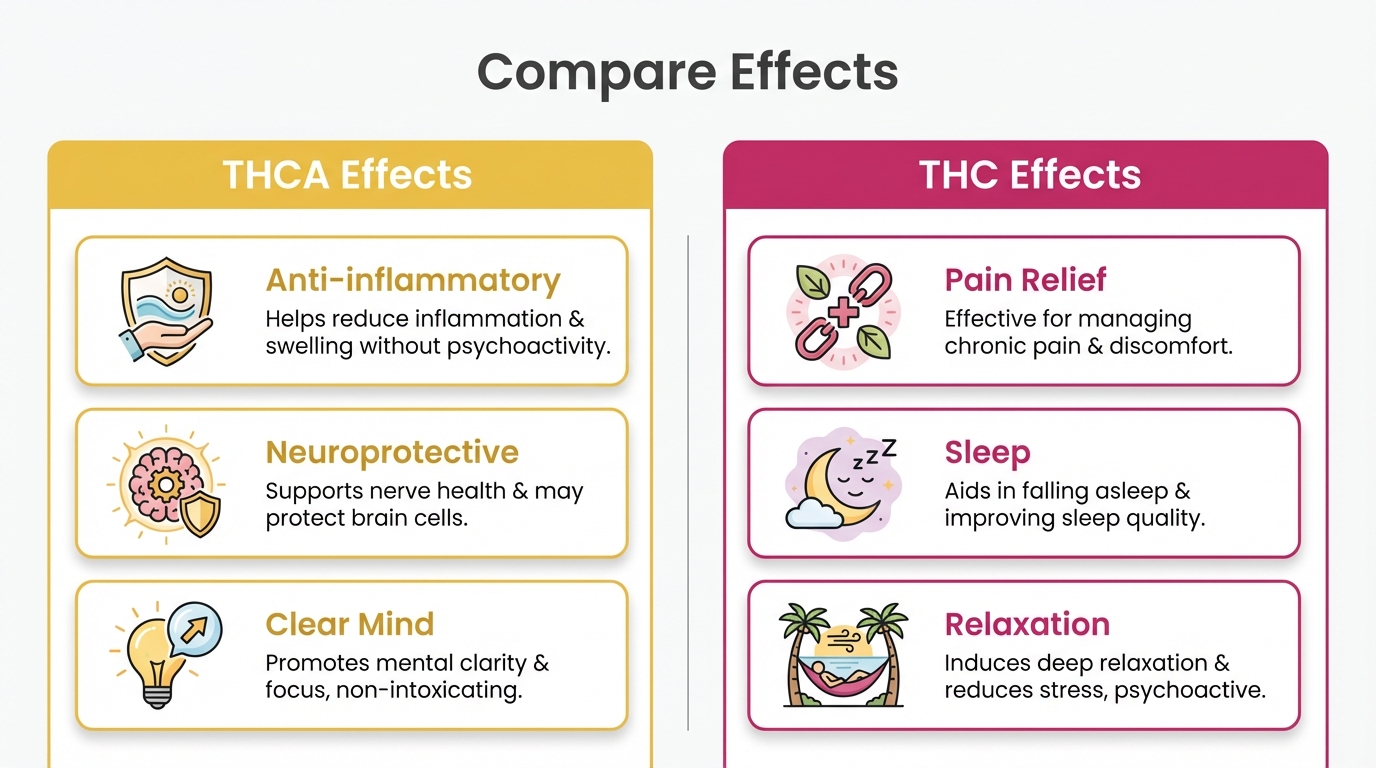
Their effects diverge sharply along the line of psychoactivity. THCA delivers anti-inflammatory, neuroprotective, and anti-nausea benefits while keeping you clear-headed; THC binds directly to CB1 receptors to produce pain relief, sleep support, and stress reduction alongside its characteristic high.
Both compounds can trigger a positive drug test because the body metabolizes THC into THC-COOH, the same metabolite standard urine panels detect. Any THCA product that undergoes heat activation produces this metabolite identically, with detection windows ranging from seven days for single use to a month or longer for chronic consumers.
Legally, hemp-derived THCA is federally compliant under the 2018 Farm Bill when products contain less than 0.3% delta-9 THC. However, some states use total THC testing that counts THCA toward the legal limit, creating a patchwork of regulations that varies significantly by location.
THCA is tetrahydrocannabinolic acid, the naturally occurring precursor to THC found in raw cannabis. It differs from THC chemically by one structural feature: an extra carboxyl group. The sections below cover their molecular formulas, structural relationship, and shared origin in the cannabis plant.
THCA has the molecular formula C22H30O4, while THC has the molecular formula C21H30O2. According to the National Center for Biotechnology Information, THCA (delta-9-tetrahydrocannabinolic acid) carries that additional carboxyl group (COOH) attached to its molecular structure. This extra group is what prevents THCA from binding efficiently to CB1 receptors in the brain, which explains why raw cannabis does not produce a high. When heat removes this carboxyl group through decarboxylation, the molecule loses one carbon atom and one oxygen atom, converting into the smaller, psychoactive THC compound. Although the difference seems minor on paper, that single structural change fundamentally alters how each molecule interacts with the endocannabinoid system. For anyone comparing cannabinoid products, this chemical distinction is the foundation for understanding every other difference between THCA and THC, from their effects to their legal classification.
Understanding decarboxylation reveals exactly how and when this chemical conversion occurs.
Decarboxylation is the process of heating cannabis to activate its compounds by removing a carboxyl group from their molecular structure. Temperature, inhalation methods, cooking, and aging each trigger this conversion differently.
THCA decarboxylation is triggered at temperatures between 200°F and 245°F. According to Leafly, when making edibles, heating buds at 240°F to 250°F for 30 to 40 minutes produces reliable conversion. The relationship between temperature and time is inverse: lower heat requires longer exposure. Decarbing at 220°F can take up to 60 minutes, while 240°F may require 30 minutes or less.
This precision matters because most competitor content glosses over exact temperature and time thresholds. For anyone preparing homemade edibles or infusions, using an oven thermometer helps maintain consistent heat and prevents accidental THC degradation from temperatures that climb too high.
For those seeking precisely dosed THC products without the guesswork of home preparation, lab-tested edibles like Delta 9 gummies provide consistent cannabinoid content verified through third-party testing.
Smoking or vaping converts THCA to THC through instantaneous high-temperature decarboxylation. As Certified Headies explains, smoking and vaping automatically heat THCA enough to convert it to THC, making them decarboxylation methods in their own right.
When a flame or heating element contacts cannabis flower, temperatures exceed 400°F within seconds. That rapid heat strips the carboxyl group from THCA almost immediately, producing THC that enters the lungs as inhalable vapor or smoke. This is why raw cannabis flower produces no psychoactive effect until it is lit or vaporized. For most consumers, inhalation remains the simplest path from THCA to active THC because no preparation or timing is involved.
Cooking or baking converts THCA to THC by applying sustained, moderate heat over an extended period. Oven temperatures used for edibles, typically between 240°F and 350°F, gradually remove the carboxyl group from THCA molecules throughout the baking process.
Most recipes call for a dedicated decarboxylation step before incorporating cannabis into butter or oil. Skipping this step is one of the most common mistakes home edible makers encounter, often resulting in weak or inconsistent potency. Infusing decarbed flower into a fat source also improves absorption, since THC is fat-soluble. Controlled, even heat distribution produces more predictable results than relying on the baking process alone.
Yes, THCA converts to THC over time through aging, though the process is extremely slow compared to heat-based methods. Prolonged exposure to light, air, and ambient warmth gradually breaks down the carboxyl group in THCA molecules without any deliberate heating.
This natural degradation is why improperly stored cannabis flower may test higher in THC and lower in THCA than when it was originally harvested. Over extended periods, THC itself further degrades into CBN, a less psychoactive cannabinoid associated with sedation. Proper storage in airtight, light-proof containers at cool temperatures slows both conversions, preserving the original cannabinoid profile for longer.
Understanding how each conversion method works helps clarify the practical differences between THCA and THC in everyday use.
The effects of THCA and THC differ primarily in psychoactivity. THCA produces therapeutic benefits without intoxication, while THC creates the characteristic cannabis “high.” The following sections break down what each compound does and whether THCA can get you high.
THCA produces anti-inflammatory, neuroprotective, anti-convulsant, and anti-seizure effects without decarboxylation. Because THCA retains its carboxyl group in raw form, it does not bind effectively to CB1 receptors in the brain, so no psychoactive response occurs.
According to a 2017 study published in the National Center for Biotechnology Information, THCA-A does not elicit psychoactive effects in humans, and its pharmacological value is often neglected for this reason. This makes THCA a preferred option for patients who need to remain clear-headed and functional throughout the day. Terpenes and cannabinoids also work together in raw cannabis to produce a broader range of non-intoxicating effects. For anyone prioritizing therapeutic support without cognitive impairment, THCA in its unheated form offers a compelling profile.
THC produces psychoactive effects commonly known as a “high,” which are subjective and vary among individuals and consumption methods. Common effects include altered senses, such as seeing brighter colors, along with a distorted sense of time.
THC activates CB1 receptors concentrated in the brain and central nervous system, directly influencing mood, memory, pain perception, appetite, and motor function. According to research from the University of Illinois Chicago, low levels of THC reduce stress, but this effect is highly dose-dependent; higher doses can increase anxiety instead. THC can also elevate arousal and confusion. This dose sensitivity is something many consumers underestimate, and it remains one of the strongest arguments for starting with lower-potency products when exploring THC for the first time.
No, THCA cannot get you high the same way THC does. THCA lacks psychoactive properties because its molecular structure prevents it from effectively binding to CB1 receptors in the brain. Only after decarboxylation, when heat removes the carboxyl group and converts THCA into THC, does the compound produce intoxicating effects.
Choosing between THCA and THC ultimately depends on individual goals and lifestyle preferences. If staying clear-headed is the priority, THCA is the better choice. If a psychoactive experience is the goal, THC is the compound to seek out. This distinction is foundational for making informed product decisions, especially since many hemp flower products contain high levels of THCA that will convert to THC once smoked or vaped.
The potential benefits and uses of THCA span anti-inflammatory support, nausea relief, and neuroprotection. Each area is backed by emerging preclinical research, covered below.
THCA might support anti-inflammatory responses by modulating pathways linked to swelling and tissue damage. According to a 2020 study published in the National Center for Biotechnology Information, Δ9-THCA-A reduced arthritis in collagen-induced arthritis mice, preventing the infiltration of inflammatory cells, synovium hyperplasia, and cartilage damage. These preclinical findings suggest THCA could hold promise for inflammatory conditions such as:
Because THCA does not produce psychoactive effects, it offers a compelling option for individuals seeking anti-inflammatory support while remaining fully functional throughout the day.
THCA might help with nausea and appetite by interacting with receptors involved in gastrointestinal regulation. According to a 2013 study published in the National Center for Biotechnology Information, THCA may be a more desirable therapeutic treatment for nausea and vomiting than THC because it is both more potent and devoid of psychoactive properties. This distinction matters for patients undergoing chemotherapy or managing chronic digestive conditions who need relief without cognitive impairment. For anyone prioritizing clear-headedness alongside symptom management, THCA represents one of the more practical cannabinoid options currently under investigation.
THCA is being studied for neuroprotective properties through research focused on neurodegenerative and neuroinflammatory diseases. According to a 2017 study published in the National Library of Medicine, Δ9-THCA shows potent neuroprotective activity worth considering for the treatment of Huntington’s disease and possibly other neurodegenerative conditions. Researchers have also identified potential applications for conditions such as multiple sclerosis, Alzheimer’s disease, and Parkinson’s disease. Much of this work remains preclinical, yet the early results are promising enough to warrant continued investigation. With both anti-inflammatory and neuroprotective activity identified, THCA’s therapeutic profile raises important questions about how it compares to the benefits THC offers.
The potential benefits and uses of THC span pain relief, sleep support, and stress reduction. Each application depends on dosage, method of consumption, and individual response.
THC helps with pain management by interacting with CB1 receptors in the brain and central nervous system, which play a direct role in regulating pain signaling. This interaction can reduce the perception of discomfort, particularly for individuals dealing with nerve-related conditions. According to the Centers for Disease Control and Prevention, a few studies have found that cannabis can be helpful in treating neuropathic pain, a specific type of chronic pain caused by damaged nerves. Neuropathic pain is notoriously difficult to treat with conventional medications, which makes THC a noteworthy option for those who have not responded well to standard approaches. For anyone exploring cannabinoid-based pain support, starting with a low dose remains the most practical strategy.
THC affects sleep and relaxation by binding to CB1 receptors that regulate mood and motor function, promoting a calming effect that can ease the transition into rest. Many users report falling asleep faster and experiencing fewer nighttime disruptions after consuming THC in controlled amounts. Research published by the National Center for Biotechnology Information indicates that current evidence suggests cannabis may have a beneficial effect in sleep disorders and may improve patient-reported sleep scores. The method of consumption matters here; edibles tend to produce longer-lasting sedative effects compared to inhalation, though onset is slower. For individuals whose restlessness stems from racing thoughts or physical tension, even a modest dose can make a meaningful difference in overall sleep quality.
THC is used for stress and mood support through its dose-dependent influence on the endocannabinoid system. At low doses, THC can promote a sense of calm by modulating neurotransmitter activity tied to anxiety and emotional regulation. A study from the University of Illinois Chicago found that low levels of THC reduce stress, but in a highly dose-dependent manner, meaning higher doses can actually increase anxiety rather than relieve it. This finding underscores why careful dosing is essential when using THC for mood-related purposes. Choosing the right product format and starting conservatively allows users to find their personal threshold without overcorrecting.
With THC’s therapeutic potential established, understanding how both THCA and THC interact with drug testing adds an important practical layer.
THCA and THC show up on a drug test differently, but both can lead to a positive result. Standard screening panels, detection windows, and the role of metabolites determine the outcome.
Most standard drug tests are not checking for THCA directly. They target THC and its metabolites, especially THC-COOH, which remains in the body for a longer period. This distinction matters because THCA itself is non-psychoactive, yet any conversion to THC before or during consumption produces the same metabolite that triggers a positive result.
According to Nashville Treatment Solutions, standard urine drug tests screen specifically for THC-COOH rather than the parent cannabinoid. Once THCA converts to THC through heating, smoking, or even partial degradation over time, the body metabolizes it into THC-COOH. This metabolite accumulates in fat tissue and releases slowly, which is why detection windows extend well beyond the last use.
For anyone consuming THCA products through methods that involve heat, such as vaping or smoking, the conversion to THC is immediate. The body then processes THC identically regardless of whether it originated from THCA flower or traditional THC products. Even raw THCA consumption carries some risk, since small amounts of natural decarboxylation can occur during storage and handling.
Detection timelines vary based on frequency of use:
For anyone facing a drug test, the practical takeaway is straightforward: THCA products that undergo any form of heat activation will produce the same metabolite that standard panels detect. Planning ahead and understanding these detection windows is essential for making informed decisions about consumption timing.
The legal status of THCA vs THC in the U.S. depends on federal hemp definitions and individual state regulations. Federal law treats hemp-derived THCA differently from delta-9 THC, but this distinction creates significant gray areas.
THCA is legal under the 2018 Farm Bill when derived from hemp containing less than 0.3% delta-9 THC on a dry weight basis. The bill defines hemp as any part of the cannabis plant, or its derivatives, that meets this THC threshold. Because THCA is chemically distinct from delta-9 THC, hemp-derived THCA products technically comply with federal law.
However, this compliance creates a notable loophole. According to Vicente Sederberg LLP, THCA flower is hemp that looks and functions like marijuana but falls into a legal gray area under increasingly broad interpretations of the law by the DEA and some federal courts. Since THCA converts to psychoactive THC when heated, the practical distinction between legal THCA flower and illegal marijuana becomes razor-thin. This is one of the most misunderstood aspects of cannabinoid law, and consumers should never assume federal legality guarantees protection everywhere.
State laws differ on THCA and THC significantly, with some states adopting total THC testing that counts THCA toward the legal limit. States like Oregon, Montana, and Hawaii use total THC calculations, which include the potential THC yield from THCA after decarboxylation. Under these frameworks, high-THCA hemp flower can exceed the legal threshold and be classified as marijuana.
Other states follow the federal standard, testing only for delta-9 THC content. This patchwork means a THCA product legal in one state may be prohibited in a neighboring one. Before purchasing or traveling with any THCA product, checking current state-specific regulations is essential.
THCA does become subject to stricter legal classification once it converts to THC through decarboxylation. Raw THCA in unheated form qualifies as a legal hemp derivative under federal law. The moment heat transforms it into delta-9 THC, the resulting compound falls under controlled substance regulations if it exceeds the 0.3% threshold.
This conversion is precisely why the legal status of THCA remains contentious. A product can be sold legally as hemp, yet the consumer’s act of smoking or vaping it produces a substance regulated differently. For anyone navigating this landscape, understanding that legality hinges on the compound’s state at the point of testing, not at the point of consumption, is critical.
Understanding these legal distinctions helps inform which cannabinoid products best fit your needs and location.
The most common ways to consume THCA vs THC depend on whether you want to preserve the raw, non-psychoactive compound or activate it into its psychoactive form. Raw methods, edibles, and vapes each serve different purposes.
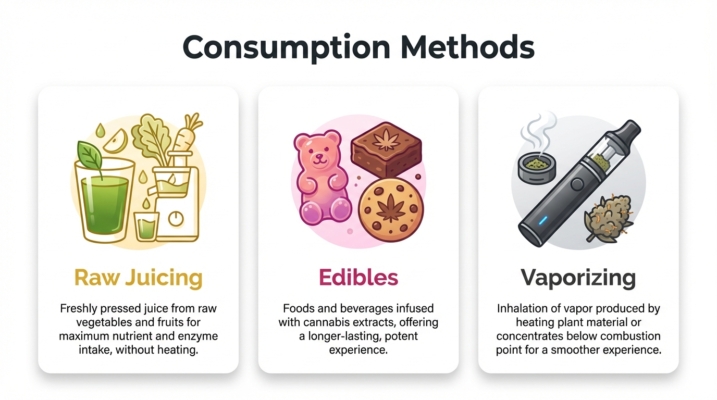
Raw cannabis flower is used for THCA consumption through methods that avoid heat, preserving the cannabinoid’s non-psychoactive molecular structure. The most popular approaches include:
According to Hemp-Flower.com, juicing represents one of the most effective THCA consumption methods for maximizing bioavailability and therapeutic potential. Because no decarboxylation occurs, the THCA remains intact, delivering its anti-inflammatory and neuroprotective properties without producing a high. For anyone seeking functional wellness benefits from cannabis, raw consumption is arguably the most underutilized method available.
Edibles are used for THC consumption by incorporating decarboxylated cannabis into food products, which activates THCA into THC before ingestion. Common edible formats include:
Oral bioavailability of THC is notably lower than inhalation, ranging from 6%±3% in food products to 10–20% with cannabis extracts. This lower absorption rate means edibles produce a delayed onset, typically 30 to 90 minutes, but effects last significantly longer than inhaled methods. Precise dosing matters here more than with any other consumption format, since overconsumption is the most common mistake new edible users make.
Vapes are used for both THCA and THC by heating cannabis concentrates or flower to temperatures that trigger instant decarboxylation, converting THCA into THC upon inhalation. This makes vaping a dual-purpose method: the product starts as THCA but delivers THC effects.
Inhaled THC achieves a bioavailability of 10% to 35%, considerably higher than oral consumption. Effects onset within minutes, making vapes the fastest-acting delivery method for both compounds. Vape cartridges and disposable pens offer precise temperature control, which influences the ratio of cannabinoids and terpenes released with each draw.
Consumers looking for convenient vape options can find strain-specific Delta 8 cartridges and high-potency disposable pens that provide fast-acting effects with consistent cannabinoid profiles verified through comprehensive lab testing.
For consumers who want rapid psychoactive effects from THCA flower, vaping is the most efficient conversion method available. With consumption methods clarified, choosing the right product becomes the next practical decision.
You choose between THCA and THC products by matching each compound to your goals, lifestyle, and sensitivity to psychoactive effects. The sections below cover who benefits most from THCA, who should reach for THC, and what lab testing details matter before purchasing.
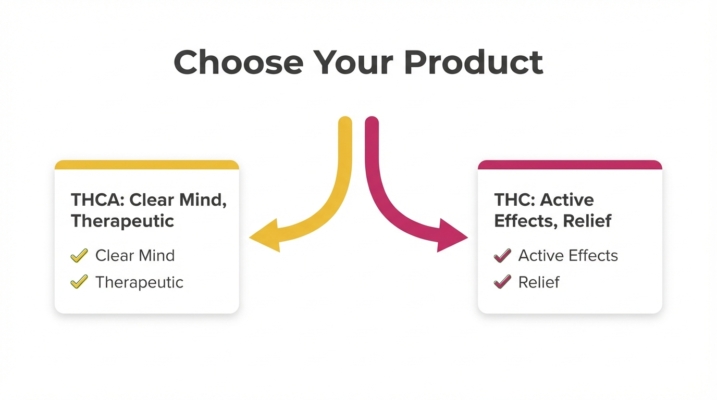
You should consider THCA over THC if you need therapeutic support without intoxication. THCA delivers anti-inflammatory, neuroprotective, and anti-nausea benefits while keeping you clear-headed and functional throughout the day. This makes it well suited for several user profiles:
For daily wellness routines where mental clarity is non-negotiable, THCA is often the more practical starting point.
You should consider THC over THCA if you are seeking psychoactive effects or specific symptom relief that benefits from CB1 receptor activation. THC binds directly to CB1 receptors in the brain and central nervous system, producing effects that THCA cannot replicate in its raw form. According to a University of Illinois Chicago study, low-dose THC reduces stress in a highly dose-dependent manner.
THC is a stronger fit for these situations:
Because dosing sensitivity varies widely between individuals, starting low and increasing gradually remains the safest approach for anyone new to THC products.
You should look for a current Certificate of Analysis from an accredited third-party laboratory. This document confirms cannabinoid potency, terpene profiles, and the absence of contaminants such as pesticides, heavy metals, and residual solvents. Key details to verify include:
Potency labels without verifiable lab reports are a red flag. With the right documentation in hand, selecting a product that aligns with your desired experience becomes far more straightforward.
You can explore hemp-derived THCA and THC products by choosing a trusted retailer that provides third-party lab testing and clear cannabinoid labeling. The sections below cover how Inda Cloud supports this process and the essential takeaways from the THCA vs THC comparison.
Yes, Inda Cloud’s lab-tested hemp products can help you experience both THCA and THC. IndaCloud offers a curated selection of hemp-derived options, including THCa flower, Delta 9 edibles, Delta 8 vapes, and pre-rolls, all containing less than 0.3% delta-9 THC to meet federal compliance under the 2018 Farm Bill. Every product undergoes comprehensive third-party testing for potency and purity, with lab reports available to consumers. Whether you prefer raw THCa flower for its non-psychoactive therapeutic properties or Delta 9 gummies for a controlled psychoactive experience, IndaCloud provides clearly labeled products organized by cannabinoid type, desired effect, and potency level. The brand serves over 250,000 verified customers with convenient, discreet delivery across the continental United States.
The key takeaways about THCA vs THC center on their distinct chemical properties, effects, and legal classifications:
Choosing between THCA and THC ultimately depends on whether you prioritize staying clear-headed or seeking a psychoactive experience. Regardless of your preference, selecting lab-tested products from a transparent source like IndaCloud ensures both quality and compliance.
Yes, THC gummies are legal to buy in most of the United States right…
Learn more
Raw, unheated THCA clears your system in roughly 24 to 48 hours. Once you…
Learn more
Yes, edibles show up on drug tests. Standard panels detect THC edibles exactly the…
Learn more
THCP binds cannabinoid receptors roughly 33 times harder than THC in lab testing. THCA,…
Learn more
