



Blogs

Are THC Gummies Legal? A 2026 State-by-State Guide
Yes, THC gummies are legal to buy in most of the United States right…
Learn more
You must be 21+ to enter this site
 FREE SHIPPING $89+
 FREE GIFT ON $120+
 100% FEDERALLY LEGAL
 LAB TESTED FOR PURITY
FREE SHIPPING $89+
FREE GIFT ON $120+
100% FEDERALLY LEGAL
LAB TESTED FOR PURITY
FREE SHIPPING $89+
FREE GIFT ON $120+
100% FEDERALLY LEGAL
LAB TESTED FOR PURITY
FREE SHIPPING $89+
FREE GIFT ON $120+
100% FEDERALLY LEGAL
LAB TESTED FOR PURITY
FREE SHIPPING $89+
FREE GIFT ON $120+
100% FEDERALLY LEGAL
LAB TESTED FOR PURITY
FREE SHIPPING $89+
FREE GIFT ON $120+
100% FEDERALLY LEGAL
LAB TESTED FOR PURITY
FREE SHIPPING $89+
FREE GIFT ON $120+
100% FEDERALLY LEGAL
LAB TESTED FOR PURITY
FREE SHIPPING $89+
FREE GIFT ON $120+
100% FEDERALLY LEGAL
LAB TESTED FOR PURITY
LAB TESTED FOR PURITY
FREE SHIPPING $89+
FREE GIFT ON $120+
100% FEDERALLY LEGAL
LAB TESTED FOR PURITY
FREE SHIPPING $89+
FREE GIFT ON $120+
100% FEDERALLY LEGAL
LAB TESTED FOR PURITY
FREE SHIPPING $89+
FREE GIFT ON $120+
100% FEDERALLY LEGAL
LAB TESTED FOR PURITY
FREE SHIPPING $89+
FREE GIFT ON $120+
100% FEDERALLY LEGAL
LAB TESTED FOR PURITY
FREE SHIPPING $89+
FREE GIFT ON $120+
100% FEDERALLY LEGAL
LAB TESTED FOR PURITY
FREE SHIPPING $89+
FREE GIFT ON $120+
100% FEDERALLY LEGAL
LAB TESTED FOR PURITY
FREE SHIPPING $89+
FREE GIFT ON $120+
100% FEDERALLY LEGAL
LAB TESTED FOR PURITY

Delta 8 THC dosage is the specific milligram amount of this hemp-derived cannabinoid consumed per session, and getting it right determines whether your experience is comfortable, effective, or overwhelming. Because Delta 8 operates at roughly half the potency of Delta 9 THC, precise dosing requires its own framework.
This guide covers starting doses and experience-level recommendations, product-specific dosing strategies, the individual factors that shift your ideal amount, how CBD modulates Delta 8’s effects through receptor-level interactions, and sourcing lab-tested products you can trust.
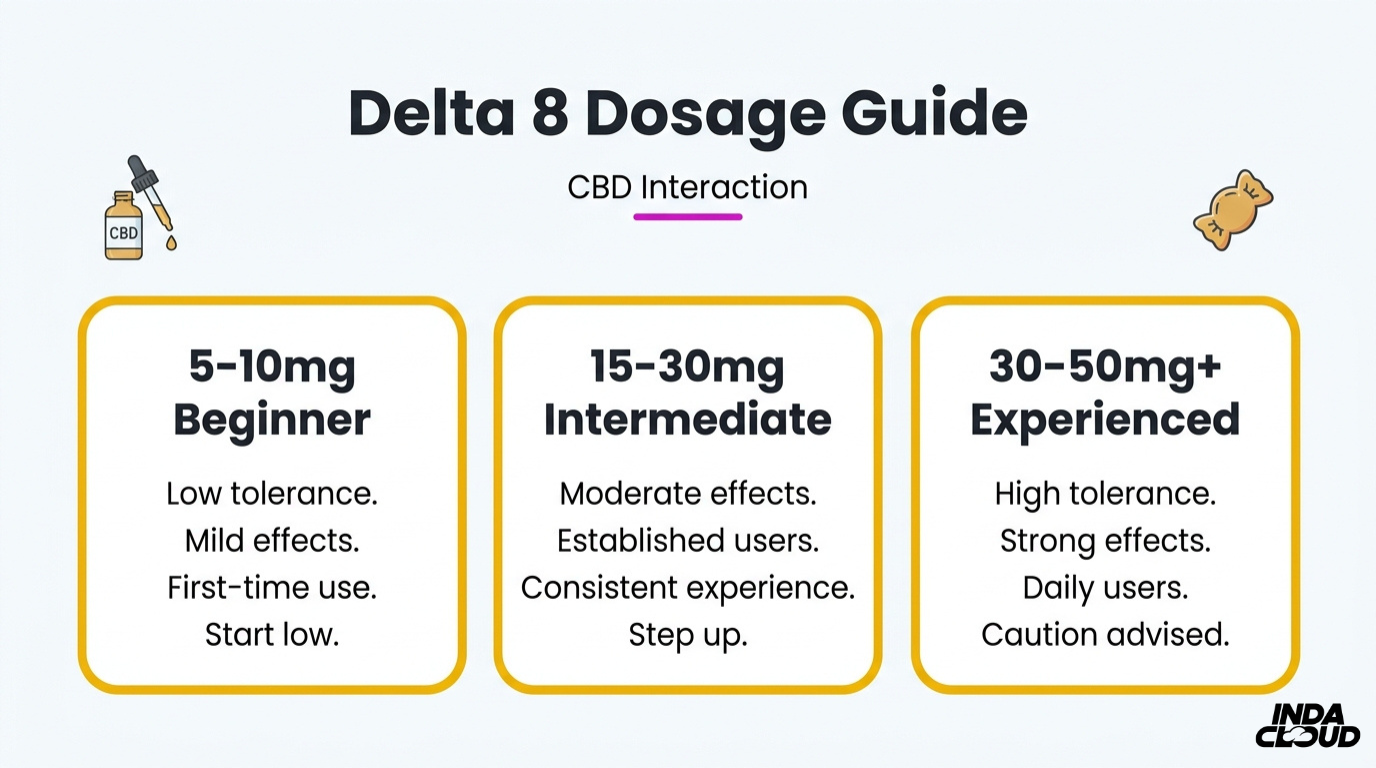
Beginners benefit from a 5 to 10 mg starting dose, while intermediate users typically settle between 15 and 30 mg and experienced consumers work within 30 to 50 mg or higher. Each tier builds on personal response data rather than guesswork.
Dosage changes meaningfully across product types. Edibles require patience through a 60 to 90 minute onset window, vapes deliver near-instant effects that demand cautious puff-by-puff titration, and tinctures offer a middle ground with sublingual absorption in 15 to 30 minutes.
Body weight, metabolism, tolerance, and desired outcome all influence how a given dose feels. Heavier individuals and faster metabolisms process Delta 8 differently, which is why two people taking identical milligrams can report vastly different experiences.
CBD functions as a negative allosteric modulator of CB1 receptors, softening Delta 8’s psychoactive intensity without eliminating it. Specific ratios serve distinct goals: CBD-dominant blends support focus and calm, balanced 1:1 ratios target mild discomfort, and Delta 8-dominant ratios promote sleep.
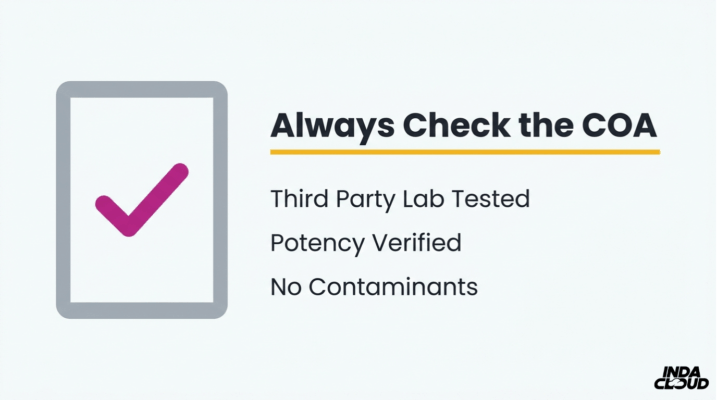
Verified third-party lab testing through a Certificate of Analysis remains the single most important factor in product safety, confirming potency and screening for contaminants like heavy metals and residual solvents.
Delta 8 THC is a naturally occurring cannabinoid found in hemp that produces milder psychoactive effects than its more well-known cousin, Delta 9 THC. Dosage matters because Delta 8’s unique potency profile means the amount you consume directly shapes your experience, from gentle relaxation to stronger euphoria.
As a partial agonist of CB1 and CB2 receptors, Delta 8 THC exhibits approximately half the potency of Delta 9 THC in most measures of biological activity, according to a 2022 review published in the National Library of Medicine. This reduced potency is precisely why dialing in the right dose is so critical. Taking too little may produce no noticeable effect, while taking too much can lead to unwanted side effects like anxiety, dizziness, or confusion.
Delta 8 THC binds to the CB1 receptor in the central nervous system, producing potential anxiolytic, analgesic, and appetite-stimulating effects. Because the compound is highly lipophilic, it accumulates in fat tissues and has a long terminal half-life. This means effects from a single dose, particularly edibles, can build slowly and linger longer than expected if you overconsume.
Proper dosing also matters from a safety perspective. Getting your dose right from the start helps you enjoy Delta 8’s benefits while minimizing risk, making a thoughtful approach to dosage the foundation of every positive experience.
Delta 8 THC dosage is measured in milligrams (mg) of active Delta 8 THC per serving. Product labels, lab reports, and certificates of analysis specify this concentration, making milligrams the universal unit across edibles, vapes, tinctures, and flower. Understanding how to read these measurements ensures accurate, consistent dosing.
Every Delta 8 product lists its total milligram content alongside a per-serving amount. A 500 mg gummy package containing 20 pieces, for example, delivers 25 mg per gummy. Vape cartridges express potency as a percentage of Delta 8 THC by total weight, while tinctures measure milligrams per dropper or per milliliter. According to a report published in Frontiers in Toxicology, a Certificate of Analysis from a third-party laboratory is essential for verifying cannabinoid potency and testing for contaminants such as residual solvents, heavy metals, and pesticides.
Key measurements to check on any Delta 8 product include:
Relying solely on “number of gummies” or “number of puffs” without knowing the milligram content per serving leads to inconsistent experiences. For anyone building a reliable routine, milligram-based tracking is far more dependable than counting servings alone. With dosage measurement clarified, the next step is identifying the right starting dose for your experience level.
A good starting Delta 8 dose for beginners is 5 to 10 mg. According to the Journal of Cannabis Research, this range is recommended for beginners or those with low tolerance. Starting low allows your body to gauge its individual response before increasing the amount.
Because Delta 8 affects everyone differently, factors like body weight, metabolism, and prior cannabinoid experience all play a role in how even a small dose feels. First-time users should wait at least two hours after an edible dose before considering more, since oral onset is notably slower than inhalation. For most newcomers, 5 mg offers a mild, manageable introduction, while 10 mg provides a slightly more noticeable effect. Patience at this stage helps avoid overconsumption and builds a reliable baseline for future adjustments.
The amount of Delta 8 you should take based on experience level ranges from 5–10 mg for beginners to 50 mg or more for experienced users. The following subsections break down recommended doses for first-time, intermediate, and experienced consumers.
A first-time user should take 5–10 mg of Delta 8 THC. This low starting dose allows your body to gauge its sensitivity to the cannabinoid without overwhelming effects. Because Delta 8 is a partial agonist of CB1 receptors with roughly half the potency of Delta 9 THC, even modest amounts can produce noticeable relaxation and mild euphoria.
Start with a single 5 mg serving, especially with edibles, where onset may take one to two hours. Wait at least three hours before considering a second dose. Keeping a simple log of milligrams consumed and effects felt helps establish a personal baseline for future sessions.
An intermediate user should take 15–30 mg of Delta 8 THC per session. At this level, consumers who have used Delta 8 several times already understand how their body responds, and a moderate dose delivers more pronounced relaxation, mood elevation, and body comfort.
Intermediate users can consider the following approach:
Tolerance builds gradually with regular use, so periodic reassessment keeps dosing efficient. For most intermediate consumers, staying within the 15–30 mg window balances effectiveness with a comfortable experience.
An experienced user should take 30–50 mg or more of Delta 8 THC, depending on individual tolerance and desired intensity. Seasoned consumers have a well-established understanding of their personal response, which allows for higher, more targeted dosing.
Even at advanced levels, increasing dose gradually remains important. According to a study published in the National Library of Medicine (PMC), a dose-response relationship exists between ingested Delta 8 THC dose and medical outcome severity, with a median dose of 4.1 mg/kg associated with minor adverse effects. This reinforces the value of incremental adjustments rather than large jumps.
Experienced users benefit most from consistent product sourcing and verified lab results, since potency variations between batches can significantly shift the actual milligrams consumed. Understanding your personal Delta 8 response at each product type helps maintain reliable sessions as dosing increases.
Delta 8 dosage differs by product type because each delivery method has a unique bioavailability, onset time, and duration. The sections below cover optimal dosing for edibles, vapes, tinctures, and flower or pre-rolls.
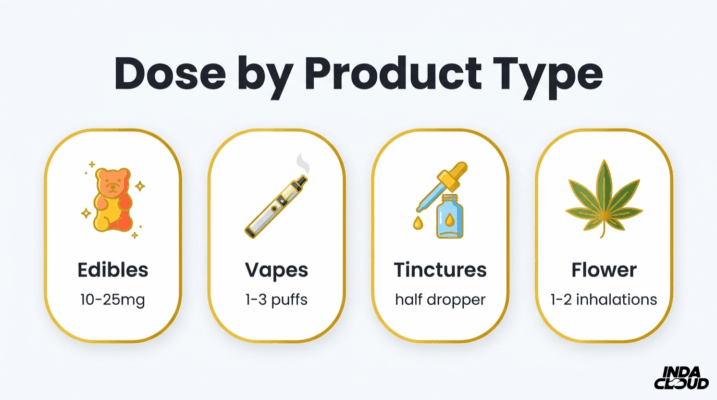
You should take 10 to 25 mg of Delta 8 in edibles as a standard starting range, adjusting based on experience level. Beginners benefit from starting at the lower end, around 10 mg, then increasing gradually.
Edibles pass through the digestive system before reaching the bloodstream, which delays onset to roughly 60 to 90 minutes. Because effects build slowly, waiting at least two hours before taking more prevents accidental overconsumption. The trade-off for that slower onset is a longer-lasting experience, often four to eight hours. For anyone new to Delta 8 edibles, patience during that initial window is the single most important dosing habit to develop.
You should take one to three puffs of Delta 8 when vaping, then wait five to ten minutes before inhaling more. Vaping delivers Delta 8 directly through lung tissue into the bloodstream, producing effects within minutes.
This rapid onset makes it easier to titrate your dose in real time; however, it also means overconsumption can happen quickly if you chain multiple draws without pausing. Effects from vaping typically last one to three hours, shorter than edibles. Because potency varies between cartridges and disposable pens, always check the milligram-per-puff estimate on the product label. Starting low and building incrementally remains the safest approach, especially with high-potency vape hardware.
You should take half a dropper (roughly 10 to 15 mg) of Delta 8 in tinctures as a practical starting dose. Tinctures offer a middle ground between edibles and vapes in both onset speed and duration.
When held under the tongue for 30 to 60 seconds, sublingual absorption allows Delta 8 to enter the bloodstream faster than digestion, typically within 15 to 30 minutes. Swallowing immediately shifts the tincture toward an edible-like timeline. Most tincture bottles list total milligrams per bottle and per milliliter, making precise dose calculation straightforward. This measurability gives tinctures a practical advantage for users who want consistent, repeatable dosing without guesswork.
You should take one to two small inhalations of Delta 8 flower or pre-rolls, then wait several minutes to gauge the effect. Like vaping, smoking delivers cannabinoids through the lungs, so onset is nearly immediate.
Dosing flower is less precise than other formats because Delta 8 concentration varies by strain and even by section of the bud. According to the National Library of Medicine, Delta-8-THC is a partial agonist of CB1 and CB2 receptors with approximately half the potency of Delta-9-THC in most measures of biological activity. That lower potency gives users a wider margin, yet the lack of standardized per-puff milligram counts still makes cautious, incremental inhalation essential.
With product-specific dosing strategies in place, understanding the broader factors that influence your ideal dose adds another layer of precision.
Your ideal Delta 8 dosage is influenced by body weight, tolerance level, metabolism, and desired effects. Each factor shifts how your body processes and responds to Delta 8 THC, making personalized dosing essential.
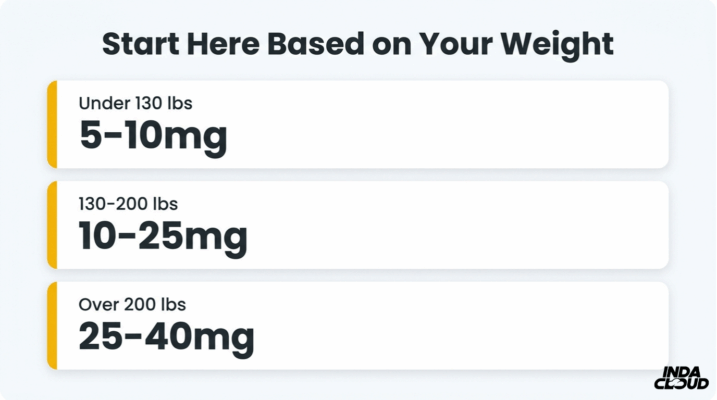
Body weight affects Delta 8 dosage because cannabinoids are lipophilic compounds that distribute through fat and tissue based on body composition. Heavier individuals generally require higher doses to achieve the same concentration of Delta 8 THC in the bloodstream, while lighter individuals tend to feel effects at lower doses.
A practical starting framework for oral Delta 8 dosing by body weight includes:
These ranges serve as starting points only. Because Delta 8 THC is highly lipophilic (log P of 7.4), it accumulates in fat tissues, which means body fat percentage can matter as much as total weight. Individuals with higher body fat may experience a slower onset but longer-lasting effects due to this tissue accumulation.
Tolerance level changes the right Delta 8 dose significantly, as regular cannabinoid use causes CB1 receptor downregulation, requiring progressively higher amounts to achieve the same effects. Someone with no prior THC exposure will respond to doses that a daily user barely notices.
Tolerance develops through repeated activation of CB1 receptors. In a within-subject cross-over trial published in Drug and Alcohol Dependence, whole blood Delta 8 THC concentrations peaked between 2 and 4 hours post-oral dose, with the psychoactive 11-OH-Delta-8-THC metabolite reaching peak levels faster than the parent compound. This pharmacokinetic profile means tolerance affects not just intensity but also how quickly and for how long you feel effects. For anyone noticing diminished results, a tolerance break of 48 to 72 hours can partially reset CB1 receptor sensitivity.
Your metabolism impacts Delta 8 effects by determining how quickly your body converts the parent compound into its active metabolites. Delta 8 THC is metabolized in the liver primarily by the CYP450 enzyme system, where CYP2C9 handles 11-hydroxylation and CYP3A4 handles 7-hydroxylation.
Individuals with faster metabolic rates process Delta 8 more quickly, often experiencing a faster onset, stronger peak, and shorter duration. Slower metabolisms produce a more gradual, extended experience. Several factors influence this metabolic speed:
This is why two people taking identical doses can report vastly different experiences.
Desired effects shape your Delta 8 dose because a clear dose-response relationship exists between the amount consumed and the intensity of outcomes. According to a study published in the National Library of Medicine, a median dose of 4.1 mg/kg was associated with minor adverse effects in reported cases, confirming that higher milligram-per-kilogram doses produce stronger, sometimes unwanted, reactions.
Matching dose to intention is straightforward:
Starting at the low end of your target range and increasing gradually remains the safest approach. With these individual factors understood, the next step is recognizing what happens when dosing goes too high.
If you take too much Delta 8 THC, you may experience a range of uncomfortable side effects that vary in severity based on the dose consumed. Common symptoms reported in overconsumption cases include:
According to America’s Poison Centers, from 2021 to 2025, U.S. Poison Centers managed 10,434 Delta-8 THC-related exposure cases, with symptoms including hallucinations, vomiting, tremor, anxiety, dizziness, confusion, and loss of consciousness. Research published in the National Library of Medicine also confirms that a dose-response relationship exists between ingested Delta-8 THC dose and medical outcome severity, with a median dose of 4.1 mg/kg associated with minor adverse effects.
These effects are typically temporary and resolve as the compound is metabolized. However, because Delta-8 THC is highly lipophilic and accumulates in fat tissues, the discomfort from an excessive oral dose can persist for several hours. If symptoms become severe, contacting a poison control center or seeking medical attention is the safest course of action. Starting low and increasing gradually remains the most reliable way to avoid overconsumption, especially with edibles where onset is delayed.
Understanding how to manage overconsumption sets the stage for exploring how CBD may help moderate Delta 8’s effects.
CBD interacts with Delta 8 THC primarily through receptor-level modulation in the endocannabinoid system. The subsections below cover how CBD tempers psychoactive intensity, amplifies wellness potential, and contributes to the entourage effect.
Yes, CBD can reduce the psychoactive effects of Delta 8. CBD functions as a negative allosteric modulator of the CB1 receptor, meaning it changes the receptor’s shape so Delta 8 THC binds less efficiently. According to a study published in the British Journal of Pharmacology, CBD’s non-competitive allosteric action at CB1 decreases the binding affinity and potency of THC agonists, including Delta 8 THC.
In practical terms, this means adding CBD to a Delta 8 session can soften the high without eliminating it entirely. Users prone to THC-related anxiety often find that a balanced ratio keeps the experience manageable. For anyone exploring Delta 8 for the first time, pairing it with CBD offers a useful safety net.
Yes, CBD can enhance the wellness benefits of Delta 8 by contributing its own distinct pharmacological properties. Delta 8 THC binds CB1 and CB2 receptors to produce analgesic, anxiolytic, and appetite-stimulating effects, while CBD supports the endocannabinoid system through separate pathways involving serotonin and TRPV1 receptors.
When combined, these two cannabinoids address overlapping yet distinct mechanisms. CBD’s calming influence may extend Delta 8’s relaxation window, and its anti-inflammatory activity can complement Delta 8’s pain-modulating properties. This layered approach often delivers broader relief than either cannabinoid provides alone, making combination products increasingly popular among wellness-focused consumers.
The entourage effect between Delta 8 and CBD is the synergistic interaction where multiple cannabinoids, terpenes, and plant compounds work together to produce effects greater than any single compound alone. Rather than competing, Delta 8 and CBD occupy complementary roles: Delta 8 activates CB1 receptors for mood and comfort, while CBD modulates that activation and engages additional receptor systems.
This cooperative dynamic is why full-spectrum and broad-spectrum products often feel more balanced than isolate-based alternatives. Clinical cannabis formulations frequently leverage specific THC-to-CBD ratios to optimize this synergy for targeted outcomes. For users dialing in their ideal Delta 8 experience, understanding the entourage effect helps explain why ratio selection matters.
The best Delta 8 to CBD ratio depends on the specific effect you want to achieve. Ratios higher in CBD promote calm and clarity, while ratios favoring Delta 8 deliver stronger psychoactive results. The following sections break down ideal ratios for relaxation, focus, sleep, and mild discomfort.
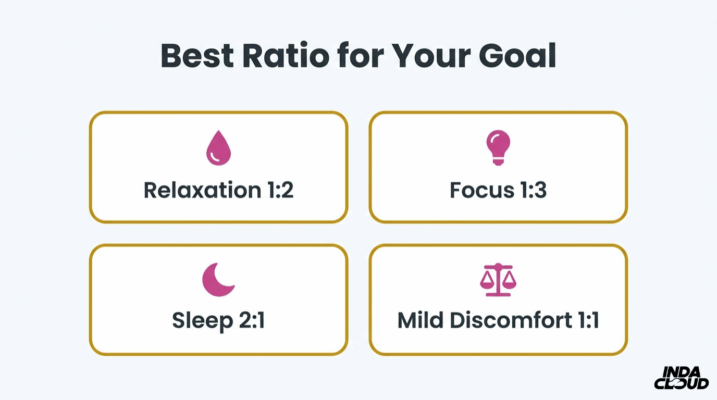
The Delta 8 to CBD ratio that works best for relaxation is 1:2 (Delta 8 to CBD). This ratio provides a gentle sense of calm without heavy psychoactive effects, because the higher proportion of CBD tempers Delta 8’s intoxicating qualities. CBD acts as a negative allosteric modulator of the CB1 receptor, reducing THC agonist binding intensity; when applied to a relaxation-focused ratio, this mechanism softens the high while preserving a soothing body effect. For those who prefer a slightly more noticeable sensation, a 1:1 ratio offers balanced relaxation with mild euphoria. Starting at a low total dose and adjusting upward gives the most controlled experience.
The Delta 8 to CBD ratio that works best for focus is 1:3 or higher in favor of CBD. A CBD-dominant ratio supports mental clarity, while the small amount of Delta 8 can promote light mood elevation without cognitive fog. According to the British Journal of Pharmacology, CBD functions as a non-competitive negative allosteric modulator of the CB1 receptor, decreasing the binding affinity and potency of THC agonists like Delta 8. This pharmacological relationship explains why CBD-heavy ratios maintain alertness rather than sedation. Keeping the total Delta 8 portion under 5 mg is a practical starting point for productivity-oriented use, since higher amounts may shift the experience from focused to relaxed.
The Delta 8 to CBD ratio that works best for sleep is 2:1 (Delta 8 to CBD). A Delta 8-dominant ratio leverages its stronger sedative and anxiolytic properties to promote drowsiness, while the supporting CBD helps ease residual tension without overpowering the calming effect. Clinical trials for cannabis-based medicines commonly utilize specific THC-to-CBD ratios, such as 1:1 for pain management, to balance therapeutic benefits and side effects; for sleep, tilting toward more Delta 8 intensifies the sedating response. An evening dose taken 60 to 90 minutes before bed allows oral formats enough time to reach peak blood concentrations. Pairing this ratio with a consistent nighttime routine often yields the best results.
The Delta 8 to CBD ratio that works best for mild discomfort is 1:1. A balanced ratio combines Delta 8’s analgesic activity at CB1 receptors with CBD’s own soothing properties, creating a complementary effect. According to a dosing and chemical composition report from MN.gov, clinical trials for cannabis-based medicines frequently use a 1:1 THC-to-CBD ratio specifically for pain management to balance therapeutic benefits and side effects. Both cannabinoids contribute through different receptor pathways, so neither needs to dominate for this purpose. Starting with 5 to 10 mg of each cannabinoid provides a conservative entry point; from there, gradual adjustments help identify the minimum effective dose without unnecessary intensity.
Understanding these ratio guidelines makes adjusting your combined dosage far more intuitive.
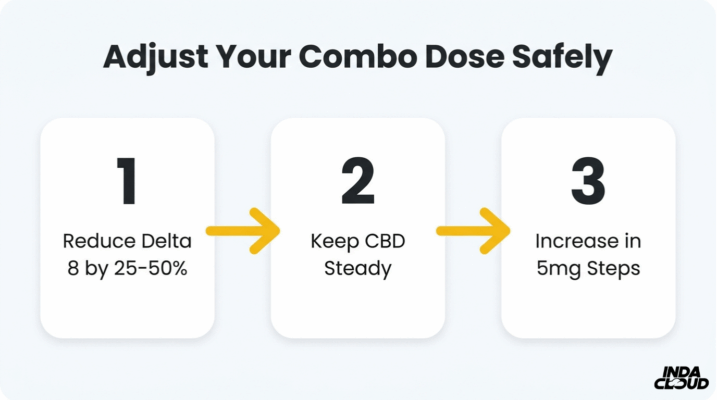
You should adjust Delta 8 dosage when combining it with CBD by starting lower than your usual standalone dose and increasing gradually. Because CBD acts as a negative allosteric modulator of CB1 receptors, it changes how Delta 8 binds and behaves in your body, meaning your typical dose may feel different when CBD is present.
A practical approach involves reducing your standard Delta 8 dose by roughly 25% to 50% when first adding CBD to the mix. If you normally take 25 mg of Delta 8 alone, starting at 12.5 to 15 mg alongside your chosen CBD amount gives you room to assess the combined effect before scaling up. According to a report published by the British Journal of Pharmacology, CBD functions as a non-competitive negative allosteric modulator of CB1 receptors, which can decrease the binding affinity and potency of THC agonists like Delta 8 THC.
The key adjustment principles to follow include:
For most people, the CBD component softens the psychoactive intensity of Delta 8 without eliminating it entirely. This means you may eventually find that your combined dose settles close to, or even slightly above, your original standalone Delta 8 amount once you understand how the two interact in your system. Patience during this calibration period is far more valuable than chasing a specific number.
With your combined dosage dialed in, the next consideration is whether daily use of both cannabinoids remains safe over time.
Taking Delta 8 and CBD together every day is generally considered safe for most healthy adults when proper dosing practices are followed. However, long-term daily use requires attention to tolerance, product quality, and individual health factors.
Daily combination use carries specific considerations worth understanding. CBD acts as a negative allosteric modulator of the CB1 receptor, which can decrease the binding affinity of THC agonists like Delta 8 THC, according to a 2015 study published in the British Journal of Pharmacology. This modulatory relationship means CBD may help buffer some of Delta 8’s more intense effects over time, potentially making the combination more tolerable for sustained use than Delta 8 alone.
Still, a few practical safeguards matter for anyone considering daily use:
For most people, the combination’s safety profile improves when CBD is used at a ratio that meaningfully counterbalances Delta 8’s psychoactivity. Consistency in product source and dosing routine matters more than any single factor when it comes to long-term daily use. Finding lab-tested products from a transparent source is the single most important step for sustained safety.
You can find trusted Delta 8 and CBD products online by choosing brands that provide third-party lab testing, transparent Certificates of Analysis, and clear dosage information for every experience level.
Yes, IndaCloud offers lab-tested Delta 8 products for every experience level. Every product undergoes comprehensive third-party testing to verify cannabinoid potency and screen for contaminants, with detailed lab reports available to consumers. Beginners can start with lower-potency edibles and gummies, while intermediate and experienced users can explore higher-strength options across vapes, flower, pre-rolls, and concentrates. Products are organized by cannabinoid type, desired effect, and potency level, making it simple to match a product to your comfort zone. With over 250,000 verified customers and a team of 35+ cannabis experts, IndaCloud provides the transparency and variety needed to dose confidently at any stage of your journey.
The key takeaways about Delta 8 dosage and CBD interactions center on starting low, understanding product differences, and using CBD strategically. According to the FDA, Delta 8 THC products can cause adverse events, so verified lab testing and proper dosing are essential safety measures.
Core principles to remember include:
Combining these principles with products from a transparent, lab-tested source like Inda Cloud helps you build a safe, personalized cannabinoid routine.
Yes, THC gummies are legal to buy in most of the United States right…
Learn more

Raw, unheated THCA clears your system in roughly 24 to 48 hours. Once you…
Learn more

Yes, edibles show up on drug tests. Standard panels detect THC edibles exactly the…
Learn more

Green Wednesday is the Wednesday before Thanksgiving, the cannabis industry’s second-biggest shopping day of…
Learn more
