FREE SHIPPING $89+
 FREE GIFTS ALL ORDERS $120+
 100% FEDERALLY LEGAL
  LAB TESTED FOR PURITY


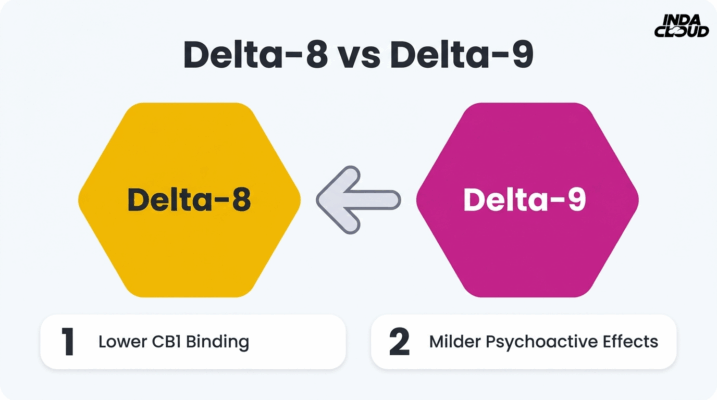
Delta-8 THC is a naturally occurring cannabinoid and positional isomer of delta-9 THC that binds to CB1 receptors with lower affinity, producing milder psychoactive effects while still engaging the body’s endocannabinoid system.
This guide covers how delta-8 flower and sprays are made, their psychoactive and physical effects, potential benefits and risks, long-term use considerations, and product quality standards.
Delta-8 flower is produced by applying concentrated delta-8 distillate onto hemp buds, since the plant naturally contains very little of this cannabinoid. Infusion methods that saturate deeper into the flower outperform surface coatings in potency consistency, and sprays offer an alternative delivery format with sublingual or topical application for faster, more controlled dosing.
The effects of delta-8 THC include gentle euphoria, relaxation, and altered time perception with notably less anxiety and paranoia than delta-9 THC produces. Its lower CB1 binding affinity translates to roughly 50% to 75% of delta-9’s psychoactive intensity, making it a more approachable option for those sensitive to stronger cannabinoids.
Users report practical benefits including stress relief, appetite stimulation, discomfort management, and improved sleep quality. Delta-8’s calming profile supports relaxation without heavy sedation, which suits daytime use and social settings.
Repeated use carries real risks. Tolerance and physical dependence can develop through CB1 receptor downregulation, and cognitive distortions during acute use raise concerns about cumulative effects with chronic consumption. Dedicated long-term human studies remain limited.
Federal legality hinges on hemp derivation with less than 0.3% delta-9 THC, though state laws vary significantly. Third-party lab testing and batch-specific certificates of analysis are the most reliable tools for verifying product safety, potency accuracy, and legal compliance.
What Is Delta-8 THC and How Is It Different from Delta-9?
Delta-8 THC is a naturally occurring cannabinoid and a positional isomer of delta-9 THC, the primary psychoactive compound in cannabis. The key structural difference lies in the placement of a double bond: delta-8 has this bond between carbon atoms 8 and 9, while delta-9 positions it between carbons 9 and 10. This seemingly minor molecular variation produces a meaningful pharmacological distinction.
Delta-8 THC binds to CB1 receptors in the endocannabinoid system with notably lower affinity than delta-9 THC. According to the British Journal of Pharmacology, delta-8 THC’s CB1 binding affinity shows Ki values ranging from 78 nM to 251 nM, depending on the biological system studied. Because CB1 receptor activation drives the psychoactive “high” associated with cannabis, this reduced binding translates to milder intoxicating effects.
For users who find delta-9 THC overwhelming, this difference matters. Delta-8 delivers a calmer, more clear-headed experience while still engaging the same receptor pathways. The lower potency per milligram makes delta-8 a practical option for those seeking functional relaxation without intense psychoactivity.
Understanding this molecular distinction helps explain why delta-8 flower and sprays have become popular product formats.
How Is Delta-8 THC Flower Made?
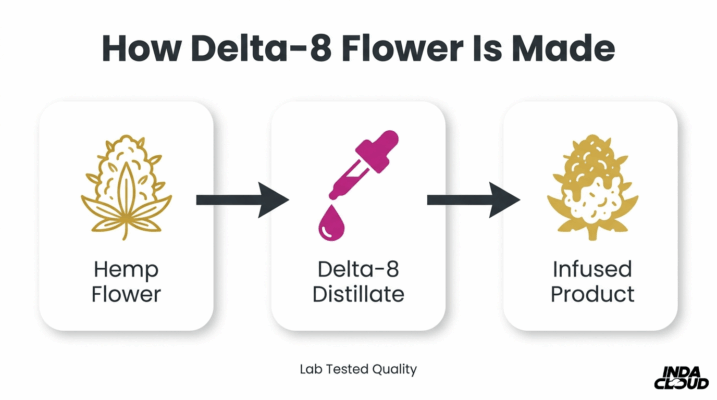
Delta-8 THC flower is made by applying concentrated delta-8 distillate onto hemp flower. The sections below cover the spraying process, differences between infusion and coating methods, and quality indicators to evaluate.
What Does Spraying Hemp Flower with Delta-8 Distillate Involve?
Spraying hemp flower with delta-8 distillate involves heating the concentrated extract until it reaches a liquid consistency, then evenly misting it onto dried hemp buds. This step is necessary because hemp plants naturally produce very little delta-8 THC. According to the American Chemical Society, the delta-8 isomer content of marijuana plants (Cannabis spp.) is typically no more than 1%, making external application of distillate the primary method for creating delta-8 flower products.
The distillate itself begins with CBD extracted from compliant hemp. Manufacturers use chemical conversion to transform CBD into delta-8 THC, a positional isomer of delta-9 with its double bond between carbon atoms 8 and 9. The FDA has noted that potentially unsafe chemicals can enter this conversion process, producing harmful by-products in the final product. Sourcing distillate from manufacturers who use clean, verified processes is one of the most important steps consumers can take before purchasing delta-8 flower.
How Does Infusion Differ from Coating in Delta-8 Flower?
Infusion differs from coating in delta-8 flower primarily in how deeply the distillate penetrates the plant material. Coating applies a surface layer of delta-8 distillate onto the outside of the bud, often through a quick spray. The cannabinoid sits on the exterior, which can lead to uneven potency and a sticky texture.
Infusion involves a slower, more controlled process where distillate saturates deeper into the flower’s trichomes and pores. This produces more consistent cannabinoid distribution throughout each bud. Infused flower typically burns more evenly and delivers a smoother experience compared to surface-coated alternatives. For anyone prioritizing reliable effects per session, infused delta-8 flower tends to outperform coated options in both flavor and consistency.
What Should You Look for in High-Quality Delta-8 Flower?
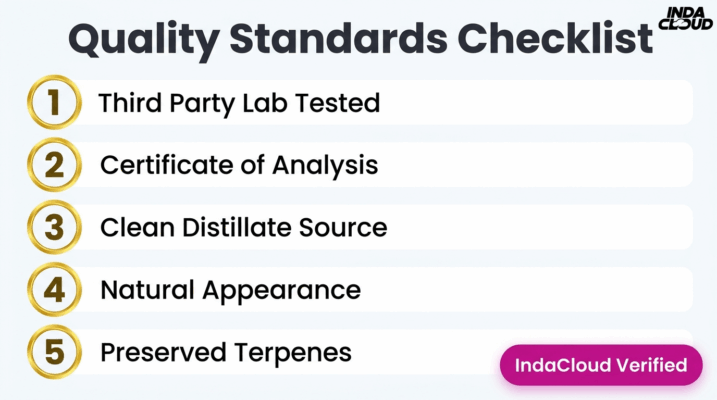
High-quality delta-8 flower should meet several key criteria:
- Third-party lab testing confirms cannabinoid potency, delta-9 THC compliance below 0.3%, and absence of residual solvents or heavy metals.
- Certificate of Analysis (COA) is publicly accessible and matches the specific batch you are purchasing.
- Clean distillate sourcing ensures the conversion process from CBD to delta-8 used safe, regulated chemicals rather than household alternatives.
- Natural appearance indicates the flower is not oversaturated; buds should look and feel like quality hemp, not excessively glossy or damp.
- Terpene profile is preserved or reintroduced, contributing to strain-specific aroma and a fuller entourage effect.
With the U.S. hemp-derived cannabinoid market growing 1,283% in three years to approximately $2.76 billion, according to Cannabis Business Times, the number of delta-8 products on the market has surged. Not all meet the same standards. Prioritizing these quality markers helps separate trustworthy products from poorly manufactured ones.
Knowing how delta-8 flower is produced makes it easier to evaluate delta-8 sprays and their distinct delivery methods.
What Are Delta-8 THC Sprays and How Do They Work?
Delta-8 THC sprays are liquid formulations containing delta-8 distillate, designed for application onto hemp flower or direct sublingual use. The following subsections cover application methods and dosage considerations.
How Are Delta-8 Sprays Applied to Flower or Used Sublingually?
Delta-8 sprays are applied to flower by misting delta-8 THC distillate evenly across dried hemp buds, allowing the liquid to absorb before smoking or vaping. For sublingual use, the spray is dispensed under the tongue and held for 30 to 60 seconds before swallowing.
Each method produces different onset times. Sprayed flower that is smoked delivers effects within minutes as cannabinoids enter the bloodstream through the lungs. Sublingual absorption bypasses the digestive system, typically producing effects within 15 to 30 minutes. According to a 2022 review in The Permanente Journal, orally consumed THC is metabolized in the liver by CYP2C and CYP3A enzymes into 11-OH-THC, a psychoactive metabolite, before conversion to non-psychoactive 11-COOH-THC. Sublingual delivery partially avoids this first-pass metabolism, often resulting in more predictable onset compared to edibles.
What Dosage Considerations Matter with Delta-8 Sprays?
The dosage considerations that matter with delta-8 sprays include spray concentration, number of pumps per application, individual tolerance, and the chosen delivery method. Because each pump dispenses a measured amount of distillate, users can control intake more precisely than with pre-infused flower.
Key factors affecting dosage response include:
- Milligrams per spray pump: Most sprays deliver between 1 mg and 5 mg of delta-8 THC per actuation.
- Delivery method: Sublingual use produces faster, more concentrated effects per milligram than spraying onto flower, where some cannabinoid is lost to combustion.
- Body weight and tolerance: Heavier individuals or those with established cannabinoid tolerance generally require higher amounts.
- Prior cannabinoid experience: Beginners should start with one to two pumps and wait at least 30 minutes before increasing.
For anyone new to delta-8 sprays, starting low and adjusting gradually remains the safest approach to finding a comfortable, effective dose. Understanding these variables helps set realistic expectations before exploring delta-8’s broader effects.
What Are the Effects of Delta-8 THC?
The effects of Delta-8 THC include mild psychoactive sensations, mood elevation, physical relaxation, and reduced anxiety compared to Delta-9 THC. The following sections cover short-term psychoactive effects, mood and anxiety responses, physical impacts, and intensity differences between Delta-8 and Delta-9.
What Are the Short-Term Psychoactive Effects of Delta-8 THC?
The short-term psychoactive effects of Delta-8 THC include relaxation, euphoria, altered time perception, and mild cognitive changes. Because Delta-8 binds to CB1 receptors with lower affinity than Delta-9, its psychoactive intensity is noticeably reduced.
Users commonly report these short-term effects:
- Gentle euphoria and mental uplift without overwhelming intoxication.
- Altered sense of time, with moments feeling slower or stretched.
- Difficulty concentrating and mild short-term memory disruption.
- A calm, clear-headed sensation often described as “functional.”
For most people, these effects make Delta-8 THC a more approachable cannabinoid, particularly for those sensitive to the stronger cognitive disruption that Delta-9 can produce.
How Does Delta-8 THC Affect Mood and Anxiety?
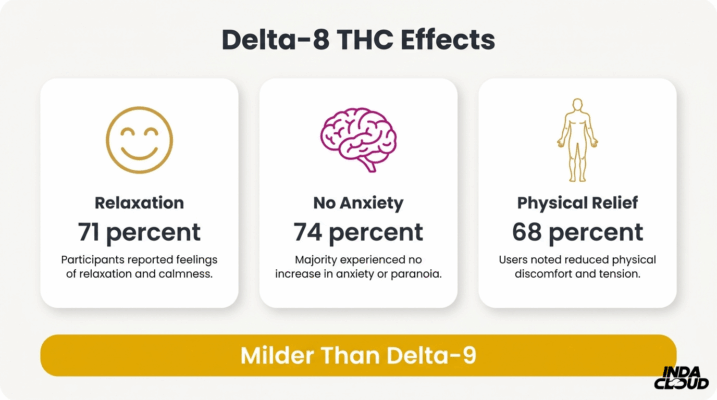
Delta-8 THC affects mood and anxiety by promoting relaxation and euphoria while producing significantly less anxious or paranoid responses than Delta-9 THC. According to a 2022 survey published in the Journal of Cannabis Research, 74% of Delta-8 users did not experience anxiety, and 83% did not experience paranoia, while 71% reported a great deal of relaxation and 68% reported euphoria.
This anxiolytic profile likely stems from Delta-8’s reduced CB1 receptor binding affinity. Lower receptor activation produces calming effects without the overstimulation that often triggers anxiety at higher THC potencies. For users prone to THC-related nervousness, Delta-8 offers a notably smoother experience that supports mood without the sharp emotional edges.
What Are the Physical Effects of Delta-8 THC on the Body?
The physical effects of Delta-8 THC on the body include muscle relaxation, mild pain relief, appetite stimulation, and dry mouth. Delta-8 interacts with both CB1 and CB2 receptors throughout the body, influencing pain signaling, inflammation, and digestive function.
Common physical responses include:
- General body relaxation and tension reduction.
- Mild analgesic effects that ease soreness and discomfort.
- Increased appetite, sometimes called “the munchies.”
- Dry mouth and occasional dry eyes.
- Slight drowsiness at higher doses.
These physical effects tend to be gentler than those produced by Delta-9 THC, making Delta-8 a practical option when physical relief is desired without heavy sedation.
How Does Delta-8 THC Compare to Delta-9 THC in Intensity?
Delta-8 THC compares to Delta-9 THC in intensity as a milder, less potent cannabinoid. According to research published in the British Journal of Pharmacology, Delta-8 binds to CB1 receptors with Ki values ranging from 78 nM to 251 nM, reflecting lower binding affinity than Delta-9 THC.
This reduced affinity translates to key experiential differences:
- Psychoactive strength is roughly 50% to 75% that of Delta-9.
- Cognitive impairment and memory disruption are less pronounced.
- Anxiety and paranoia occur far less frequently with Delta-8.
- Onset and duration follow similar timelines, but peak intensity stays lower.
In practical terms, Delta-8 delivers a controlled, manageable experience that many users prefer for daytime use or social settings. Understanding this intensity gap helps when selecting the right product for your needs and tolerance level.
What Are the Benefits of Using Delta-8 THC?
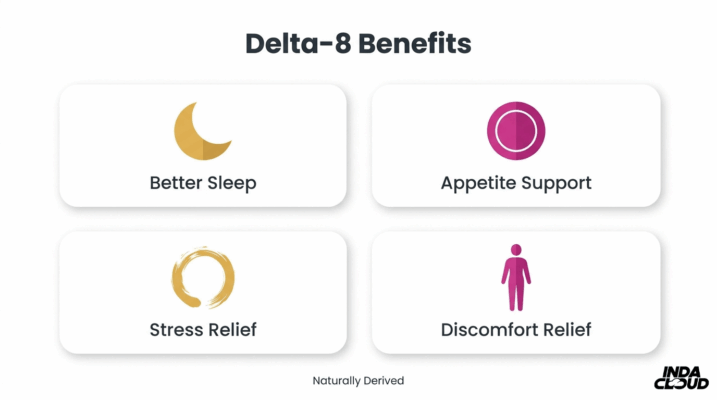
The benefits of using delta-8 THC include relaxation, stress relief, appetite stimulation, discomfort management, and improved sleep quality. Each benefit reflects how this milder cannabinoid interacts with the body’s endocannabinoid system.
Can Delta-8 THC Help with Relaxation and Stress Relief?
Yes, delta-8 THC can help with relaxation and stress relief. Delta-8 THC activates CB1 receptors in the central nervous system, producing a calming effect without the intensity often associated with delta-9 THC. According to a study published in the Journal of Cannabis Research, 71% of delta-8 THC users reported experiencing a great deal of relaxation, while 74% did not experience anxiety and 83% did not experience paranoia. These findings suggest that delta-8 THC delivers meaningful stress relief with a lower risk of the anxious side effects that can accompany stronger cannabinoids. For anyone seeking a gentler way to unwind, this profile makes delta-8 a compelling option.
Does Delta-8 THC Support Appetite Stimulation?
Yes, delta-8 THC supports appetite stimulation. Delta-8 THC binds to CB1 receptors in areas of the brain that regulate hunger signaling, which can increase the desire to eat. Many users report noticeable appetite enhancement even at lower doses. Because delta-8 produces milder psychoactive effects than delta-9 THC, it may offer appetite benefits without overwhelming cognitive changes. This balance makes delta-8 particularly practical for individuals who want to support healthy eating patterns while remaining clear-headed throughout the day.
Can Delta-8 THC Help with Discomfort and Soreness?
Yes, delta-8 THC can help with discomfort and soreness. Delta-8 THC interacts with both CB1 and CB2 receptors involved in the body’s pain-modulation pathways. User surveys consistently show that over half of delta-8 consumers report meaningful relief from physical discomfort. Its anti-inflammatory properties, mediated through CB2 receptor activity, may reduce soreness at the source rather than simply masking the sensation. For those managing everyday physical tension or post-activity soreness, delta-8 offers a functional alternative that typically carries fewer cognitive side effects than higher-potency cannabinoids.
Is Delta-8 THC Useful for Improving Sleep Quality?
Yes, delta-8 THC is useful for improving sleep quality. Delta-8 THC promotes drowsiness through its interaction with CB1 receptors, which influence the body’s sleep-wake cycle. Its relaxation properties, combined with reduced likelihood of anxiety, create favorable conditions for falling and staying asleep. Many users find that a moderate dose taken in the evening helps quiet racing thoughts without producing next-day grogginess. Because delta-8 is less potent than delta-9 THC, it suits individuals who want gentle sedation rather than heavy impairment before bed.
With these potential benefits in mind, understanding possible side effects helps you use delta-8 THC responsibly.
What Are the Side Effects and Risks of Delta-8 THC?
The side effects and risks of delta-8 THC include cognitive distortions, potential tolerance development, and safety concerns for certain populations. The sections below cover common side effects, tolerance buildup, and who should avoid this cannabinoid.
What Are the Common Side Effects of Delta-8 THC?
The common side effects of delta-8 THC are primarily cognitive in nature, though most users report minimal anxiety or paranoia. According to a study published in the Journal of Cannabis Research, a moderate amount or a lot of cognitive distortions were reported by users, including difficulty concentrating (81%), difficulties with short-term memory (80%), and an altered sense of time (74%).
Additional side effects may include:
- Dry mouth and red eyes, common across most cannabinoid products.
- Drowsiness or sedation, particularly at higher doses.
- Mild dizziness or lightheadedness in some users.
Notably, most participants in the same study did not experience anxiety (74%) or paranoia (83%), which distinguishes delta-8 from stronger cannabinoids that often trigger those responses. For anyone new to cannabinoid products, starting with a low dose remains the most practical way to gauge individual sensitivity.
Can You Build a Tolerance to Delta-8 THC Over Time?
Yes, you can build a tolerance to delta-8 THC over time. Delta-8-THC produces qualitatively similar effects to delta-9-THC, including the risk of tolerance development with repeated use. Preclinical research published in Drug and Alcohol Dependence found that repeated administration of delta-8-THC produced tolerance and cross-tolerance to other cannabinoid agonists, consistent with downregulated CB1 receptor function.
This means that regular users may need progressively higher amounts to achieve the same effects. Tolerance breaks, where use is paused for a period, are commonly recommended to help reset CB1 receptor sensitivity. For most people, even a short break can make a noticeable difference in how the body responds to subsequent use.
Who Should Avoid Using Delta-8 THC?
The people who should avoid using delta-8 THC include pregnant or nursing individuals, anyone under 21 years of age, and those taking medications metabolized by CYP2C or CYP3A liver enzymes. Because THC is processed through these hepatic pathways, drug interactions are a real concern for people on certain prescriptions.
Other groups that should exercise caution include:
- Individuals with a history of substance dependence, given delta-8’s documented abuse liability.
- People with cardiovascular conditions, as cannabinoids can temporarily affect heart rate and blood pressure.
- Anyone in a state where delta-8 THC products are restricted or banned.
Consulting a healthcare provider before use is essential for anyone managing a chronic condition or taking daily medications. Understanding long-term implications becomes equally important for regular users.
What Happens with Long-Term Use of Delta-8 THC?
Long-term use of delta-8 THC can lead to tolerance, dependence, and potential cognitive changes similar to those associated with delta-9 THC. The following subsections cover tolerance and dependence risks, cognitive considerations, and what current research reveals.
How Does Prolonged Delta-8 Use Affect Tolerance and Dependence?
Prolonged delta-8 use affects tolerance and dependence in ways that closely mirror delta-9 THC. Delta-8 THC produces qualitatively similar effects to delta-9 THC, including risk of drug dependence and abuse liability. According to a study published in Drug and Alcohol Dependence, repeated administration of delta-8 THC (50 mg/kg, s.c.) produced tolerance and cross-tolerance to WIN 55,212-2 in tetrad testing, consistent with downregulated CB1 receptor function.
This downregulation means the brain’s cannabinoid receptors become less responsive over time, requiring higher doses to achieve the same effects. Users who consume delta-8 daily should be aware that physical dependence can develop gradually, making periodic tolerance breaks a practical consideration.
Are There Known Cognitive Effects from Long-Term Delta-8 Use?
There are limited studies specifically isolating the cognitive effects of long-term delta-8 use. However, because delta-8 THC binds to the same CB1 receptors as delta-9 THC, researchers expect overlapping cognitive impacts. User surveys have documented cognitive distortions during acute use, including difficulty concentrating and short-term memory challenges, which raises reasonable concern about cumulative effects with chronic consumption.
Until dedicated longitudinal studies on delta-8 are completed, treating it with the same caution applied to regular delta-9 use is the most responsible approach. Anyone noticing persistent memory or focus issues should consider reducing frequency.
What Does Current Research Say About Chronic Delta-8 Consumption?
Current research on chronic delta-8 consumption remains limited compared to delta-9 THC. The FDA has noted that delta-8 THC products have not been evaluated or approved for safe use, and the agency continues to monitor adverse event reports associated with these products. Most existing data relies on preclinical animal models and cross-referencing with the broader cannabinoid literature rather than long-term human trials.
This gap makes it difficult to draw definitive conclusions about years of regular use. For consumers exploring delta-8 products, prioritizing lab-tested options and staying informed as new research emerges represents the most balanced strategy for managing potential long-term risks.
Is Delta-8 THC Legal in the United States?
Delta-8 THC is legal in the United States at the federal level when derived from hemp, but state laws vary significantly. The distinction hinges on the source plant and its delta-9 THC concentration.
According to the Marijuana Policy Project, delta-8 is not a federally controlled substance when extracted from hemp plants containing less than 0.3% delta-9 THC. However, delta-8 becomes a federally controlled substance when extracted from marijuana. The 2018 Farm Bill created this distinction by legalizing hemp and removing the hemp plant, along with its seeds and derivatives, from the Controlled Substances Act.
Despite federal legality for hemp-derived products, individual states have taken different approaches. Some states have explicitly banned or restricted delta-8 THC sales, while others permit them with varying regulations. Consumers should verify their own state’s current laws before purchasing. This patchwork of regulation makes understanding product sourcing and compliance essential when selecting delta-8 THC products.
How Should You Choose Delta-8 THC Products for Quality and Safety?
You should choose delta-8 THC products by verifying third-party lab testing, reviewing certificates of analysis, and confirming the retailer enforces age requirements. The following subsections cover why independent testing matters and how COAs protect your purchase.
Why Does Third-Party Lab Testing Matter for Delta-8 Products?
Third-party lab testing matters for delta-8 products because it provides independent verification of cannabinoid content, potency accuracy, and the absence of harmful contaminants. Since delta-8 THC is typically synthesized from CBD through chemical conversion, residual solvents, heavy metals, and unintended byproducts can remain in finished products if manufacturing standards are lax.
Independent laboratories screen for these contaminants without any financial ties to the manufacturer, which removes conflicts of interest from quality assessment. According to a 2024 study published in Cannabis and Cannabinoid Research, most retailers reported a minimum purchase age of 21 for delta-8 THC products, yet 4% reported 18 years or no minimum age. This inconsistency highlights how uneven the market remains, making lab-verified products essential for consumer protection.
Brands that invest in routine third-party testing signal accountability. For anyone purchasing delta-8 flower, sprays, or edibles, confirming that a product has been independently tested is the single most reliable quality indicator.
What Role Do Certificates of Analysis Play in Delta-8 Purchases?
Certificates of analysis play a critical role in delta-8 purchases by documenting exactly what a product contains, batch by batch. A COA is the formal lab report generated after third-party testing, listing cannabinoid concentrations, terpene profiles, and screening results for pesticides, residual solvents, microbials, and heavy metals.
When evaluating a COA, look for these key elements:
- The product name and batch number matching what you are buying.
- Cannabinoid potency results confirming delta-8 THC content aligns with the label.
- Delta-9 THC levels at or below the 0.3% federal compliance threshold.
- Contaminant panels showing tested and passed results for solvents, pesticides, and metals.
- The name and accreditation of the testing laboratory.
A missing or outdated COA is a significant red flag. Reputable brands make current COAs accessible directly on their product pages. This transparency is one of the most practical tools consumers have for separating trustworthy delta-8 products from poorly regulated alternatives.
Understanding lab results and COAs prepares you to dial in the right delta-8 dosage next.
How Do You Determine the Right Delta-8 THC Dosage?
You determine the right delta-8 THC dosage by starting low, assessing your tolerance, and adjusting based on the product type. The sections below cover beginner dosing and how flower and spray formats affect intake.
What Dosage Should Beginners Start with for Delta-8 THC?
Beginners should start with 5 to 10 milligrams of delta-8 THC per session. Because delta-8 binds to CB1 receptors with lower affinity than delta-9, its psychoactive effects are milder, but individual sensitivity still varies widely. Taking a small initial dose allows new users to gauge their response before increasing.
Key guidelines for first-time dosing include:
- Wait at least 60 to 90 minutes before taking more if using an edible or spray.
- Increase by 5-milligram increments across subsequent sessions, not within the same one.
- Track how each dose affects relaxation, mood, and any cognitive changes like altered time perception.
- Consider body weight, metabolism, and prior cannabinoid experience as factors that shift effective thresholds.
For most new users, staying at or below 10 milligrams per session for the first week provides a reliable baseline without overwhelming effects.
How Does Dosage Differ Between Delta-8 Flower and Sprays?
Dosage differs between delta-8 flower and sprays primarily because of bioavailability and onset speed. Inhalation through smoking flower delivers delta-8 THC directly to the lungs, producing effects within minutes. Sublingual sprays, by contrast, absorb through oral mucosa and typically take 15 to 30 minutes to reach peak effect.
According to a 2022 review published in The Permanente Journal, oral THC travels to the liver where CYP2C and CYP3A enzymes metabolize it into 11-OH-THC, a psychoactive metabolite, before conversion into inactive 11-COOH-THC. This first-pass metabolism means sprays used sublingually bypass some, but not all, hepatic processing, resulting in different intensity profiles compared to inhaled flower.
Practical dosing differences include:
- Delta-8 flower: Start with one to two small puffs; effects are nearly immediate, making real-time dose control easier.
- Delta-8 sprays: Start with one measured spray (typically 1 to 3 milligrams); wait before adding more since delayed onset can lead to overconsumption.
Flower suits users who prefer quick feedback, while sprays offer more precise, pre-measured dosing. Understanding these pharmacokinetic differences helps you select the format that best matches your experience level and desired control.
Where Can You Find Lab-Tested Delta-8 THC Flower and Products?
You can find lab-tested delta-8 THC flower and products through reputable online retailers that provide third-party certificates of analysis. Reputable retailers offer hemp-derived delta-8 options backed by rigorous third-party testing.
Can IndaCloud’s Hemp-Derived Delta-8 Products Meet Your Needs?
Yes, IndaCloud’s hemp-derived delta-8 products can meet your needs if you prioritize lab-tested quality, federal compliance, and convenient delivery. Quality retailers provide delta-8 flower, edibles, vapes, and pre-rolls, all third-party tested and containing less than 0.3% delta-9 THC as required under the 2018 Farm Bill. Independent testing matters because, according to a 2024 study published in ACS Omega, when delta-8 THC samples marketed as compliant were analyzed using refined HPLC methods, all samples contained well over 0.3% delta-9 THC. This finding underscores why choosing a brand with transparent lab reports is essential. IndaCloud ships directly to consumers across the continental United States, with detailed certificates of analysis available for every product batch. For anyone seeking reliable, federally legal delta-8 products, verified testing separates trustworthy brands from the rest.
What Are the Key Takeaways About Delta-8 THC Flower, Sprays, Effects, Benefits, and Long-Term Use?
The key takeaways about delta-8 THC flower, sprays, effects, benefits, and long-term use center on informed, cautious consumption:
- Delta-8 THC flower is made by applying delta-8 distillate to hemp flower, since the plant produces very little delta-8 naturally.
- Sprays offer sublingual and topical application methods with faster onset than edibles.
- Most users report relaxation, euphoria, and pain relief with fewer anxiety or paranoia responses compared to delta-9 THC.
- Benefits include stress relief, appetite stimulation, and sleep support, though individual results vary.
- Long-term use carries risks of tolerance, dependence, and downregulated CB1 receptor function similar to delta-9 THC.
- Third-party lab testing and certificates of analysis remain the most reliable indicators of product safety and legal compliance.
Prioritizing lab-verified products from transparent retailers like IndaCloud helps ensure both quality and peace of mind.