


Blogs

Are THC Gummies Legal? A 2026 State-by-State Guide
Yes, THC gummies are legal to buy in most of the United States right…
Learn more
You must be 21+ to enter this site
 FREE SHIPPING $89+
 FREE GIFT ON $120+
 100% FEDERALLY LEGAL
 LAB TESTED FOR PURITY
FREE SHIPPING $89+
FREE GIFT ON $120+
100% FEDERALLY LEGAL
LAB TESTED FOR PURITY
FREE SHIPPING $89+
FREE GIFT ON $120+
100% FEDERALLY LEGAL
LAB TESTED FOR PURITY
FREE SHIPPING $89+
FREE GIFT ON $120+
100% FEDERALLY LEGAL
LAB TESTED FOR PURITY
FREE SHIPPING $89+
FREE GIFT ON $120+
100% FEDERALLY LEGAL
LAB TESTED FOR PURITY
FREE SHIPPING $89+
FREE GIFT ON $120+
100% FEDERALLY LEGAL
LAB TESTED FOR PURITY
FREE SHIPPING $89+
FREE GIFT ON $120+
100% FEDERALLY LEGAL
LAB TESTED FOR PURITY
FREE SHIPPING $89+
FREE GIFT ON $120+
100% FEDERALLY LEGAL
LAB TESTED FOR PURITY
LAB TESTED FOR PURITY
FREE SHIPPING $89+
FREE GIFT ON $120+
100% FEDERALLY LEGAL
LAB TESTED FOR PURITY
FREE SHIPPING $89+
FREE GIFT ON $120+
100% FEDERALLY LEGAL
LAB TESTED FOR PURITY
FREE SHIPPING $89+
FREE GIFT ON $120+
100% FEDERALLY LEGAL
LAB TESTED FOR PURITY
FREE SHIPPING $89+
FREE GIFT ON $120+
100% FEDERALLY LEGAL
LAB TESTED FOR PURITY
FREE SHIPPING $89+
FREE GIFT ON $120+
100% FEDERALLY LEGAL
LAB TESTED FOR PURITY
FREE SHIPPING $89+
FREE GIFT ON $120+
100% FEDERALLY LEGAL
LAB TESTED FOR PURITY
FREE SHIPPING $89+
FREE GIFT ON $120+
100% FEDERALLY LEGAL
LAB TESTED FOR PURITY

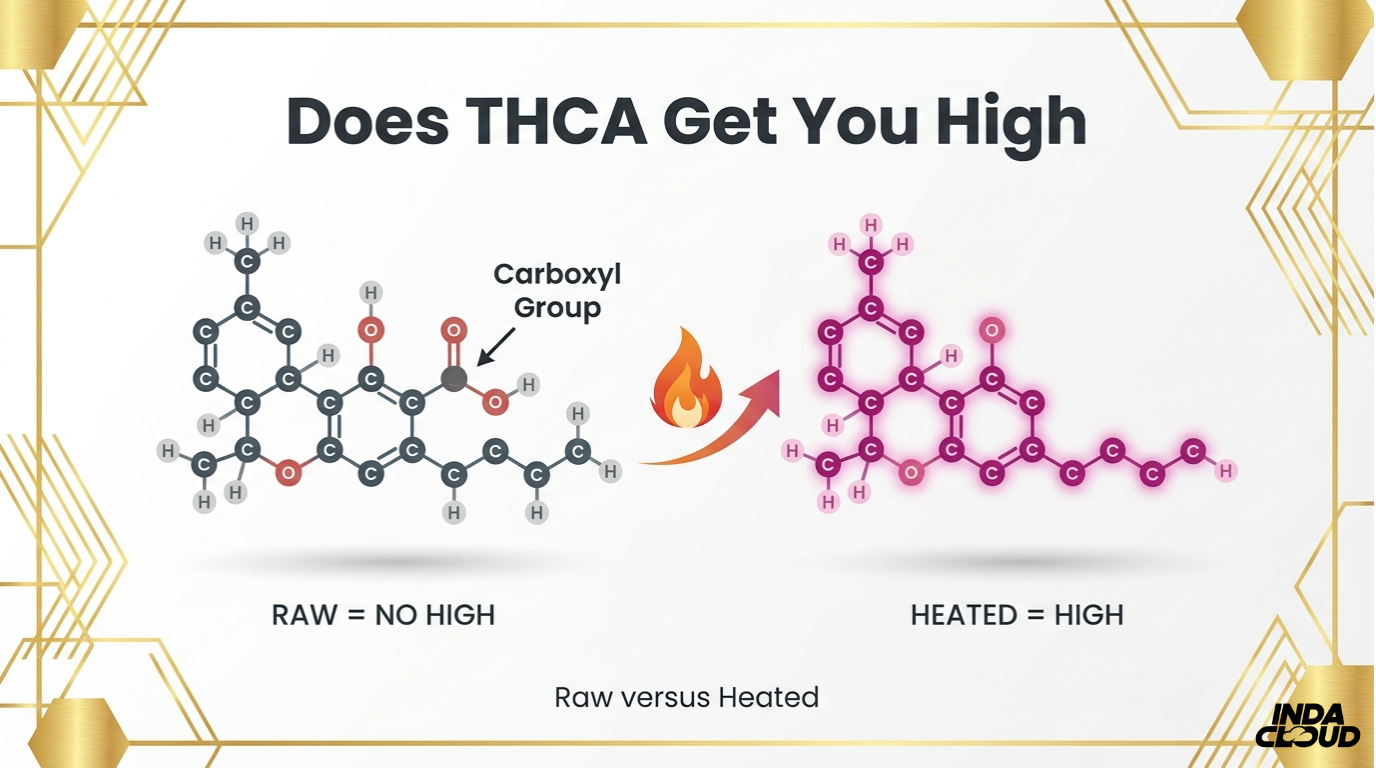
THCA is tetrahydrocannabinolic acid, the raw cannabinoid precursor to THC found naturally in cannabis plants. It does not produce a high in its acidic form, but it converts into psychoactive THC when exposed to heat.
This guide covers the science behind THCA’s molecular structure and conversion process, how different consumption methods determine whether you experience euphoria, the factors that shape intensity and duration, the legal and drug testing implications, and how to select quality products.
THCA carries a carboxyl group that prevents it from binding effectively to CB1 receptors in the brain. Only when heat strips that group away through decarboxylation does the molecule become delta-9 THC, which is the compound responsible for cannabis euphoria.
The consumption method is the deciding factor. Smoking or vaping THCA flower triggers near-instant conversion, producing a high identical to traditional cannabis. Eating raw THCA in smoothies or juices preserves the acidic form and produces no intoxication. Cooking with THCA requires controlled temperatures to maximize THC yield without degrading potency.
Several variables influence how intense the experience feels once THCA converts. Product potency, individual tolerance, body composition, and whether you inhale or ingest all shape the character and duration of effects. Heated THCA delivers full-strength delta-9 effects, while delta-8 remains a milder alternative.
THCA also shows therapeutic promise in its raw form, including neuroprotective and anti-nausea properties, without producing euphoria. However, heated THCA will trigger a positive drug test because the body metabolizes it into the same compounds as any THC source.
Legally, THCA occupies a gray area under the 2018 Farm Bill. Federal and state regulations vary, making third-party lab testing and verified Certificates of Analysis essential for confirming both compliance and product quality.
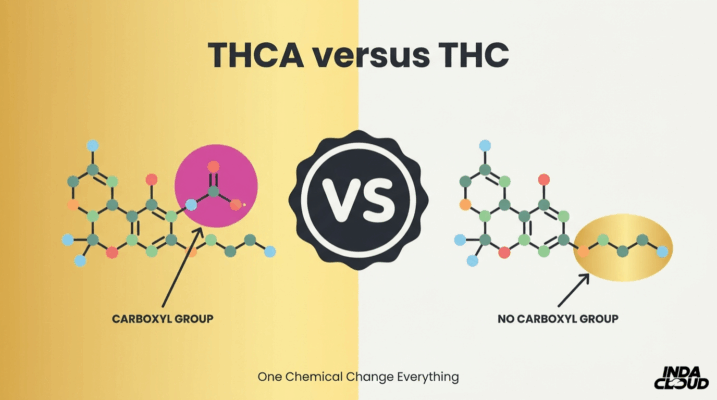
THCA is tetrahydrocannabinolic acid, the naturally occurring precursor to THC found in raw cannabis. It differs from THC primarily through a single structural feature: a carboxyl group that prevents psychoactive effects. The sections below explain how this molecular distinction shapes each compound’s behavior.
THCA exists as the dominant cannabinoid in live, unharvested cannabis plants. The carboxyl (-COOH) group attached to its molecular structure prevents it from binding efficiently with CB1 receptors in the brain, which is why raw THCA does not produce a high. THC, by contrast, lacks this carboxyl group, allowing it to interact strongly with CB1 receptors and trigger euphoria.
This chemical relationship is not a simple toggle between two stable states. According to research published in Industrial & Engineering Chemistry Research, when frozen THCA degrades under UV light, the process does not increase concentrations of its neutral analogue THC, suggesting that degradation follows a separate pathway entirely. In other words, THCA does not always convert neatly into THC; environmental conditions determine whether the molecule becomes psychoactive or breaks down into something else altogether.
For consumers exploring hemp-derived cannabinoid products, this distinction matters. A THCA flower sitting in a jar is chemically different from the smoke it produces once heated. IndaCloud offers a diverse selection of THCa flower and pre-rolls sourced from U.S.-grown hemp, with third-party lab testing to verify cannabinoid profiles and purity before and after decarboxylation. Understanding that boundary between the raw acidic form and the activated neutral form is essential before evaluating whether THCA can get you high.
THCA is not psychoactive in its raw form. This cannabinoid acid lacks the ability to produce a high because its molecular structure prevents it from effectively binding to the brain’s cannabinoid receptors. Understanding why requires a closer look at what THCA actually is at the chemical level.
THCA, or tetrahydrocannabinolic acid, is the non-psychoactive acidic precursor to Δ9-THC. According to a study published by the National Institutes of Health, THCA has the molecular formula C22H30O4 and is biosynthesized in the glandular trichomes of Cannabis sativa through the action of the enzyme THCA synthase on cannabigerolic acid (CBGA). In simpler terms, the living cannabis plant produces THCA naturally; THC itself does not exist in significant quantities in raw, freshly harvested flower.
The critical distinction lies in a single carboxyl (-COOH) group attached to the THCA molecule. This extra chemical group changes the molecule’s three-dimensional shape, making it too bulky to fit snugly into CB1 receptors in the brain. Since CB1 receptor activation is what produces the euphoric “high” associated with cannabis, THCA’s poor fit at this receptor site means it cannot trigger intoxication. Only when heat or prolonged degradation removes that carboxyl group through decarboxylation does the molecule become Δ9-THC, which binds CB1 receptors far more effectively.
For anyone consuming raw cannabis, whether in juices, smoothies, or unheated tinctures, the THCA remains structurally intact and will not produce euphoria. This is a meaningful distinction for those interested in the potential wellness properties of the cannabinoid without the psychoactive experience. With this chemistry in mind, the next section explores exactly how THCA converts into THC through heat and time.
THCA converts into THC through decarboxylation, a heat-driven chemical reaction that removes the carboxyl group from the THCA molecule. The three primary conversion pathways are smoking or vaping, cooking, and gradual degradation over time.
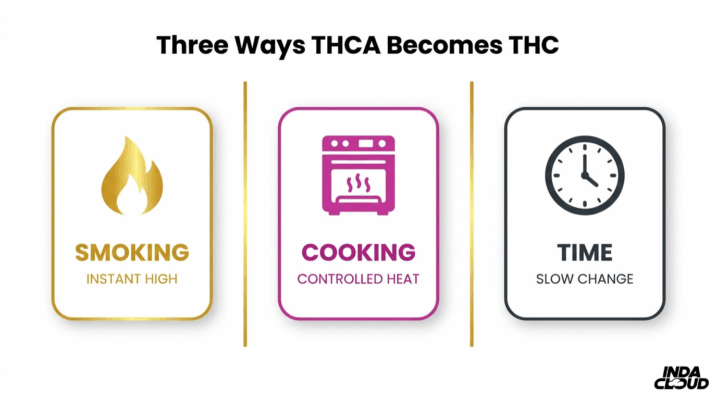
When you smoke or vape THCA, it converts into THC almost instantly. The flame from a lighter or the heating element in a vape pen generates temperatures well above the decarboxylation threshold, stripping the carboxyl group from THCA in a fraction of a second. This rapid conversion is why THCA flower produces psychoactive effects identical to traditional cannabis when smoked. For anyone exploring THCA products, smoking and vaping remain the most efficient conversion methods because virtually no THCA survives the process unconverted.
When you cook or bake with THCA, it converts into THC through sustained heat exposure during the decarboxylation process. Unlike the instant conversion from smoking, cooking requires careful temperature and time management to maximize THC yield. According to a study published in Cannabis and Cannabinoid Research, the decarboxylation of THCA-A follows first-order kinetics with an activation energy of 88 kJ/mol and a frequency factor of 8.7×10⁸ sec⁻¹.
Effective kitchen decarboxylation typically involves:
Rushing this process with excessive heat risks degrading THC into CBN, which reduces potency. Low and slow is the most reliable approach for homemade edibles.
Yes, THCA does convert to THC at room temperature over time, though slowly and incompletely. According to a 2022 study in Industrial & Engineering Chemistry Research, temperature has an appreciable effect on the stability of both THCA and THC, with THCA rapidly degrading at room temperature (25 ± 3 °C). This gradual breakdown means improperly stored flower loses its original cannabinoid profile over weeks and months.
However, room-temperature conversion is unreliable for producing consistent THC levels. Much of the degraded THCA may transform into CBN or other oxidation byproducts rather than clean THC. Refrigeration slows this process significantly, preserving both potency and freshness. For anyone serious about maximizing their experience, proper storage matters just as much as choosing the right consumption method. IndaCloud’s warehouse process ensures products are shipped within 48 hours in nondescript packaging, helping preserve cannabinoid potency from fulfillment through delivery.
Smoking THCA flower does get you high. The flame from a lighter or the heat inside a bowl reaches temperatures far exceeding 145°C, which instantly triggers decarboxylation. This process strips the carboxyl group from THCA and converts it into delta 9 THC before the vapor reaches your lungs. Once inhaled, delta 9 THC binds to CB1 receptors in the brain, producing the classic euphoric, psychoactive effects associated with cannabis. The high from smoked THCA flower is virtually identical to smoking traditional THC-rich cannabis because the end product entering your bloodstream is the same molecule. According to a 2017 study published in Cannabis and Cannabinoid Research, at temperatures such as 145°C, the decarboxylation reaction rate for THCA is so high that conversion happens almost instantaneously. For anyone considering THCA flower as a non-intoxicating option, smoking eliminates that possibility entirely; only raw, unheated consumption preserves THCA in its non-psychoactive form.
Eating raw THCA does not get you high. THCA requires heat to convert into THC, and consuming raw cannabis skips that critical step. Without decarboxylation, the carboxyl group on the THCA molecule remains intact, preventing it from binding effectively to CB1 receptors in the brain.
When you eat raw cannabis flower, whether in a smoothie, salad, or juice, the THCA passes through your digestive system largely unchanged. Your body temperature (approximately 37°C) falls far below the 80°C to 145°C range where meaningful decarboxylation begins. According to a study published in Cannabis and Cannabinoid Research, decarboxylation conditions for THCA were examined at temperatures ranging from 80°C to 145°C, confirming that body heat alone cannot trigger the conversion.
This is precisely why raw cannabis juicing has gained popularity among wellness-focused consumers who want potential therapeutic benefits without intoxication. For anyone specifically seeking euphoria, raw consumption is the wrong method; heating THCA through smoking, vaping, or cooking remains essential to unlock psychoactive effects.
The effects of THCA compare to Delta 9 THC based on whether heat has converted THCA into THC before consumption. The following subsections break down euphoria equivalence, onset and duration differences, and how Delta 8 fits into the comparison.
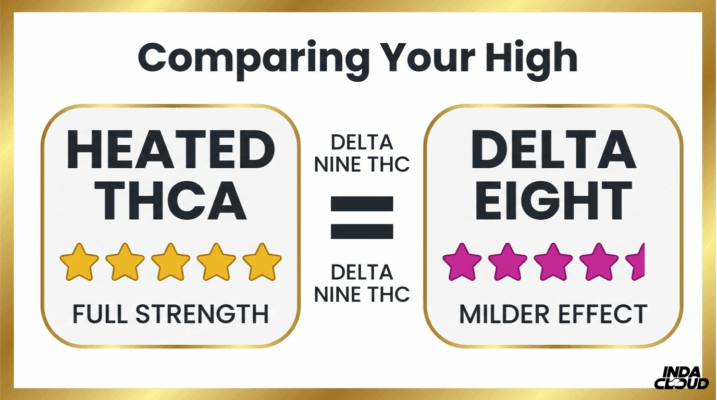
The euphoria from heated THCA is virtually identical to Delta 9 THC because decarboxylation converts THCA into the same Delta 9 molecule. Once heat removes the carboxyl group, the resulting compound binds to CB1 receptors with the same affinity and produces the same psychoactive effects. Smoking THCA flower or vaping a THCA concentrate delivers a high indistinguishable from traditional Delta 9 cannabis.
This chemical equivalence is why regulators treat them the same. In June 2023, the DEA clarified that post-decarboxylation testing must include THCA when determining whether a substance meets the legal definition of hemp, according to a report published in the Tort Trial & Insurance Practice Law Journal.
The practical takeaway is straightforward: if you heat THCA, expect the full Delta 9 experience in potency, character, and duration.
The onset and duration differ between THCA and Delta 9 primarily based on consumption method, not the cannabinoid source. When THCA flower is smoked or vaped, decarboxylation happens instantly , so effects typically begin within minutes and peak around 15 to 30 minutes. This mirrors the timeline of smoking conventional Delta 9 cannabis flower.
Edibles tell a different story. THCA converted during cooking must pass through digestion and first-pass liver metabolism before reaching the bloodstream, delaying onset to 30 to 90 minutes with effects lasting several hours. Pre-made Delta 9 edibles follow the same pattern. Because heated THCA becomes Delta 9 THC, the pharmacokinetic profile is equivalent once the conversion is complete. Choosing between inhalation and ingestion matters more than whether the product label says THCA or Delta 9.
THCA compares to Delta 8 THC for euphoria in two distinct ways depending on whether THCA is consumed raw or heated. Raw THCA produces no euphoria because it does not effectively bind CB1 receptors. Heated THCA converts to Delta 9 THC, which produces a noticeably stronger high than Delta 8.
Delta 8 THC is a less potent isomer of Delta 9. Users commonly describe Delta 8 as producing milder euphoria with less anxiety and a clearer headspace. Heated THCA, by contrast, delivers the full-strength Delta 9 experience. For those seeking intense euphoria, heated THCA products offer greater potency. For those who prefer a gentler, more functional effect, Delta 8 remains a popular alternative.
Understanding these distinctions helps match the right cannabinoid to your desired experience and tolerance level.
The factors that influence how high THCA gets you include the THCA percentage in the product, your chosen consumption method, and your individual tolerance level.
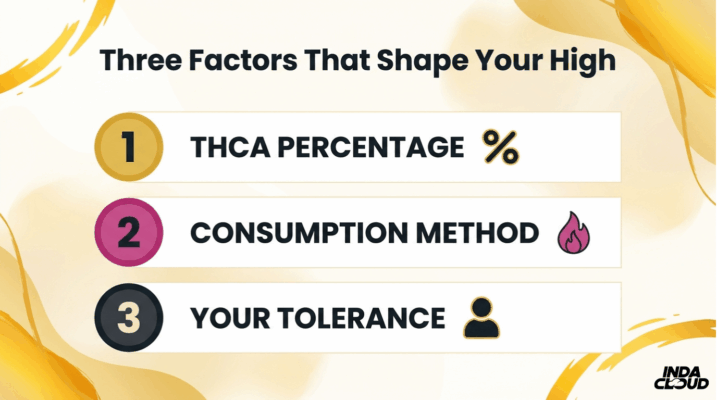
The THCA percentage affects the intensity by directly determining how much THC becomes available after decarboxylation. Flower testing at 25% THCA will produce significantly stronger effects than flower at 15% THCA, since a higher concentration means more raw material converts to active THC when heat is applied. However, the listed percentage represents potential potency, not a guaranteed experience. Not all THCA converts with perfect efficiency; losses during combustion or uneven heating can reduce the actual THC delivered. For most consumers, products above 20% THCA deliver a noticeably more intense high, making potency labels one of the most reliable predictors of effect strength.
Your consumption method changes the high by altering both the conversion efficiency of THCA to THC and the speed of absorption. Smoking and vaping apply direct, intense heat that rapidly decarboxylates THCA, delivering THC to the lungs for near-immediate onset within minutes. Edibles prepared with properly decarboxylated THCA follow a slower path; the liver metabolizes THC into 11-hydroxy-THC, a compound that crosses the blood-brain barrier more effectively and often produces stronger, longer-lasting effects. Raw consumption of THCA, without heat, produces no meaningful high because the carboxyl group remains intact. Choosing between inhalation and ingestion fundamentally shapes the character of the experience, not just its timing.
Your individual tolerance impacts the effects by determining how sensitively your CB1 receptors respond to THC after THCA decarboxylation. Several personal factors shape this response:
A first-time user consuming THCA flower at 20% will likely experience far more intense effects than a daily consumer using the same product. Understanding your personal baseline helps you choose the right potency and dosing approach.
A THCA high feels like a standard cannabis high once the THCA has been heated and converted to THC. The experience varies by strain, dosage, and personal tolerance, but common sensations include:
The specific character of the high depends largely on the strain profile. Indica-dominant THCA strains tend to produce sedating, full-body effects suited for evening relaxation, while sativa-dominant varieties lean toward cerebral stimulation, creativity, and social energy. Hybrids blend both qualities in varying ratios.
Because heated THCA is chemically identical to delta-9 THC, the resulting high carries the same spectrum of effects, including potential side effects at higher doses such as dry mouth, red eyes, or mild anxiety. For those newer to cannabis, starting with a lower-potency THCA product and increasing gradually remains the most reliable way to find a comfortable intensity.
Understanding what the high feels like is one thing; knowing whether THCA offers value without any high at all is another consideration entirely.
The potential benefits of THCA without the high include neuroprotective activity, anti-nausea effects, and anti-inflammatory support. These properties emerge when THCA is consumed raw, before heat converts it into psychoactive THC.
THCA activates PPARγ receptors rather than CB1 receptors, which explains why it can deliver therapeutic effects without producing euphoria. A 2017 study published in the British Journal of Pharmacology found that Δ9-THCA acts as a potent PPARγ agonist, showing neuroprotective activity in mice by improving motor deficits and preventing striatal degeneration. Separately, research in the same journal demonstrated that THCA reduces nausea-induced conditioned gaping in rats at doses as low as 0.05 mg/kg through a CB1 receptor-mediated mechanism.
These findings suggest THCA may offer meaningful wellness applications for individuals who want to avoid intoxication entirely. Raw consumption methods, such as adding fresh cannabis leaves to smoothies or juices, preserve the acidic form and prevent decarboxylation. For anyone exploring non-psychoactive cannabinoid options, THCA represents one of the more promising compounds currently under investigation.
With its therapeutic profile established, the next consideration is whether THCA products comply with federal law.
THCA occupies a complicated legal gray area in the United States. Federal law and state regulations treat this cannabinoid differently depending on how it is tested and classified.
The legality of THCA in the United States depends on how regulators measure THC content. The 2018 Farm Bill defines hemp as cannabis containing no more than 0.3 percent delta-9 THC on a dry weight basis, a definition that some interpret as allowing high-THCA products since THCA itself is not delta-9 THC. Under this reading, raw cannabis flower rich in THCA but low in delta-9 THC technically qualifies as legal hemp.
However, this interpretation faces growing pushback. In June 2023, the DEA clarified that post-decarboxylation testing must include THCA when determining whether a substance meets the legal definition of hemp, according to a report published in the Tort Trial & Insurance Practice Law Journal. This distinction matters because heating THCA converts it into delta-9 THC, which means a product that appears compliant in its raw form could exceed the 0.3 percent threshold once the conversion potential is factored in.
State laws add another layer of complexity. Several states have enacted their own restrictions on THCA products:
For consumers, this patchwork of regulations means that a THCA product purchased legally in one state may be illegal in another. Checking local laws before buying is essential. The regulatory landscape continues shifting as federal agencies and state legislatures respond to the rapid growth of hemp-derived cannabinoid products.
Understanding where THCA stands legally also raises practical questions about drug testing and detection.
THCA can show up on a drug test, particularly if it has converted to THC before or after consumption. The answer depends on the type of test, how THCA was consumed, and how the body metabolizes it.
Standard drug tests do not specifically screen for THCA in its raw, acidic form. However, most cannabis drug panels target THC-COOH, the primary metabolite the body produces after processing THC. According to Weedmaps, GC-MS (gas chromatography-mass spectrometry) is commonly used to confirm the presence of THC-COOH in confirmatory testing. Because smoking, vaping, or cooking THCA converts it into THC through decarboxylation, the resulting metabolites are identical to those produced by any THC source.
Even consuming raw THCA carries some risk. Partial decarboxylation can occur during digestion or storage, producing trace amounts of THC that the body then metabolizes into detectable compounds. Some immunoassay-based screening tests may also cross-react with THCA or structurally similar cannabinoids, potentially triggering a preliminary positive result.
For anyone subject to workplace or legal drug testing, the safest assumption is that THCA products will produce a positive result. The metabolic pathway from THCA to THC to THC-COOH makes these compounds functionally indistinguishable once processed by the body.
Understanding drug test risks is essential when selecting cannabinoid products, and quality sourcing helps ensure you know exactly what you are consuming.
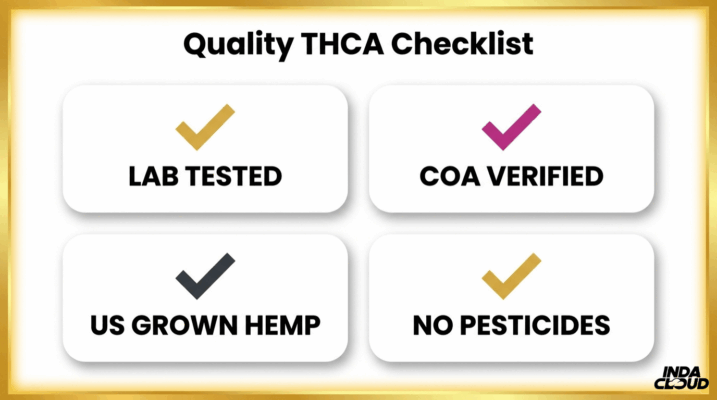
You can choose quality THCA products by verifying third-party lab testing, checking for full-panel Certificates of Analysis, and selecting reputable brands that prioritize transparency. The following sections cover how IndaCloud meets these standards and summarize the key takeaways about THCA and euphoria.
Yes, IndaCloud’s hemp-derived THCA products can deliver euphoria legally when heated. Because THCA converts to THC through smoking, vaping, or cooking, high-THCA flower and pre-rolls produce psychoactive effects while remaining federally compliant below 0.3% delta-9 THC before decarboxylation.
IndaCloud ensures product quality through rigorous third-party testing. According to Secret Nature, a full-panel Certificate of Analysis for THCA products includes potency testing as well as screening for pesticides, heavy metals, microbials, and residual solvents. Inda Cloud publishes these COAs for every batch, giving consumers verifiable proof of both purity and legal compliance.
Key quality indicators to evaluate before purchasing include:
For most consumers, a verified COA is the single most reliable tool for distinguishing premium THCA products from untested alternatives.
The key takeaways about whether THCA gets you high center on one critical distinction: heat transforms everything. In its raw, unheated form, THCA does not produce psychoactive effects because its carboxyl group prevents meaningful CB1 receptor binding. Once decarboxylation occurs through smoking, vaping, or cooking, THCA converts to THC and delivers full euphoria.
Factors that shape your experience include:
THCA also offers therapeutic potential without the high when consumed raw, though heated use will trigger a positive drug test. Choosing lab-tested products from transparent brands like IndaCloud helps ensure both a safe and enjoyable experience. Check out our THCa flower, edibles, and more. If you’re looking for a bargain, check out our 1 oz THCa flower deals.
Yes, THC gummies are legal to buy in most of the United States right…
Learn more
Raw, unheated THCA clears your system in roughly 24 to 48 hours. Once you…
Learn more
Yes, edibles show up on drug tests. Standard panels detect THC edibles exactly the…
Learn more
Green Wednesday is the Wednesday before Thanksgiving, the cannabis industry’s second-biggest shopping day of…
Learn more
