


Blogs

Are THC Gummies Legal? A 2026 State-by-State Guide
Yes, THC gummies are legal to buy in most of the United States right…
Learn more
You must be 21+ to enter this site
 FREE SHIPPING $89+
 FREE GIFT ON $120+
 100% FEDERALLY LEGAL
 LAB TESTED FOR PURITY
FREE SHIPPING $89+
FREE GIFT ON $120+
100% FEDERALLY LEGAL
LAB TESTED FOR PURITY
FREE SHIPPING $89+
FREE GIFT ON $120+
100% FEDERALLY LEGAL
LAB TESTED FOR PURITY
FREE SHIPPING $89+
FREE GIFT ON $120+
100% FEDERALLY LEGAL
LAB TESTED FOR PURITY
FREE SHIPPING $89+
FREE GIFT ON $120+
100% FEDERALLY LEGAL
LAB TESTED FOR PURITY
FREE SHIPPING $89+
FREE GIFT ON $120+
100% FEDERALLY LEGAL
LAB TESTED FOR PURITY
FREE SHIPPING $89+
FREE GIFT ON $120+
100% FEDERALLY LEGAL
LAB TESTED FOR PURITY
FREE SHIPPING $89+
FREE GIFT ON $120+
100% FEDERALLY LEGAL
LAB TESTED FOR PURITY
LAB TESTED FOR PURITY
FREE SHIPPING $89+
FREE GIFT ON $120+
100% FEDERALLY LEGAL
LAB TESTED FOR PURITY
FREE SHIPPING $89+
FREE GIFT ON $120+
100% FEDERALLY LEGAL
LAB TESTED FOR PURITY
FREE SHIPPING $89+
FREE GIFT ON $120+
100% FEDERALLY LEGAL
LAB TESTED FOR PURITY
FREE SHIPPING $89+
FREE GIFT ON $120+
100% FEDERALLY LEGAL
LAB TESTED FOR PURITY
FREE SHIPPING $89+
FREE GIFT ON $120+
100% FEDERALLY LEGAL
LAB TESTED FOR PURITY
FREE SHIPPING $89+
FREE GIFT ON $120+
100% FEDERALLY LEGAL
LAB TESTED FOR PURITY
FREE SHIPPING $89+
FREE GIFT ON $120+
100% FEDERALLY LEGAL
LAB TESTED FOR PURITY

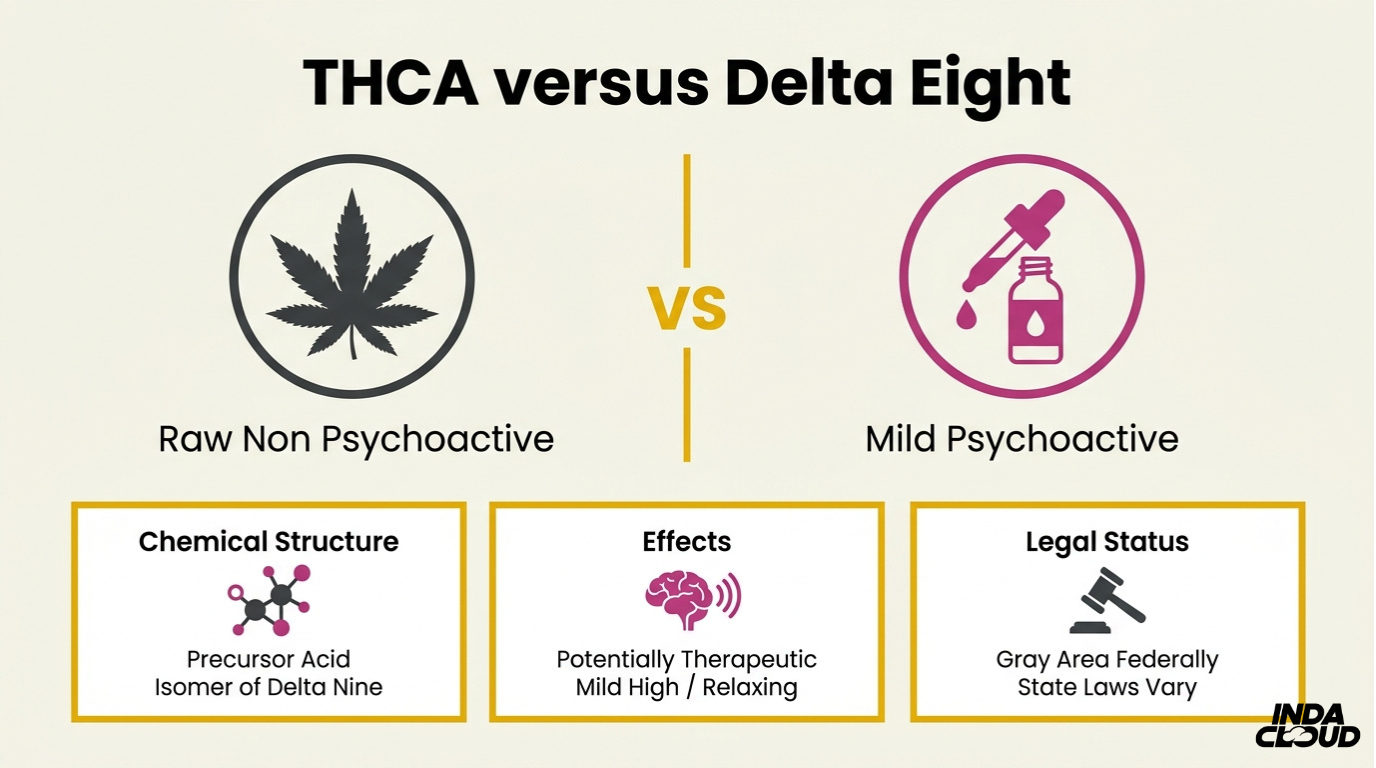
THCA is a non-psychoactive cannabinoid acid found in raw cannabis, while Delta 8 THC is a mildly psychoactive analogue of delta-9 THC. The two compounds differ in chemical structure, legal classification, and the type of experience they deliver.
This guide covers their molecular foundations and how each compound works, the distinct effects and potency levels they produce, potential wellness benefits for both cannabinoids, the evolving legal and drug testing landscape, and how to evaluate product quality before purchasing.
THCA carries an extra carboxyl group that blocks CB1 receptor binding, keeping it non-intoxicating in raw form. Heat removes that group through decarboxylation, converting THCA into full-strength delta-9 THC. Delta 8 requires no conversion; it binds directly to CB1 receptors and produces psychoactive effects in every product format.
Raw THCA delivers no high and is associated with potential anti-inflammatory and anti-emetic properties. Once heated, it becomes as potent as traditional THC. Delta 8 sits on the opposite end of the intensity spectrum, offering a milder, more sedative experience that many beginners find manageable.
Both cannabinoids face tightening federal restrictions following 2025 legislation that explicitly targets THCA and Delta 8. State-level bans vary widely, and both compounds trigger positive results on standard drug screening panels.
Product quality varies significantly across the market, particularly for Delta 8, which is typically synthesized from hemp-derived CBD through chemical conversion. Third-party lab testing for potency, pesticides, heavy metals, and residual solvents remains the most reliable way to verify safety before purchasing from any retailer.
THCA is tetrahydrocannabinolic acid, a non-psychoactive cannabinoid found naturally in raw cannabis plants. It works by interacting with the body’s endocannabinoid system without producing a high, unless heat converts it into THC through decarboxylation.
THCA has the molecular formula C22H30O4 and a molecular weight of 358.5 g/mol, according to the National Library of Medicine’s PubChem database. Unlike its derivative delta-9 THC, this acidic precursor does not bind effectively to CB1 receptors in the central nervous system, which is why consuming raw cannabis flower does not produce psychoactive effects.
The biosynthetic pathway behind THCA begins with cannabigerolic acid (CBGA), often called the “mother cannabinoid.” THCA synthase, a specialized enzyme in the cannabis plant, converts CBGA into THCA through a process involving hydride transfer from C3 of CBGA to N5 of flavin adenine dinucleotide (FAD). This enzymatic conversion occurs naturally as the plant matures.
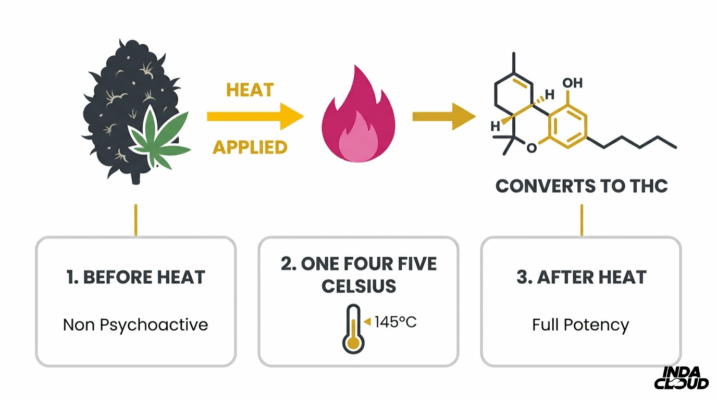
When exposed to heat through smoking, vaping, or cooking, THCA loses its carboxyl group and converts into delta-9 THC. Maximum THC formation from THCA occurs in approximately 5 to 10 minutes at 145°C, according to research published by the National Institutes of Health, with significant THC loss at longer heating times due to evaporation. This temperature sensitivity is what makes consumption method so important when choosing THCA products.
In its raw, unheated form, THCA offers a distinctly different profile. Research suggests it exhibits potential analgesic, anti-inflammatory, and anti-emetic properties through mechanisms like COX-1 and COX-2 enzyme inhibition. For consumers exploring hemp-derived cannabinoids, understanding this heat-dependent transformation is essential to predicting the actual experience a THCA product will deliver.
Delta 8 THC is a psychoactive cannabinoid and an analogue of delta-9 THC that produces milder intoxicating effects by binding to CB1 receptors in the central nervous system. Unlike THCA, delta 8 delivers psychoactive results without requiring decarboxylation.
Delta 8 THC works by interacting with the body’s endocannabinoid system, specifically targeting CB1 receptors located in the brain and central nervous system. According to the National Cancer Institute’s NCI Thesaurus, delta 8 THC binds to the cannabinoid G-protein coupled receptor CB1, exhibiting lower psychotropic potency than delta-9 THC. This reduced binding affinity is what gives delta 8 its characteristically gentler high.
Most commercial delta 8 products are not extracted directly from cannabis in significant quantities. Instead, manufacturers typically synthesize delta 8 from hemp-derived CBD through a chemical conversion process. Once consumed, delta 8 undergoes metabolism in the liver, similar to other THC variants, producing metabolites that interact with cannabinoid receptors throughout the body.
Delta 8 THC has a molecular formula of C21H30O2 and a molecular weight of 314.5 g/mol, as documented by PubChem. Its potential activities include:
For consumers comparing cannabinoids, delta 8 stands out as an option that delivers noticeable psychoactive effects right out of the package, without the intensity often associated with delta-9 THC. This profile makes it particularly relevant when weighing it against THCA, which behaves very differently depending on whether heat is applied.
THCA and Delta 8 differ in chemical structure primarily through molecular formula, molecular weight, and the presence of a carboxyl group. These structural distinctions determine whether each compound is psychoactive and how it interacts with the body’s endocannabinoid system.
THCA has the molecular formula C22H30O4 and a molecular weight of 358.5 g/mol. The defining feature is an additional carboxyl group (COOH) attached to the molecule, which prevents it from fitting into CB1 receptors in the brain. This is why raw, unheated THCA produces no intoxicating effects. According to PubChem (National Library of Medicine), THCA is classified as a non-psychoactive precursor of THC. When heat removes that carboxyl group through decarboxylation, the molecule converts into delta-9 THC and becomes psychoactive.
Delta 8 THC has the molecular formula C21H30O2 and a molecular weight of 314.5 g/mol. Without the carboxyl group, Delta 8 is already in its active form and binds directly to CB1 receptors in the central nervous system. The key structural nuance separating Delta 8 from Delta 9 THC is the placement of a double bond on the eighth carbon chain rather than the ninth. This small positional shift results in lower psychotropic potency compared to delta-9 THC.
The core structural differences between THCA and Delta 8 are:
Understanding these molecular differences matters because structure directly dictates function. For consumers exploring cannabinoid options, this distinction shapes everything from how a product is consumed to the type of experience it delivers.
The effects of THCA compare to Delta 8 differently depending on whether THCA has been heated. Raw THCA produces no high, while decarboxylated THCA delivers potent Delta 9-level effects. Delta 8 offers a milder, more relaxed experience.
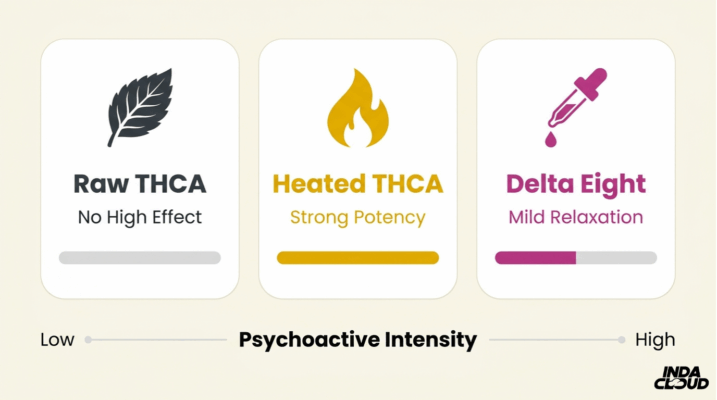
THCA feels non-intoxicating before decarboxylation. In its raw, acidic form, THCA does not bind efficiently to CB1 receptors in the central nervous system, so it produces no psychoactive high. Users who consume raw cannabis flower, juices, or tinctures containing THCA typically report no euphoria, altered perception, or cognitive impairment.
What many people experience instead are subtle functional effects. Raw THCA is often used for its potential wellness properties, including support for comfort and calm, without any of the “stoned” sensation associated with THC. This makes unheated THCA products appealing to those who want cannabinoid support during the day without impairment.
THCA feels very different after decarboxylation because heat converts it into Delta 9 THC, the primary psychoactive cannabinoid. Approximately 70% of THCA converts to THC after 30 minutes at 110°C, with conversion accelerating significantly above 140°C. Once this transformation occurs, the effects become indistinguishable from traditional Delta 9 THC.
Smoking, vaping, or baking THCA flower triggers this conversion almost instantly. Users can expect full psychoactive effects, including euphoria, heightened sensory perception, and potential couch-lock depending on the strain. For anyone who has experienced Delta 9, heated THCA delivers essentially the same intensity. This is precisely why THCA flower has become so popular; it offers potent effects under a hemp-legal framework.
Delta 8 feels noticeably milder compared to Delta 9 THC. According to the NCI Thesaurus via PubChem, Delta 8 THC binds to the CB1 receptor in the central nervous system but exhibits lower psychotropic potency than Delta 9. The relative potency ratio falls in the range of 1 to 1.4, confirming Delta 9 is slightly stronger.
Consumers consistently describe Delta 8 as having “indica-like” sedative properties with less anxiety and mental fog than Delta 9. Common reported effects include:
Because Delta 8 is typically synthesized from hemp-derived CBD rather than extracted directly from cannabis, product quality varies widely. This gentler profile makes Delta 8 a practical starting point for users who find full-strength THC too intense.
Understanding how each cannabinoid feels helps clarify which potential wellness benefits THCA and Delta 8 may offer.
The potential benefits of THCA vs Delta 8 span different wellness areas due to their distinct mechanisms. THCA works through non-psychoactive pathways, while Delta 8 offers mild psychoactive support.
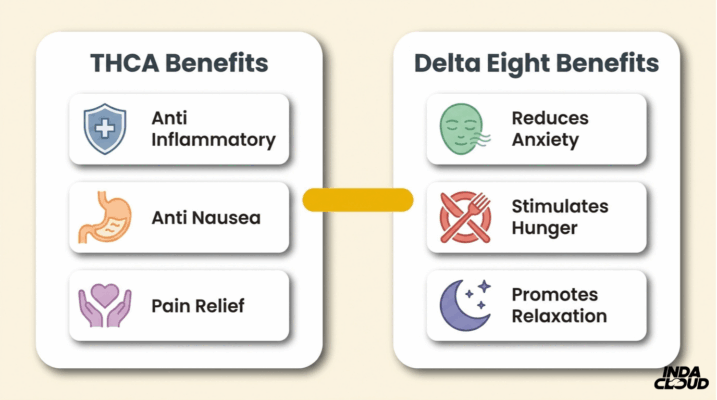
THCA offers potential wellness benefits related to pain relief, inflammation reduction, and nausea management. As a non-psychoactive cannabinoid, THCA interacts with the body without producing a high in its raw form. According to research cited by Dr. Ethan Russo, THCA exhibits potential analgesic, anti-inflammatory, and anti-emetic activities by activating CB1 receptors and inhibiting COX-1/COX-2 enzymes.
Key potential benefits of THCA include:
Because these benefits occur without psychoactive effects, THCA appeals to users who want cannabinoid support during daily activities. For anyone prioritizing functional wellness without intoxication, THCA remains one of the most promising cannabinoids to watch.
Delta 8 offers potential wellness benefits that include antiemetic, anxiolytic, appetite-stimulating, analgesic, and neuroprotective activities. Unlike THCA, Delta 8 produces these effects alongside mild psychoactive properties, which some users find beneficial for relaxation and stress relief.
Reported potential benefits of Delta 8 include:
Delta 8’s milder psychoactive profile makes it a practical option for users who want gentle relaxation paired with functional support. For those comfortable with light euphoria, Delta 8 offers a broader experiential range than non-psychoactive alternatives.
With benefits clarified, understanding whether these cannabinoids produce intoxicating effects helps narrow the right choice.
THCA will not get you high in its raw form, but it will after heat converts it to THC. Delta 8 produces a mild high on its own. The answer depends entirely on how each cannabinoid is consumed.
In its natural, unheated state, THCA is non-psychoactive. It cannot bind effectively to CB1 receptors in the central nervous system, so consuming raw THCA flower or tinctures produces no intoxicating effect. This changes completely once heat is applied. Smoking, vaping, or baking THCA triggers decarboxylation, converting it into delta-9 THC, the most potent psychoactive cannabinoid in cannabis. According to a study published by the National Institutes of Health, approximately 70% of THCA converts to THC after 30 minutes at 110°C, with conversion accelerating significantly above 140°C. Once that conversion occurs, the resulting high is essentially a full-strength delta-9 THC experience.
Delta 8 THC, by contrast, is psychoactive in every product form. Whether consumed as a gummy, vape, or tincture, Delta 8 binds to CB1 receptors and produces noticeable euphoria, relaxation, and altered perception. However, its psychotropic potency is lower than delta-9 THC. Consumers often describe the Delta 8 high as noticeably milder, with “indica-like” sedative properties that feel more manageable and less likely to trigger anxiety.
The practical distinction matters: THCA products offer a choice between non-psychoactive and fully psychoactive use depending on preparation method, while Delta 8 delivers a consistent, gentler high regardless of format. For anyone seeking a controlled, lower-intensity experience without the full force of traditional THC, Delta 8 is the more predictable option. Those who want flexibility, raw wellness benefits without impairment plus full psychoactive potential when heated, often gravitate toward THCA.
Understanding this difference in psychoactivity is the first step; comparing their relative potency reveals how the intensity of each high actually stacks up.
THCA and Delta 8 compare in potency based on whether THCA has been heated and converted into THC. Raw THCA produces no psychoactive potency, while Delta 8 delivers a mild but consistent high. Once decarboxylated, THCA becomes delta-9 THC, which surpasses Delta 8 in strength.
Delta 8 THC binds to the CB1 receptor in the central nervous system, but it exhibits lower psychotropic potency than delta-9 THC. According to a 2025 EFSA Journal assessment, the relative potency ratio between delta-9 THC and Delta 8 THC falls in the range of 1 to 1.4, confirming delta-9 as the stronger compound. Since heated THCA converts directly into delta-9, its post-decarboxylation potency exceeds Delta 8 by that same margin.
Consumers often report that Delta 8 feels noticeably milder, with sedative, “indica-like” qualities rather than the intense cerebral effects associated with delta-9 THC. For anyone comparing these two cannabinoids, the key distinction is timing: THCA carries zero potency in its raw state but unlocks full delta-9 strength when smoked or vaped, while Delta 8 delivers a predictable, moderate experience every time. This potency gap matters most when selecting products suited to individual tolerance levels.
Delta 8 is generally better for beginners seeking a mild, predictable psychoactive experience, while THCA suits those who want non-psychoactive wellness benefits in its raw form. The best choice depends on whether a beginner wants to feel a high or avoid one entirely.
Delta 8 THC produces a gentler psychoactive effect than traditional THC, which makes it more approachable for first-time users who want controlled, mild euphoria. According to ACS Laboratory, consumers report that Delta 8 THC is noticeably milder than Delta 9 and often has “indica-like” sedative properties. This lower intensity means beginners face less risk of overwhelming effects like anxiety or paranoia.
THCA, on the other hand, is non-psychoactive in its raw form. Beginners interested in potential anti-inflammatory or anti-nausea support without any high can use THCA tinctures, capsules, or raw flower juice. However, once THCA is heated through smoking, vaping, or cooking, it converts to THC and becomes fully psychoactive. Beginners who choose THCA flower should understand that lighting it will produce effects comparable to traditional cannabis.
For someone completely new to cannabinoids, the decision comes down to intent:
Regardless of which cannabinoid a beginner selects, starting with a low dose and increasing gradually remains the safest approach. Understanding how each compound behaves before and after heat exposure helps new users set accurate expectations for their experience.
THCA and Delta 8 occupy a shifting legal landscape in the United States, shaped by federal hemp law and newer restrictive legislation. The sections below cover the federal legal status of each cannabinoid and the specific states that restrict their sale.
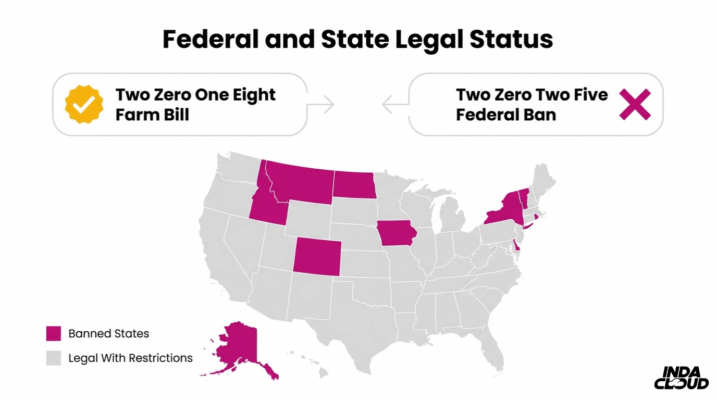
The federal legal status of THCA has changed significantly. The 2018 Farm Bill originally defined hemp as any part of the Cannabis sativa L. plant containing no more than 0.3 percent delta-9 THC on a dry-weight basis, according to the Congressional Research Service. Because THCA is not delta-9 THC, raw hemp flower naturally rich in THCA technically fell within that legal definition.
However, this loophole attracted regulatory scrutiny. THCA converts readily to psychoactive THC when heated, making high-THCA products functionally equivalent to marijuana once smoked or vaped. Federal lawmakers responded by closing this gap with legislation signed in November 2025 that establishes clear bans on THCA. For consumers, this means federally compliant THCA products face far stricter oversight than they did under the original Farm Bill framework.
The federal legal status of Delta 8 THC is now restricted. Like THCA, Delta 8 initially existed in a regulatory gray area because the 2018 Farm Bill focused its THC limit specifically on delta-9 THC. The DEA’s 2020 interim final rule clarified that all synthetically derived tetrahydrocannabinols remain controlled substances under the Controlled Substances Act, which raised questions about Delta 8 produced through chemical conversion of CBD.
The November 2025 federal legislation removed remaining ambiguity by explicitly categorizing Delta 8 as a restricted substance. This classification reflects growing concern over unregulated production methods and consumer safety. Anyone purchasing Delta 8 products should verify both federal and state compliance before buying, as enforcement is expected to tighten.
The states that restrict THCA or Delta 8 sales span a growing portion of the country. Even before the 2025 federal legislation, many states had already enacted their own bans or tight regulations on these cannabinoids.
Delta 8 THC is totally banned in Alaska, Colorado, Delaware, Idaho, Iowa, Montana, New York, North Dakota, Rhode Island, and Vermont as of 2025. Several additional states impose age restrictions, product-type limitations, or require specific licensing for sale.
THCA restrictions vary more widely by state, though the new federal bans are expected to standardize enforcement. Consumers should always check current state laws before purchasing either cannabinoid, since regulations continue to evolve rapidly. With legal standards tightening at both levels, understanding your state’s specific rules is essential before exploring any THCA or Delta 8 product.
Both THCA and Delta 8 can show up on a drug test. Standard screening panels detect THC metabolites, and both cannabinoids produce metabolites that trigger positive results.
Delta 8 THC triggers positive results on standard drug tests because the body metabolizes it into 11-nor-9-carboxy-delta-8-THC. According to Destiny Recovery Center, this metabolite cross-reacts with immunoassays designed for delta-9-THC metabolites, meaning most urine, blood, and saliva panels cannot distinguish between delta-8 and delta-9 use.
THCA presents a similar risk. Once heated through smoking, vaping, or cooking, THCA converts to delta-9 THC, which the liver processes into the same detectable metabolites screened by standard panels. Even raw THCA consumption may produce trace metabolites depending on individual metabolism.
For anyone facing upcoming employment or legal screenings, the safest approach is to avoid both cannabinoids entirely. Neither compound gets a pass from standard testing protocols, regardless of its legal status in your state.
THCA and Delta 8 are available in a wide range of product forms, from smokable flower to infused edibles. The most popular formats differ between the two cannabinoids based on how each one is consumed and activated.
The most popular THCA product types are flower, pre-rolls, and concentrates. THCA flower is the leading format because smoking or vaping it triggers decarboxylation, converting THCA into active THC on contact with heat. Pre-rolls offer the same activation in a ready-to-use format, making them a convenient option for users who prefer not to grind and pack flower themselves.
THCA concentrates, such as diamonds and live rosin, also rank among top sellers due to their high potency when dabbed or vaporized. Raw THCA tinctures and capsules serve a smaller but growing segment of consumers interested in the cannabinoid’s non-psychoactive properties. For those exploring THCA flower specifically, the format’s versatility across smoking, vaping, and cooking makes it the most adaptable product type in this category.
The most popular Delta 8 product types are gummies, vape cartridges, and disposable pens. Because Delta 8 THC is typically synthesized from hemp-derived CBD rather than extracted directly from plant material, it lends itself well to manufactured formats. According to a 2024 Dataintelo report, the global Delta 8 THC beverages market alone was valued at USD 1.24 billion, reflecting strong consumer demand for ingestible Delta 8 formats.
Gummies dominate the edibles category due to precise dosing and ease of use. Vape cartridges and disposables remain popular for users seeking faster onset, since inhalation delivers effects within minutes. Delta 8 tinctures, softgels, and infused beverages round out the product landscape, giving consumers flexibility across consumption preferences and lifestyle needs.
With product formats understood, the next step is knowing how to choose between them.
Choosing between THCA and Delta 8 products depends on your desired effects, legal situation, and commitment to verifying product quality. The following subsections cover the key decision factors and how to confirm lab testing standards.
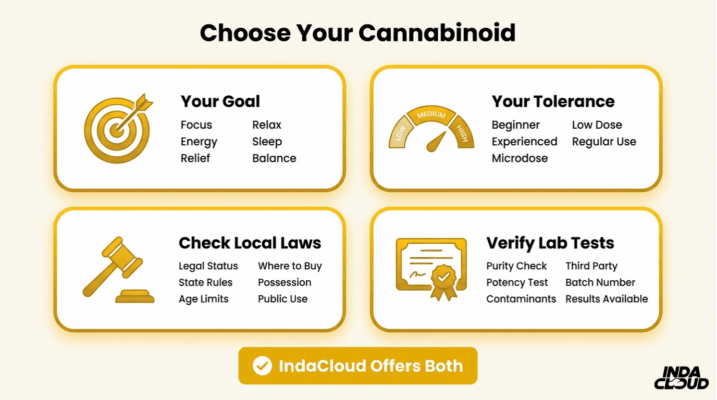
The factors that matter when deciding THCA vs Delta 8 include your experience level, desired psychoactive intensity, consumption method, and local legality. Consider these key decision points:
Matching the cannabinoid to your personal goals prevents both underwhelming and overwhelming experiences.
You verify quality and lab testing for either cannabinoid by reviewing third-party Certificates of Analysis (COAs) before purchasing. As of 2025, mandatory cannabis testing in over 38 states requires analysis for potency, pesticides, heavy metals, residual solvents, and microbiological impurities, according to industry compliance data compiled by Qbud. Look for these verification markers:
Lab testing verification matters especially for Delta 8 because its synthetic conversion process can leave chemical residues if production standards are lax. With quality confirmed, the next step is finding a trusted source for both cannabinoids.
Lab-tested THCA and Delta 8 products are available through reputable online retailers that publish third-party certificates of analysis. The following sections cover what IndaCloud offers and the key takeaways from comparing these two cannabinoids.
Yes, IndaCloud offers both THCA and Delta 8 products through its online store at indacloud.co. The product lineup spans multiple formats:
Every IndaCloud product undergoes third-party lab testing for potency, purity, and contaminant screening. Detailed certificates of analysis are available on the website, so consumers can verify exactly what they are purchasing. With over 250,000 verified customers and a team of 35 cannabis experts, IndaCloud has built its reputation on transparency and quality assurance. Many online retailers offer direct shipping to customers, with some providing free shipping on qualifying orders.
The key takeaways about THCA vs Delta 8 center on their distinct chemical behaviors, effects, and legal considerations. Here are the most actionable insights from this comparison:
Choosing between THCA and Delta 8 ultimately depends on your desired experience, tolerance level, and local laws. For consumers who prioritize verified quality and convenient access to both cannabinoids, IndaCloud provides a reliable, lab-tested selection designed to fit seamlessly into your lifestyle.
Yes, THC gummies are legal to buy in most of the United States right…
Learn more
Raw, unheated THCA clears your system in roughly 24 to 48 hours. Once you…
Learn more
Yes, edibles show up on drug tests. Standard panels detect THC edibles exactly the…
Learn more
Green Wednesday is the Wednesday before Thanksgiving, the cannabis industry’s second-biggest shopping day of…
Learn more
