FREE SHIPPING $89+
 FREE GIFTS ALL ORDERS $120+
 100% FEDERALLY LEGAL
  LAB TESTED FOR PURITY


Delta 8 THC is a naturally occurring cannabinoid found in cannabis that produces milder psychoactive effects than delta 9 THC, with a lower affinity for CB1 receptors that translates to reduced intensity and fewer adverse reactions. Because it exists only in trace amounts in the plant, most commercial delta 8 is created by converting hemp-derived CBD through a chemical process called isomerization.
This guide covers how delta 8 compares to other cannabinoids, what its effects feel like across different product types, first-time preparation and dosing, legal status and state restrictions, product safety and quality verification, drug testing implications, side effects, and responsible use practices.
Delta 8 differs from delta 9 in a single molecular bond placement, yet that small structural change produces a noticeably gentler experience; survey data shows most users report significant relaxation and euphoria with minimal anxiety or paranoia. CBD, by contrast, is entirely non-intoxicating and serves a fundamentally different purpose.
Effects vary by product format. Vapes deliver delta 8 to the bloodstream within minutes and last two to four hours, while edibles require 30 to 90 minutes for onset but sustain effects for up to eight hours. Flower and pre-rolls fall between the two.
Beginners benefit from starting at 5 to 15 mg per session and waiting at least 90 minutes before redosing, especially with edibles. Delta 8 can interact with prescription medications metabolized by cytochrome P450 enzymes, so consulting a healthcare provider beforehand is important for anyone on existing treatments.
Federal law permits hemp-derived delta 8 under the 2018 Farm Bill, though 13 states currently ban it outright. Verifying third-party lab reports, reviewing certificates of analysis for five core testing panels, and choosing transparent brands like IndaCloud are the most reliable ways to ensure product safety. Delta 8 metabolites will trigger a positive result on standard drug screenings regardless of which product type you use.
What Is Delta 8 THC and How Is It Different from Other Cannabinoids?
Delta 8 THC is a naturally occurring cannabinoid found in cannabis that produces milder psychoactive effects than its more abundant relative, delta 9 THC. The sections below cover how delta 8 compares to delta 9, how it differs from CBD, and how it is derived from hemp.
How Does Delta 8 THC Differ from Delta 9 THC?
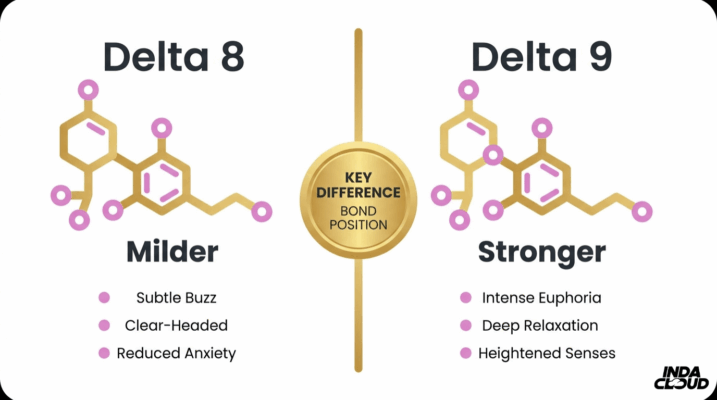
Delta 8 THC differs from delta 9 THC primarily in molecular structure and psychoactive intensity. The distinction lies in the placement of a double bond: delta 8 positions it between carbon atoms 8 and 9, while delta 9 places it between carbons 9 and 10. Because of this altered structure, delta 8 has a lower affinity for the CB1 receptor and therefore produces lower psychotropic potency.
According to an exploratory survey published in the Journal of Cannabis Research (NCBI, 2022), most delta 8 users reported significant relaxation (71%), euphoria (68%), and pain relief (55%), while experiencing notably fewer adverse effects like anxiety (74% reported none) and paranoia (83% reported none). For newcomers considering either cannabinoid, this reduced intensity often makes delta 8 a more approachable starting point.
What Is the Difference Between Delta 8 and CBD?
The difference between delta 8 and CBD centers on psychoactivity. Delta 8 THC is a partial agonist of the CB1 receptor, meaning it binds to the same receptors responsible for the cannabis “high” and produces mild euphoria and relaxation. CBD does not directly activate CB1 receptors and is non-intoxicating.
This distinction matters for product selection:
- Delta 8 THC produces noticeable mood elevation and sensory changes.
- CBD supports calm and physical comfort without any high.
- Delta 8 will trigger a positive result on standard drug tests; CBD isolate typically will not.
Both cannabinoids originate from the hemp plant, yet they serve fundamentally different purposes. If psychoactive effects are unwanted, CBD is the appropriate choice.
How Is Delta 8 THC Derived from Hemp?
Delta 8 THC is derived from hemp through a chemical process called isomerization, which converts CBD extracted from hemp into delta 8 by rearranging the molecular structure. This conversion is necessary because delta 8 occurs naturally in cannabis at substantially lower concentrations than delta 9, making direct extraction commercially impractical.
According to Cannabis Business Times, the U.S. market for delta 8 and other hemp-derived cannabinoids surged 1,283% in three years, growing from $200.5 million to nearly $2.8 billion. That explosive growth was fueled partly by a Ninth Circuit ruling affirming that the 2018 Farm Bill’s “plain and unambiguous text” legalized hemp-derived delta 8 products. This legal pathway, combined with scalable isomerization techniques, is what made the current delta 8 market possible.
With the basics of what delta 8 is and how it is made now covered, understanding its specific effects helps set clearer expectations.
What Are the Effects of Delta 8 THC?
The effects of Delta 8 THC include relaxation, mild euphoria, pain relief, and gentle mood elevation with fewer adverse reactions than Delta 9 THC. The sections below cover how the high feels, physical and mental effects, and duration.
What Does the Delta 8 High Feel Like?
The Delta 8 high feels like a milder, clearer version of the traditional cannabis experience. Users commonly describe it as relaxing without the heavy mental fog or overwhelming intensity that stronger cannabinoids can produce. According to an exploratory survey conducted by researchers at the University at Buffalo and University of Michigan, most Delta 8 THC users reported a great deal of relaxation (71%), euphoria (68%), and pain relief (55%). The experience tends to leave you functional and aware of your surroundings. Many people find it well suited for unwinding after a long day without feeling mentally incapacitated, which is part of what makes it appealing to first-time cannabinoid users.
How Does Delta 8 Affect Your Body?
Delta 8 affects your body through its interaction with the endocannabinoid system’s CB1 receptors. As a partial agonist of CB1 receptors, Delta 8 THC produces cannabimimetic activity that can ease physical tension and discomfort. Common physical effects include:
- Mild muscle relaxation and reduced physical tension.
- Increased appetite, sometimes called “the munchies.”
- Dry mouth and red eyes, which are typical cannabinoid side effects.
- A gentle body calm without heavy sedation.
Because Delta 8 has lower affinity for CB1 receptors than Delta 9 THC, these physical sensations are generally less intense. For most users, this translates to a comfortable body experience that does not interfere with everyday activities.
How Does Delta 8 Affect Your Mood and Mental State?
Delta 8 affects your mood and mental state by producing mild euphoria and a sense of calm without the anxiety or paranoia often linked to stronger THC variants. Survey data published through the National Institutes of Health found that 74% of Delta 8 users reported no anxiety and 83% reported no paranoia during use. This profile makes Delta 8 particularly practical for people who are sensitive to the psychological intensity of Delta 9. Cognitive effects like a slightly altered sense of time or mild difficulty concentrating may occur, though these tend to be subtle. For anyone seeking a mood lift that stays manageable, Delta 8 strikes a useful balance between noticeable effect and mental clarity.
How Long Do the Effects of Delta 8 Last?
The effects of Delta 8 last between two and eight hours depending on the consumption method, dosage, and individual metabolism. Inhaled forms like vapes produce effects within minutes that typically fade after two to four hours. Edibles take longer to kick in but can sustain effects for four to eight hours. Individual factors, such as body weight, tolerance, and whether you have eaten recently, also influence duration. Starting with a low dose gives you a clearer sense of your personal timeline before increasing.
With a solid understanding of how Delta 8 feels and how long it lasts, choosing the right product type becomes the next practical step.
What Are the Different Types of Delta 8 Products?
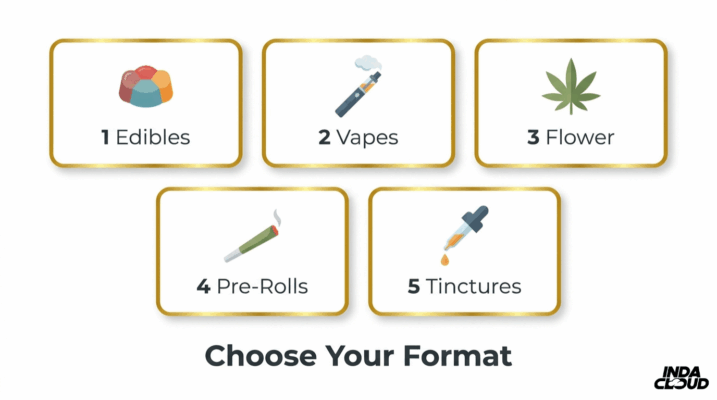
The different types of delta 8 products include edibles, vapes, flower, pre-rolls, and tinctures. Each format delivers delta 8 THC differently, affecting onset time, duration, and overall experience.
Delta 8 Edibles
Delta 8 edibles are food and beverage products infused with delta 8 THC. Common forms include gummies, chocolates, baked goods, and infused drinks. Edibles pass through the digestive system before reaching the bloodstream, which means onset is slower but effects typically last longer than inhaled formats. This makes them a popular choice for users who prefer sustained, gradual relief. Dosing is straightforward since each piece contains a measured amount of delta 8, though beginners should start with a low dose and wait before consuming more.
Delta 8 Vapes
Delta 8 vapes are inhalation devices that heat delta 8 THC distillate into vapor. They come in two primary formats: pre-filled cartridges that attach to a battery and self-contained disposable pens. Because vapor absorbs through the lungs, effects arrive faster than with edibles. Vape products are available in a wide range of strain-specific options, allowing users to choose between indica, sativa, and hybrid profiles. However, quality matters significantly with vapes. A class-action lawsuit filed in November 2024, as reported by Verisk, alleges that one manufacturer’s delta 8 vapes contained delta 9 THC, underscoring the importance of verified lab testing.
Delta 8 Flower
Delta 8 flower is hemp flower that has been coated or infused with delta 8 THC distillate. Since cannabis plants produce only trace amounts of delta 8 naturally, manufacturers apply concentrated distillate to CBD-rich hemp buds. The result is a smokable product that combines the full spectrum of hemp’s natural terpenes and cannabinoids with delta 8’s effects. Users who enjoy the ritual of grinding and packing flower often gravitate toward this format for its familiar experience and entourage effect potential.
Delta 8 Pre-Rolls
Delta 8 pre-rolls are ready-to-smoke joints filled with delta 8-infused hemp flower. They eliminate the need for grinding, rolling, or any preparation. Pre-rolls offer the same onset profile and experience as loose flower but with added convenience. Most are available in indica, sativa, and hybrid strains, so users can select based on desired effects. For anyone new to smoking delta 8, pre-rolls provide a consistent, portioned amount that simplifies dosing.
Delta 8 Tinctures
Delta 8 tinctures are liquid extracts designed for sublingual (under-the-tongue) administration. A measured dropper delivers delta 8 THC suspended in a carrier oil, typically MCT or hemp seed oil. Holding the tincture under the tongue for 30 to 60 seconds allows absorption through the mucous membranes, producing faster onset than edibles but slower than vaping. Tinctures offer precise dose control since users can adjust intake drop by drop, making them especially practical for those fine-tuning their ideal serving size.
With each product type offering a distinct experience, understanding how onset and duration vary by format helps you choose the right fit.
How Do Delta 8 Effects Vary by Product Type?
Delta 8 effects vary by product type primarily through differences in onset time, duration, and intensity. Edibles, vapes, flower, and pre-rolls each deliver delta 8 THC through distinct absorption pathways, which directly shapes the user experience.
How Quickly Do Delta 8 Edibles Take Effect?
Delta 8 edibles take effect within 30 to 90 minutes after consumption. This slower onset occurs because edibles must pass through the digestive system before delta 8 THC reaches the bloodstream. The liver metabolizes delta 8 into 11-hydroxy-delta-8-THC, a metabolite that can produce longer-lasting and more pronounced body effects compared to inhaled methods.
Several factors influence how quickly edibles kick in:
- Eating on an empty stomach speeds absorption.
- Higher body weight may require slightly larger doses.
- Individual metabolism rates create variation between users.
Although the wait is longer, edible effects typically last 4 to 8 hours. For first-time users, this extended duration means starting with a low dose is essential to avoid overcorrecting before effects fully develop.
How Quickly Do Delta 8 Vapes Take Effect?
Delta 8 vapes take effect within 1 to 5 minutes after inhalation. Vaporized delta 8 THC enters the lungs and absorbs directly into the bloodstream, bypassing the digestive system entirely. This makes vaping the fastest delivery method for delta 8.
Peak effects from vapes typically arrive within 15 to 30 minutes and last roughly 2 to 4 hours, which is noticeably shorter than edibles. According to a 2024 class-action lawsuit reported by Verisk, some delta 8 vape products were found to contain delta 9 THC due to mislabeling, underscoring why purchasing from brands that provide verified third-party lab results matters. The rapid onset of vapes makes them easier to dose incrementally; users can take a single puff, wait a few minutes, and assess effects before continuing.
How Do Delta 8 Flower and Pre-Rolls Compare in Onset Time?
Delta 8 flower and pre-rolls compare similarly in onset time because both involve combustion and direct lung absorption. Effects from either format typically begin within 2 to 10 minutes, closely mirroring the speed of vaporization.
The key differences between these two formats are practical, not pharmacological:
- Delta 8 flower requires grinding and a separate smoking device, offering more control over portion size.
- Delta 8 pre-rolls come ready to use, providing a consistent, pre-measured amount per session.
Both formats produce effects lasting approximately 2 to 4 hours. Because pre-rolls contain a fixed quantity, they can simplify dosing for newer users who prefer not to estimate amounts manually. For those prioritizing convenience, pre-rolls eliminate preparation steps while delivering the same rapid onset as loose flower.
With onset and duration varying significantly across product types, knowing your ideal experience helps narrow the right format before your first session.
What Should You Know Before Trying Delta 8 for the First Time?
Before trying Delta 8 for the first time, you should understand proper dosing, potential medication interactions, and whether this cannabinoid is appropriate for your situation. The sections below cover beginner dosage, drug interactions, and who should avoid Delta 8 THC.
What Is the Right Delta 8 Dosage for Beginners?
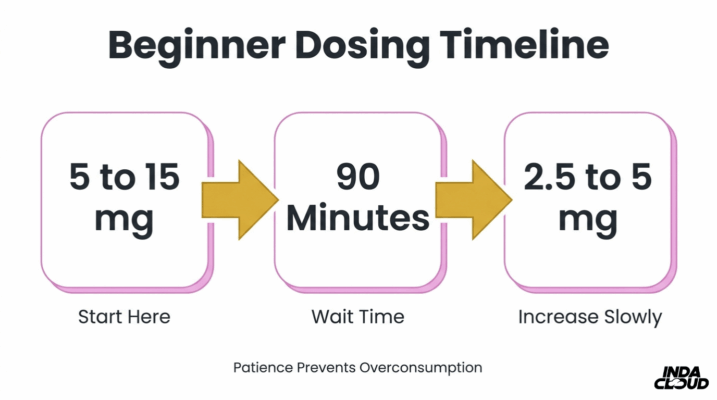
The right Delta 8 dosage for beginners is 5 to 15 mg per session. This range allows new users to gauge individual sensitivity without overconsumption. According to general industry consensus reported by Triangle Hemp Wellness, most beginners find 5 to 15 mg of Delta 8 THC to be a suitable starting point.
A practical approach to first-time dosing includes:
- Start at 5 mg, especially with edibles, where onset is slower and effects last longer.
- Wait at least 90 minutes before considering an additional dose.
- Increase by small increments of 2.5 to 5 mg in subsequent sessions.
- Cap initial sessions at no more than 15 mg total.
Because Delta 8 has lower psychotropic potency than Delta 9, some users underestimate its effects and take too much too quickly. Patience with onset time is the single most important factor for a positive first experience.
Can Delta 8 Interact with Medications?
Yes, Delta 8 can interact with medications. Delta 8 THC is metabolized by the same cytochrome P450 liver enzymes that process many common prescription drugs. This means Delta 8 may alter how your body absorbs or breaks down certain medications.
Drug categories with higher interaction risk include:
- Blood thinners, such as warfarin, where cannabinoids may amplify anticoagulant effects.
- Sedatives and benzodiazepines, which can compound drowsiness.
- Antidepressants, particularly SSRIs, where combined serotonergic activity may increase side effects.
- Heart medications, including beta-blockers and antihypertensives.
Anyone taking prescription medications should consult a healthcare provider before using Delta 8. This precaution is especially important for drugs with narrow therapeutic windows, where even minor metabolic changes can produce significant clinical effects.
Who Should Avoid Using Delta 8 THC?
Several groups should avoid using Delta 8 THC. Pregnant and breastfeeding individuals should not use any THC product, as cannabinoids cross the placental barrier and enter breast milk. Individuals under 21 lack full neurological development, making THC exposure particularly risky; the NIH reported that approximately 11% of 12th-grade students used Delta 8 in 2023, underscoring this concern.
Other groups who should avoid Delta 8 include:
- People with a personal or family history of psychotic disorders, such as schizophrenia.
- Individuals with severe cardiovascular conditions, since THC can temporarily increase heart rate.
- Anyone subject to workplace drug testing, because Delta 8 metabolites trigger positive results on standard THC screenings.
When in doubt, a conversation with a qualified healthcare provider is always the safest first step before trying any cannabinoid product.
Is Delta 8 THC Legal in the United States?
Delta 8 THC occupies a gray area in United States federal and state law. Federal legislation permits hemp-derived cannabinoids, but individual states have imposed their own restrictions. The sections below cover federal legal standing and state-level bans.
What Does Federal Law Say About Hemp-Derived Delta 8?
Federal law addresses hemp-derived Delta 8 through the 2018 Farm Bill, which defines hemp as any part of the cannabis plant containing no more than 0.3% delta-9 THC on a dry weight basis. Because Delta 8 is a distinct cannabinoid, products derived from compliant hemp fall within this legal definition. The Ninth Circuit reinforced this position, holding that the “plain and unambiguous text” of the 2018 Farm Bill legalized Delta 8 THC products derived from hemp, according to a ruling cited by Frantz Ward LLP.
However, the DEA’s Interim Final Rule specifies that hemp extracts exceeding 0.3% delta-9 THC qualify as Schedule I controlled substances. This creates a narrow compliance window for manufacturers. Consumers should verify that any Delta 8 product meets the federal delta-9 THC threshold before purchasing.
Which States Have Restricted or Banned Delta 8 THC?
The states that have restricted or banned Delta 8 THC currently total 13. As of 2026, Delta 8 is outlawed in Alaska, Colorado, Delaware, Idaho, Iowa, Montana, New York, Nevada, North Dakota, Rhode Island, Vermont, Utah, and Washington, according to the Marijuana Policy Project. Several additional states have imposed regulatory frameworks that restrict sales, labeling, or potency without a full ban.
Notably, Delta 8 THC use is highest in states where marijuana remains illegal, suggesting consumers in those markets rely on it as a legal substitute. This pattern underscores why checking your state’s current laws before purchasing is essential; regulations shift frequently as legislatures respond to the growing market.
Understanding where Delta 8 stands legally helps you evaluate product quality with greater confidence.
How Can You Tell if a Delta 8 Product Is Safe and High Quality?
You can tell if a Delta 8 product is safe and high quality by verifying third-party lab testing, reading the certificate of analysis, and watching for common red flags. The following sections cover each of these quality checkpoints.
Why Does Third-Party Lab Testing Matter for Delta 8?
Third-party lab testing matters for Delta 8 because it provides an independent verification of product safety and cannabinoid content. Unlike in-house testing, independent laboratories have no financial incentive to alter results, which makes their findings more reliable for consumers.
According to the ANSI National Accreditation Board, testing laboratories for cannabis and hemp products are generally required to be accredited to the ISO/IEC 17025 standard. This accreditation confirms that a lab follows internationally recognized procedures for accuracy and consistency.
Without independent testing, consumers have no way to confirm whether a product actually contains the cannabinoids listed on the label or whether harmful contaminants are present. For any Delta 8 purchase, a current third-party lab report should be considered non-negotiable.
What Should You Look for on a Delta 8 Certificate of Analysis?
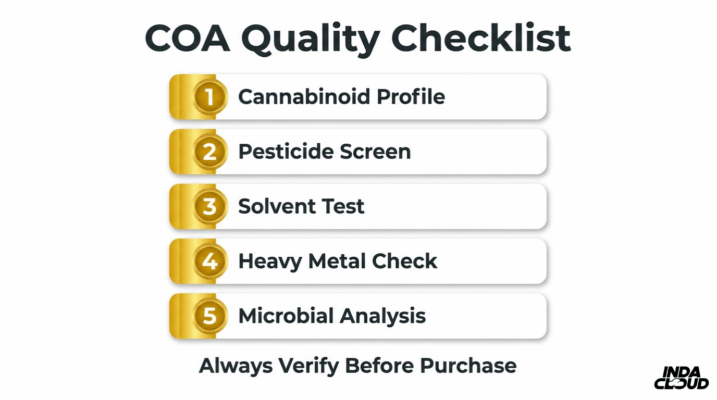
You should look for a Delta 8 certificate of analysis (COA) that covers five core testing panels. According to the Louisiana Department of Health, consumable hemp product COAs typically include a 5-panel test reporting on cannabinoids, pesticides, solvent residues, heavy-metal contaminants, and microbials.
When reviewing a COA, confirm these details:
- Cannabinoid profile matches the product label’s claimed Delta 8 THC potency.
- Pesticide screening shows results below detectable limits.
- Residual solvent testing confirms no harmful chemicals from the isomerization process remain.
- Heavy metal analysis checks for lead, arsenic, cadmium, and mercury.
- Microbial testing verifies the absence of mold, yeast, and bacteria.
Also verify that the COA includes the lab’s name, accreditation number, batch number, and a recent test date.
How Can You Spot Low-Quality or Unsafe Delta 8 Products?
You can spot low-quality or unsafe Delta 8 products by watching for several warning signs. Missing or outdated COAs, vague labeling, and unusually low prices all suggest a product that has not undergone proper quality control.
A class-action lawsuit filed in November 2024 alleges that a manufacturer’s Delta 8 vapes contained Delta 9 THC, highlighting persistent issues with market mislabeling according to Verisk. This kind of mislabeling can carry both legal and health consequences for unsuspecting buyers.
Key red flags to watch for include:
- No publicly accessible lab reports on the brand’s website.
- Packaging that mimics popular snack brands or candy, which the FDA has flagged.
- Labels missing batch numbers, ingredient lists, or cannabinoid concentrations.
- Claims that sound too good to be true, such as “cures” or medical guarantees.
Choosing brands that prioritize transparency helps reduce these risks considerably. With quality benchmarks in place, understanding how Delta 8 interacts with drug testing becomes the next practical concern.
Will Delta 8 THC Show Up on a Drug Test?
Yes, Delta 8 THC will show up on a drug test. Standard screening panels cannot distinguish between Delta 8 and Delta 9 THC metabolites, making a positive result highly likely for anyone who has recently used Delta 8 products.
The body metabolizes Delta 8 into 11-hydroxy-delta-8-THC and then into delta-8-THC-COOH, which is the primary metabolite detected in urine. This metabolite closely resembles delta-9-THC-COOH, the compound that standard drug screens target. According to research published by Aegis Sciences Corporation, delta-8 carboxy-THC produced a high degree of cross-reactivity (87–112%) across different commercially available cannabinoid immunoassay platforms.
Because of this overlap, even confirmatory testing methods may not reliably separate the two compounds. Urine, blood, saliva, and hair follicle tests all carry the risk of a positive THC result after Delta 8 use. Detection windows vary by frequency of use and individual metabolism, but occasional users may test positive for several days, while frequent users could trigger a positive result for weeks.
Anyone subject to workplace screening, athletic testing, or legal monitoring should treat Delta 8 the same as any other THC product when planning around a drug test. Understanding how Delta 8 affects your body is only part of responsible use; knowing its potential side effects helps you prepare for a well-rounded experience.
What Are the Potential Side Effects of Delta 8 THC?
The potential side effects of Delta 8 THC include dry mouth, red eyes, cognitive distortions, and temporary changes in concentration or time perception. While generally milder than Delta 9 THC, these effects still warrant attention. Below, the most commonly reported side effects, their severity, and risk factors are covered.
What Are the Most Common Side Effects?
The most common side effects of Delta 8 THC are dry mouth, red eyes, and cognitive distortions like difficulty concentrating and altered sense of time, according to GoodRx. Because Delta 8 is a partial agonist of the CB1 receptor, it produces psychoactive effects that, while less intense than Delta 9, can still affect coordination and short-term memory.
Other frequently reported effects include:
- Increased appetite and thirst
- Mild drowsiness or sedation, especially at higher doses
- Lightheadedness upon standing
- Slower reaction times
These side effects tend to be dose-dependent, so beginners who start with a lower amount are less likely to experience pronounced discomfort.
How Severe Can Delta 8 Side Effects Be?
Delta 8 side effects can range from mild discomfort to more concerning reactions requiring medical attention. Most users experience only minor, temporary effects. However, national poison control centers received 2,362 exposure cases involving Delta 8 THC products between June 2022 and August 2023, with many cases involving pediatric patients, according to the Indian Health Service.
Severity increases with several factors:
- Consuming too large a dose, particularly with edibles where onset is delayed
- Using products from unverified sources that may contain contaminants
- Combining Delta 8 with alcohol or other substances
For most adults using properly dosed, lab-tested products, severe reactions remain uncommon. The cases flagged by poison control largely reflect accidental ingestion or products with misleading packaging, not typical adult use.
Are Delta 8 Side Effects Different from Delta 9 Side Effects?
Delta 8 side effects are qualitatively similar to Delta 9 side effects but typically less intense. Survey data published through the National Institutes of Health found that 74% of Delta 8 users reported no anxiety and 83% reported no paranoia, which are two of Delta 9’s most common adverse effects.
This reduced side-effect profile stems from Delta 8’s lower affinity for the CB1 receptor. The same mechanism that makes it roughly two-thirds as potent as Delta 9 also moderates the likelihood of overwhelming psychoactive reactions. For users prone to anxiety or mental discomfort from traditional cannabis, Delta 8 often represents a more manageable option. Still, individual tolerance varies, and no cannabinoid is entirely free of risk.
What Factors Increase the Risk of Side Effects?
The factors that increase the risk of Delta 8 side effects include dosage, product quality, individual tolerance, and method of consumption. Each variable changes how the body processes and responds to Delta 8 THC.
Key risk factors include:
- High doses: Exceeding 15 mg per session as a beginner significantly raises the chance of adverse reactions.
- Unverified products: A class-action lawsuit filed in November 2024 alleged that certain Delta 8 vapes actually contained Delta 9 THC, underscoring the dangers of mislabeled products.
- Low body weight or cannabinoid inexperience: First-time users metabolize cannabinoids differently and are more susceptible to pronounced effects.
- Edible consumption without patience: Edibles take longer to activate, prompting some users to re-dose prematurely.
Choosing lab-tested products and starting with conservative doses remain the most reliable ways to minimize side-effect risk. With responsible use practices in place, the next section outlines what that approach looks like day to day.
What Does Responsible Delta 8 Use Look Like?
Responsible Delta 8 use involves managing dosage, frequency, and knowing when to abstain entirely. The following subsections cover how much to take per session, how often you can safely consume, and situations where you should avoid Delta 8 THC altogether.
How Much Delta 8 Should You Use at One Time?
You should use between 5 and 15 mg of Delta 8 at one time if you are a beginner. According to Triangle Hemp Wellness, most beginners find 5 to 15 mg of Delta 8 THC to be a suitable starting point for gauging individual tolerance. Regular users with established tolerance may gradually increase per-session doses up to 45 mg.
Starting low matters because Delta 8 is a partial agonist of the CB1 receptor, meaning its effects build incrementally. Edibles, in particular, can take longer to reach full intensity, so waiting at least 90 minutes before considering an additional dose helps prevent overconsumption. For anyone new to cannabinoids, patience with dosing is the single most important habit to develop.
How Often Is It Safe to Use Delta 8?
It is safe to use Delta 8 on an occasional to moderate basis, though no standardized frequency guideline exists from a regulatory body. Consistent daily use increases the likelihood of building tolerance, which can lead to progressively higher doses to achieve the same effects.
A practical approach is to limit sessions to a few times per week and incorporate regular breaks. These tolerance breaks allow CB1 receptors to reset, helping maintain sensitivity to lower doses over time. Monitoring how you feel between sessions also provides useful feedback; if you notice increased irritability or disrupted sleep on off days, that may signal a need to reduce frequency.
When Should You Avoid Using Delta 8 THC?
You should avoid using Delta 8 THC in several specific situations:
- You are pregnant or breastfeeding, as cannabinoids can cross the placental barrier.
- You take prescription medications, particularly blood thinners, sedatives, or anti-anxiety drugs, since Delta 8 may alter how your body metabolizes these compounds.
- You face an upcoming drug test, because Delta 8 metabolites cross-react with standard urine immunoassay kits.
- You are under 21 years of age.
- You need to drive or operate heavy machinery, as even mild psychoactive effects can impair reaction time and judgment.
When in doubt, consulting a healthcare provider before trying Delta 8 is always the safest course of action. Understanding your limits sets the foundation for choosing the right products.
Where Can You Find Trusted Delta 8 Products Online?
You can find trusted delta 8 products online through retailers that provide third-party lab testing, transparent sourcing, and compliant hemp-derived formulations. The sections below cover how IndaCloud meets these standards and summarize key takeaways about delta 8 effects, safety, and responsible use.
Can IndaCloud’s Lab-Tested Delta 8 Products Help You Find the Right Fit?
Yes, IndaCloud’s lab-tested delta 8 products can help you find the right fit. IndaCloud provides a full range of delta 8 options, including gummies, vapes, flower, and pre-rolls, all backed by third-party lab reports verifying cannabinoid content, purity, and compliance with federal hemp standards. Every product contains less than 0.3% delta-9 THC and ships directly to customers across the continental United States.
IndaCloud organizes products by desired effect, potency level, and cannabinoid type, making it straightforward for beginners and experienced users alike to match a product to their preferences. With over 250,000 verified customers and a team of 35+ cannabis experts supporting product development, IndaCloud combines accessibility with rigorous quality assurance. For anyone navigating the delta 8 market for the first time, having lab results readily available eliminates much of the guesswork that makes online purchasing feel risky.
What Are the Key Takeaways About Delta 8 Effects, Safety, and Responsible Use?
The key takeaways about delta 8 effects, safety, and responsible use center on understanding potency, verifying product quality, and starting with conservative doses. Research dating back to 1973 by Hollister and Gillespie established that delta-8-THC is about two-thirds as potent as delta-9-THC, with qualitatively similar experiential effects.
The most important principles for responsible delta 8 use include:
- Start with 5 to 15 mg per session and increase gradually over days or weeks.
- Always review a product’s certificate of analysis before purchasing.
- Confirm delta 8 legality in your state, since 13 states currently restrict or ban it.
- Expect a positive result on standard drug tests, as delta 8 metabolites cross-react with THC immunoassays.
- Avoid use before driving, operating machinery, or during pregnancy.
A lower potency profile does not eliminate risk. Choosing lab-tested products from transparent brands like IndaCloud remains the most practical way to manage both quality and safety concerns.