


Blogs

Are THC Gummies Legal? A 2026 State-by-State Guide
Yes, THC gummies are legal to buy in most of the United States right…
Learn more
You must be 21+ to enter this site
 FREE SHIPPING $89+
 FREE GIFT ON $120+
 100% FEDERALLY LEGAL
 LAB TESTED FOR PURITY
FREE SHIPPING $89+
FREE GIFT ON $120+
100% FEDERALLY LEGAL
LAB TESTED FOR PURITY
FREE SHIPPING $89+
FREE GIFT ON $120+
100% FEDERALLY LEGAL
LAB TESTED FOR PURITY
FREE SHIPPING $89+
FREE GIFT ON $120+
100% FEDERALLY LEGAL
LAB TESTED FOR PURITY
FREE SHIPPING $89+
FREE GIFT ON $120+
100% FEDERALLY LEGAL
LAB TESTED FOR PURITY
FREE SHIPPING $89+
FREE GIFT ON $120+
100% FEDERALLY LEGAL
LAB TESTED FOR PURITY
FREE SHIPPING $89+
FREE GIFT ON $120+
100% FEDERALLY LEGAL
LAB TESTED FOR PURITY
FREE SHIPPING $89+
FREE GIFT ON $120+
100% FEDERALLY LEGAL
LAB TESTED FOR PURITY
LAB TESTED FOR PURITY
FREE SHIPPING $89+
FREE GIFT ON $120+
100% FEDERALLY LEGAL
LAB TESTED FOR PURITY
FREE SHIPPING $89+
FREE GIFT ON $120+
100% FEDERALLY LEGAL
LAB TESTED FOR PURITY
FREE SHIPPING $89+
FREE GIFT ON $120+
100% FEDERALLY LEGAL
LAB TESTED FOR PURITY
FREE SHIPPING $89+
FREE GIFT ON $120+
100% FEDERALLY LEGAL
LAB TESTED FOR PURITY
FREE SHIPPING $89+
FREE GIFT ON $120+
100% FEDERALLY LEGAL
LAB TESTED FOR PURITY
FREE SHIPPING $89+
FREE GIFT ON $120+
100% FEDERALLY LEGAL
LAB TESTED FOR PURITY
FREE SHIPPING $89+
FREE GIFT ON $120+
100% FEDERALLY LEGAL
LAB TESTED FOR PURITY

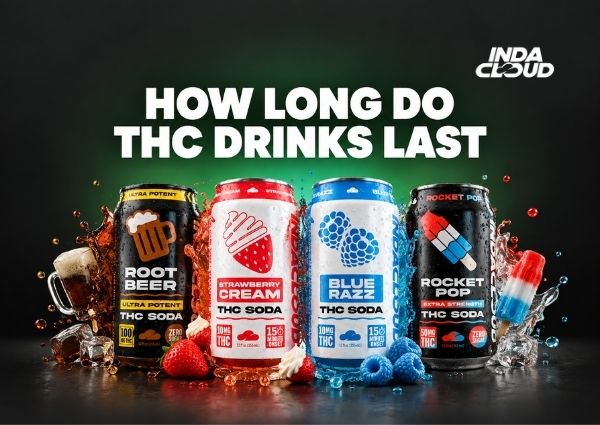
A THC drink is easier to misjudge than a gummy. It goes down like a soda, the milligrams sit in small print on the side of the can, and the effects arrive after you have already finished it.
Onset lands around 15 to 30 minutes, peak around 1 to 2 hours, and most sessions wind down inside 2 to 6 hours. Those are ranges rather than promises. Everything below is about reading them well enough to time a can around your evening.
Most cannabis-infused beverages kick in within 15 to 30 minutes, peak between 1 and 2 hours, and taper off somewhere between 2 and 6 hours after your last sip.
Here is how a typical can plays out:
Dose moves these numbers more than anything else. Formulation comes second, since not every drink is built for quick absorption, and your metabolism and tolerance handle the rest. Comparing THC sodas by milligrams per can shows how far the timeline stretches between a 10mg beverage and a 50mg one.
Anything you swallow takes the digestive route, which is slower to start and longer to finish than inhaling. Your stomach and liver both get a turn before the THC reaches your bloodstream.
Very little of a swallowed dose survives that trip. Clinical guidance published in The Permanente Journal puts oral bioavailability at roughly 4 to 12 percent, attributing the losses to stomach acid and first-pass metabolism in the liver. Inhalation lands closer to 10 to 35 percent.
The liver also changes what you feel. Grotenhermen’s pharmacokinetic review of cannabinoids reports that oral dosing converts THC to the active metabolite 11-hydroxy-THC at close to 100 percent of the parent compound, against roughly 20 percent after inhalation.
Nano-emulsification is why beverages run ahead of traditional edibles. Breaking THC into water-soluble droplets gives absorption a head start instead of making it wait on fat digestion.
The mechanism holds up in human testing. A 2025 crossover trial of a self-nanoemulsifying THC and CBD powder found peak 11-hydroxy-THC concentrations arriving in under an hour instead of about four and a half, with more than double the relative bioavailability. That was 14 volunteers and a powder, so it is evidence for the delivery method rather than a beverage figure.
Fast-acting still means waiting. Formulation quality varies between manufacturers, so a labeled dose tells you what went into the can while your body decides the rest.
Nano-emulsified drinks are commonly reported to take effect in 10 to 30 minutes, while standard beverages behave more like a light edible at 30 to 90 minutes. Those figures come from manufacturers and from what drinkers consistently describe.
No independent clinical study on canned THC beverages confirms them, which is worth holding in mind when a label advertises a number in minutes. The underlying delivery mechanism is well supported. The specific minute count on the front of a can is not.
An empty stomach speeds onset and sharpens it. A light fatty snack slows the start and can raise the intensity later.
THC is fat-soluble, so body composition affects both how quickly it moves and how long it lingers.
Two cans with identical milligrams can behave differently if the emulsion is not equally stable.
Sipping a can over 40 minutes spreads onset out. Drinking it quickly, especially carbonated, front-loads it.
The most common error with this format is a second serving before the first has finished arriving. Wait a full two hours before redosing, every time, even when onset felt quick. A drink that starts working at 20 minutes is still climbing at 45.
Peak effects usually land between 45 minutes and 2 hours after your last sip. At a well-chosen dose, that peak feels like a plateau you sit on for a while rather than a spike you ride out.
Correct dosing is what produces the plateau. Overshooting turns the same window into a sharp climb with nowhere to go but through it, which is exactly what early redosing creates.
Tolerance shifts both halves of the equation. Regular consumers often reach peak sooner and describe it as milder, while a first-time drinker at the same milligrams may hit harder and later.
Dose is the dominant lever on duration, and beverage format is a distant second. The tiers below assume a single serving with no redosing.
A 50mg single-serve can sits at the bottom edge of that top tier, which means a full evening and possibly part of the following morning. Our Blue Razz sugar-free THC soda is a 50mg can, and treating it like a 10mg seltzer is the mistake this section exists to prevent.
Format shifts the timeline by a smaller margin than dose does. Seltzers and sparkling waters usually carry lower milligrams and feel lighter and shorter as a result. Sodas span a much wider potency range, so the format tells you almost nothing about duration on its own.
Teas, coffees, and anything dairy-based tend toward a slower start, since there is more in the cup for your stomach to work through. Drink drops, mixers, and powder packs behave according to whatever dose you add, which makes measuring the pour the whole ballgame.
Cannabinoid blend matters alongside milligrams. Comparing Delta-9 sodas against a low-dose seltzer shows that two beverages with the same THC number can still land differently depending on formulation and what else is in the can.
Five factors explain most of the variation between two people drinking the same can. Each one is a dial you can adjust.
The biggest factor, and the only one you fully control. Check whether the label lists milligrams per serving or per container.
THC is fat-soluble and stores in fatty tissue, so it clears at different speeds in different bodies.
Regular consumption shortens the felt duration and blunts the peak. Time off rebuilds sensitivity faster than most people expect.
Fat changes cannabinoid absorption. A randomized crossover study in Scientific Reports found a high-fat meal sharply increased CBD absorption in 11 participants, and researchers at the University of Minnesota make the more useful point for planning: fatty food raises variability as well as absorption.
Balanced products, including many 1:1 blends, are widely described as smoother and more even, though the THC dose still sets the outer limit on duration.
Drinks occupy the middle of the three formats. They start faster and offer more control than a traditional edible, and they last longer than smoking or vaping.
| Method | Onset | Peak | Total duration | Control |
|---|---|---|---|---|
| Smoking or vaping | Under 10 minutes | 10 to 30 minutes | 2 to 4 hours | Highest, feedback is immediate |
| THC drinks | 10 to 30 minutes for nano, up to 90 for standard | 45 minutes to 2 hours | 2 to 6 hours | Good, onset arrives before you overcommit |
| Edibles | 30 minutes to 2 hours | 2 to 3 hours | 6 to 12 hours | Lowest, the wait invites early redosing |
The clinical oral figures behind that bottom row come from the same Permanente Journal guidance cited earlier, and they describe capsules and oils, not nano beverages. Beverages are the format that beat those numbers, which is why a drink is easier to steer than a gummy.
Our fuller breakdown of how drinks and edibles compare covers the trade-off in more depth. If the slower, longer arc suits you better, Delta-9 edibles are the format to look at instead of a can.
Beginners should start at 2.5 to 5 mg and stop there for the night. Two hours is the minimum wait before a second serving, and the faster onset of a beverage does not shorten it.
Faster onset is a control advantage rather than a permission slip. You get feedback sooner, which means you can stop before you overshoot. Our guidance on how many servings to take applies to cans the same way it applies to gummies.
Check milligrams per serving against milligrams per container, since a can is not automatically one serving. Our Orange Dreamsicle sugar-free THC soda and Strawberries & Cream soda both carry 50mg per can, and that number belongs in your planning before flavor does.
This is where lab testing stops being a marketing line. Every batch we sell is third-party tested with COAs posted publicly at our COA page, and per-serving milligrams are printed on the label. The Soda Shop Series lists potency per can across the line so you can pick a potency tier before you buy.
Work backwards from when you want to be finished. A 10mg can opened at 7pm has mostly resolved by bedtime. A 50mg can opened at 9pm is a 3am proposition and possibly a slow morning after.
Skip alcohol. A May 2026 JAMA Network Open crossover trial from Johns Hopkins found that combining THC edibles with alcohol produced worse and longer-lasting driving impairment than either substance alone, with impairment measurable as long as 7.5 hours after dosing. Field sobriety testing frequently missed it.
Do not drive. Clinician guidance compiled by the University of Washington’s cannabis evidence project recommends 8 to 12 hours after oral cannabis, against 6 to 8 hours after inhalation. Plan the whole night around that, not only the peak.
Store cans out of reach and locked if children are in the house. A 50mg THC soda in the fridge looks exactly like a soda, which is the entire problem.
Most shelf-stable THC beverages carry a best-by date around a year out. Potency fades well before safety becomes a question, because THC breaks down into CBN over time, and CBN is less potent and more sedating.
A four-year cannabis storage study in Forensic Science International tracked that conversion directly, with light exposure and warmth speeding it up and most of the drop happening in year one. Those measurements come from plant material rather than cans, so treat them as the reason storage matters.
Dairy or fresh-juice drinks spoil like any other perishable. Any mold, off odor, discoloration, or clumping means you discard the can.
Keep them in a cool, dark place like a pantry. Garages and cars run too hot. Heat, sunlight, and oxygen all accelerate degradation. Refrigerate after opening and finish within a few days. A can that has gone flat has lost fizz, not necessarily potency.
Yes. Hemp-derived Delta-9 THC is the same molecule tested for on a standard drug panel, and detection windows run well past the point the effects have worn off.
Hemp-derived beverages containing less than 0.3% Delta-9 THC by dry weight are federally legal under the 2018 Farm Bill, which our hemp-derived Delta-9 explainer covers in detail. State law varies, and we cannot ship to Alaska, Hawaii, Washington, or states where Delta-8 is prohibited. All sales are 21+.
The number on the can decides your night more than the flavor, the format, or the marketing on the front. A 10mg seltzer is a couple of hours. A 50mg soda is an evening with a possible morning attached.
Faster onset is the real advantage a beverage holds over a gummy, and the way to use it is to let the first serving finish before deciding anything about a second. Two hours, every time. Read the milligrams, check the COA, and pick the tier that fits the hours you actually have.
Yes, THC gummies are legal to buy in most of the United States right…
Learn more
Raw, unheated THCA clears your system in roughly 24 to 48 hours. Once you…
Learn more
Yes, edibles show up on drug tests. Standard panels detect THC edibles exactly the…
Learn more
Green Wednesday is the Wednesday before Thanksgiving, the cannabis industry’s second-biggest shopping day of…
Learn more
