FREE SHIPPING $89+
 FREE GIFTS ALL ORDERS $120+
 100% FEDERALLY LEGAL
  LAB TESTED FOR PURITY


THCA, or tetrahydrocannabinolic acid, is the raw, non-psychoactive cannabinoid naturally produced in cannabis trichomes that serves as the direct precursor to THC. Its carboxylic acid group prevents CB1 receptor binding, meaning THCA produces no high unless heat triggers decarboxylation.
This guide covers THCA’s origins and molecular identity, the science behind its conversion to THC, its therapeutic potential, how it affects the body through different consumption methods, its legal status in the United States, and how to evaluate quality products.
Cannabis plants synthesize THCA from cannabigerolic acid (CBGA) through enzymatic action during flowering, making it the dominant cannabinoid in raw flower by weight. The single structural difference between THCA and THC is that carboxylic acid group, which detaches as CO₂ when exposed to temperatures between 220 and 245°F over 30 to 60 minutes.
Preclinical research links THCA to anti-inflammatory effects through COX enzyme inhibition and PPARγ activation, neuroprotective properties relevant to conditions like Parkinson’s and Huntington’s diseases, and antiemetic potency that may exceed THC in certain models. These benefits occur without psychoactive effects when THCA remains unheated.
Consumption method determines everything. Raw juicing preserves THCA’s non-intoxicating profile, while smoking, vaping, or dabbing converts it into psychoactive THC. Concentrates like THCA diamonds can exceed 99% purity, making third-party lab verification essential.
Federally, THCA products derived from hemp remain legal under the 2018 Farm Bill’s 0.3% delta-9 THC threshold, though states like Idaho and Nebraska impose stricter restrictions. Reading a Certificate of Analysis correctly, including the total THC formula (THCA × 0.877 + delta-9 THC), helps consumers understand actual potency and compliance.
What Does THCA Stand For and How Is It Defined?
THCA stands for tetrahydrocannabinolic acid, the naturally occurring precursor to THC found in raw cannabis. It is defined as a non-psychoactive cannabinoid acid produced within the plant’s trichomes before any heat is applied.
According to the National Center for Biotechnology Information, tetrahydrocannabinolic acid has the molecular formula C22H30O4, with the IUPAC name (6aR,10aR)-1-hydroxy-6,6,9-trimethyl-3-pentyl-6a,7,8,10a-tetrahydrobenzo[c]chromene-2-carboxylic acid. This carboxylic acid group is what distinguishes THCA from its more widely known derivative. Because the extra molecular bulk prevents effective binding to CB1 receptors in the brain, THCA does not produce the intoxicating effects associated with THC.
In raw cannabis flower, THCA is the dominant cannabinoid by weight. Rather than existing as THC on the living plant, virtually all of the compound remains in its acid form until heat triggers decarboxylation. This distinction matters for consumers, researchers, and regulators alike, since the compound’s legal classification and therapeutic profile differ significantly from those of activated THC. Understanding what THCA is, at a molecular level, sets the foundation for exploring how cannabis produces it and why the conversion to THC changes everything.
How Is THCA Naturally Produced in the Cannabis Plant?
THCA is naturally produced in the cannabis plant through an enzymatic biosynthesis pathway that begins with a precursor cannabinoid. The process occurs in specialized plant structures and follows a defined chemical sequence.
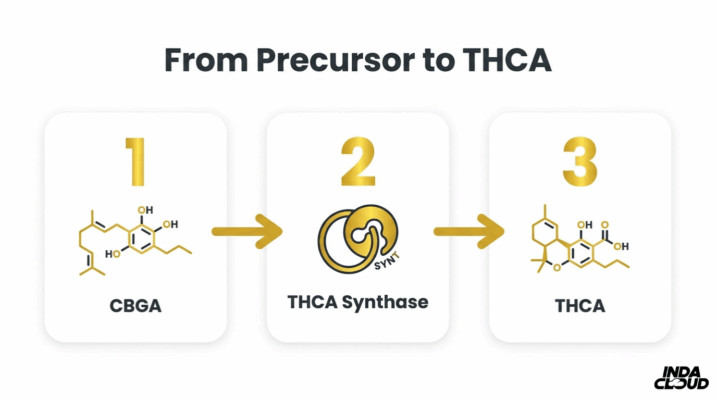
The cannabis plant synthesizes THCA within its glandular trichomes, the resin-producing glands concentrated on flowers and sugar leaves. According to a 2021 study published in Frontiers in Plant Science, THCA is synthesized from cannabigerolic acid (CBGA) through the action of the enzyme THCA synthase. CBGA serves as the universal precursor for major cannabinoids; when THCA synthase acts on CBGA, it catalyzes an oxidative cyclization reaction that converts it into THCA. This enzymatic conversion occurs primarily during the flowering stage, when trichome development peaks. Because the plant produces THCA rather than THC directly, all THC in cannabis originates as this acidic precursor. The concentration of THCA varies by genetics and growing conditions, making cultivar selection one of the most important factors in final cannabinoid content.
Understanding this biosynthetic origin clarifies why raw cannabis flower contains THCA, not THC, and why heat is required to unlock psychoactive effects.
What Is the Difference Between THCA and THC?
The difference between THCA and THC centers on one structural detail: a carboxylic acid group. THCA carries this extra molecular group, while THC does not. Below, the subsections explain how heat triggers this conversion, whether THCA produces psychoactive effects on its own, and how their chemical structures diverge.
How Does Decarboxylation Convert THCA Into THC?
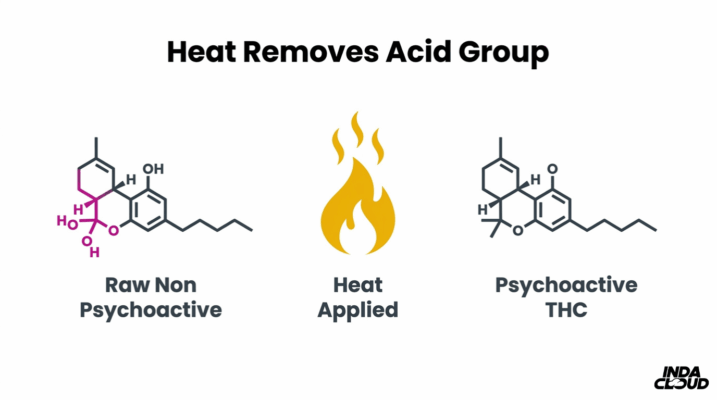
Decarboxylation converts THCA into THC by removing the carboxylic acid group from the THCA molecule, releasing it as carbon dioxide. Heat is the primary catalyst for this reaction. Smoking, vaping, or baking cannabis all supply enough thermal energy to break the bond holding that acid group in place.
According to a study published in the Journal of Industrial & Engineering Chemistry Research, optimal decarboxylation occurs at temperatures between 220 and 245°F (105 to 120°C), with the process typically requiring 30 to 60 minutes depending on the heat source. Lower temperatures preserve more terpenes but extend conversion time, while higher temperatures speed the reaction at the cost of some volatile compounds. Understanding this balance is essential for anyone looking to maximize THC potency from raw THCA flower.
Does THCA Get You High Without Being Heated?
No, THCA does not get you high without being heated. THCA is non-psychoactive in its raw form because its bulky carboxylic acid group prevents effective binding to CB1 receptors in the brain. High-potency cannabis strains contain THCA concentrations ranging from 10% to 30% by dry weight, yet consuming this flower raw produces no intoxicating effect.
Raw juicing of cannabis, for instance, allows consumption of high THCA doses without psychoactive effects. This distinction also matters in laboratory testing. High-Performance Liquid Chromatography (HPLC) is the preferred method for measuring THCA because it does not apply heat, whereas Gas Chromatography decarboxylates the sample during analysis, converting THCA to THC and skewing raw cannabinoid readings. For consumers who want therapeutic benefits without a high, keeping THCA unheated is the critical factor.
How Do THCA and THC Differ in Chemical Structure?
THCA and THC differ in chemical structure by a single carboxylic acid group (COOH) attached to the THCA molecule. THCA has the molecular formula C₂₂H₃₀O₄, while THC carries the formula C₂₁H₃₀O₂. That extra carboxyl group gives THCA a larger, three-dimensional shape that cannot fit snugly into CB1 receptor binding sites.
When heat removes this group as CO₂, the resulting THC molecule becomes smaller and flat enough to lock into CB1 receptors, producing psychoactive effects. Despite sharing nearly identical carbon ring structures, this single functional group determines whether the compound is inert or intoxicating. For anyone evaluating THCA products, recognizing this structural nuance clarifies why the same cannabis flower can be non-psychoactive raw yet powerfully psychoactive once heated.
What Are the Potential Benefits of THCA?
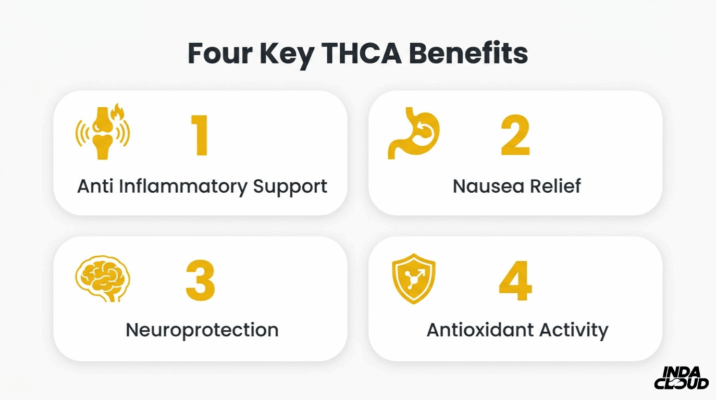
The potential benefits of THCA span anti-inflammatory support, nausea relief, neuroprotection, and antioxidant activity. Each benefit reflects THCA’s unique interactions with biological pathways before any conversion to THC occurs.
How May THCA Support Anti-Inflammatory Responses?
THCA may support anti-inflammatory responses by inhibiting cyclooxygenase enzymes and modulating key signaling pathways. According to a study published in Frontiers in Pharmacology, THCA exhibits anti-inflammatory properties by inhibiting both COX-1 and COX-2 enzymes while reducing pro-inflammatory cytokine production. Beyond enzyme inhibition, THCA also acts as a potent agonist of peroxisome proliferator-activated receptor gamma (PPARγ), a nuclear receptor involved in regulating inflammation at the cellular level. This dual mechanism, targeting both cyclooxygenase activity and PPARγ activation, gives THCA a broader anti-inflammatory profile than many single-pathway compounds. For individuals exploring cannabinoid wellness without psychoactive effects, this combination makes raw THCA particularly worth considering.
Can THCA Help With Nausea and Appetite Stimulation?
Yes, THCA can help with nausea and may support appetite stimulation based on emerging preclinical evidence. Research published in the British Journal of Pharmacology found that THCA is a more potent antiemetic than THC in preclinical models, suggesting significant potential for managing nausea and vomiting. Because THCA does not produce psychoactive effects in its raw form, it offers a practical advantage for individuals who need symptom relief while maintaining mental clarity throughout the day. This distinction is often underappreciated; the ability to address nausea without impairment makes THCA one of the more compelling raw cannabinoids for daily wellness routines.
What Neuroprotective Properties Has THCA Shown?
THCA has shown neuroprotective properties in preclinical research targeting neurodegenerative conditions. A study published in the International Journal of Molecular Sciences found that THCA demonstrates neuroprotective effects in disease models for Parkinson’s and Huntington’s diseases. These benefits are linked, in part, to THCA’s activation of the PPARγ pathway, which reduces neuroinflammation and supports neuronal survival. As Dr. Ethan Russo, a leading cannabis researcher, has noted, “THCA is non-psychoactive and has its own unique therapeutic properties, distinct from THC.” While clinical trials in humans remain limited, the preclinical data suggests that THCA’s neuroprotective profile warrants serious attention from researchers and consumers alike.
How Might THCA Contribute to Antioxidant Activity?
THCA might contribute to antioxidant activity by helping neutralize reactive oxygen species that cause cellular damage. Oxidative stress plays a role in aging, chronic inflammation, and neurodegenerative disease progression. THCA’s phenolic structure allows it to donate electrons to free radicals, stabilizing these molecules before they damage cells. This antioxidant capacity complements THCA’s anti-inflammatory and neuroprotective properties, creating overlapping protective effects. When consumed in its raw, unheated form, THCA preserves this antioxidant potential fully intact, since decarboxylation alters the molecule’s structure. Understanding how THCA interacts with the body’s endocannabinoid system adds further context to these protective effects.
What Effects Does THCA Have on the Body?
THCA affects the body through distinct pathways depending on whether it remains in raw form or undergoes heat conversion. The following subsections cover its endocannabinoid system interaction, raw consumption effects, and what changes when heat is applied.
How Does THCA Interact With the Endocannabinoid System?
THCA interacts with the endocannabinoid system differently than THC. Its bulky carboxylic acid group prevents effective binding to CB1 receptors in the brain, which is why it does not produce psychoactive effects. Instead, THCA activates alternative pathways. It acts as a potent agonist of peroxisome proliferator-activated receptor gamma (PPARγ), a nuclear receptor involved in inflammation regulation and neuroprotection.
Because THCA bypasses CB1 activation, its physiological effects occur without the intoxication associated with THC. According to Recovered.org, standard drug tests measure the metabolite THC-COOH and cannot distinguish between THC sources, meaning THCA that converts to THC during metabolism may still trigger a positive result. This indirect receptor engagement makes THCA a unique cannabinoid within the endocannabinoid system.
What Happens When You Consume Raw THCA?
When you consume raw THCA, the cannabinoid enters your body without converting to THC, preserving its non-psychoactive profile. Methods like cannabis juicing or eating raw flower deliver THCA directly to the digestive system. However, bioavailability remains limited; estimates place raw THCA absorption between 6% and 20% due to first-pass metabolism in the liver.
Despite this lower absorption rate, raw consumption allows for higher doses without intoxication. The body processes THCA through pathways like PPARγ activation rather than CB1 binding, supporting anti-inflammatory and neuroprotective responses without altering cognition. For anyone seeking the therapeutic properties of cannabis while maintaining full mental clarity, raw THCA consumption represents one of the most practical approaches available.
What Effects Occur When THCA Is Heated Before Use?
The effects that occur when THCA is heated before use are fundamentally different from raw consumption. Heat triggers decarboxylation, removing the carboxylic acid group and converting THCA into THC. This structural change allows THC to bind directly to CB1 receptors in the brain, producing psychoactive effects such as euphoria, altered perception, and relaxation.
Optimal conversion happens at temperatures between 220 and 245°F over 30 to 60 minutes, though smoking and vaping achieve near-instant decarboxylation at higher temperatures. Once converted, THC’s effects on the body include appetite stimulation, pain modulation, and mood alteration. The shift from non-psychoactive THCA to psychoactive THC underscores why consumption method is the single most important factor in determining what you actually experience.
Understanding how heat transforms THCA’s effects helps inform which consumption methods best align with your goals.
What Are the Most Common Ways to Consume THCA?
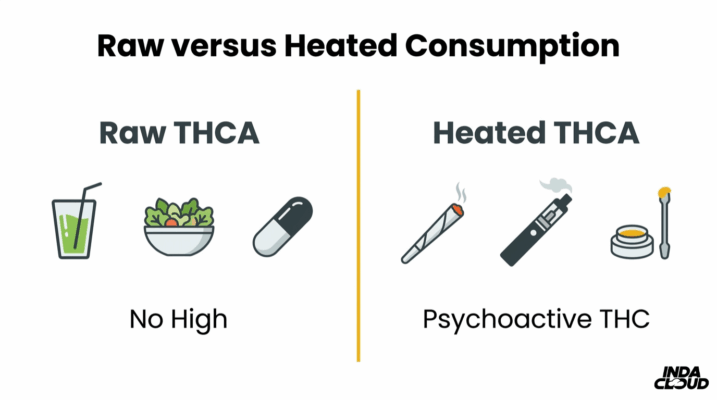
The most common ways to consume THCA include smoking flower, using pre-rolls, eating edibles, dabbing concentrates, and juicing raw cannabis. Each method affects whether THCA remains in its raw form or converts to THC through heat.
THCA Flower
THCA flower is raw cannabis bud that contains high concentrations of tetrahydrocannabinolic acid before any heat is applied. When smoked or vaporized, the heat triggers decarboxylation, converting THCA into psychoactive THC. Kept in its raw state, the flower delivers THCA without intoxicating effects. Consumers who want flexibility between raw and heated consumption often prefer flower because it accommodates both approaches. Proper storage in a cool, dark environment helps preserve the THCA content by slowing premature decarboxylation.
THCA Pre-Rolls
THCA pre-rolls are pre-ground, ready-to-smoke joints made from THCA-rich hemp flower. Lighting a pre-roll applies direct heat, which converts the THCA into THC during inhalation. This format appeals to consumers who value convenience and consistent dosing without needing to grind or pack flower themselves. Pre-rolls are available in indica, sativa, and hybrid strain profiles, allowing users to select specific terpene combinations. For those new to THCA, pre-rolls offer a controlled, single-serving format that simplifies the experience.
THCA Edibles
THCA edibles are ingestible products infused with tetrahydrocannabinolic acid. Unlike traditional cannabis edibles that contain decarboxylated THC, true THCA edibles use raw or minimally processed cannabinoid extracts to preserve the acid form. Because THCA has not been heated, these edibles do not produce psychoactive effects. However, if an edible undergoes baking or cooking at high temperatures during production, some THCA may convert to THC. Consumers seeking the raw cannabinoid’s properties should verify that the product label specifies unheated or raw THCA extraction.
THCA Concentrates and Diamonds
THCA concentrates and diamonds are highly purified crystalline extracts containing isolated tetrahydrocannabinolic acid. Diamonds, in particular, can reach purity levels above 99%, making them among the most potent THCA products available. When dabbed at high temperatures, the THCA converts rapidly into THC. According to Secret Nature, third-party testing for contaminants such as pesticides, heavy metals, and microbials is critical for ensuring the safety and purity of THCA concentrates and diamonds. Always review the certificate of analysis before purchasing these products, as purity at this concentration level demands rigorous quality verification.
Raw Cannabis Juicing
Raw cannabis juicing involves blending fresh, unheated cannabis leaves and buds into a drinkable juice. This method preserves THCA in its natural acidic form because no heat is applied during preparation. Juicing allows consumption of higher THCA doses without psychoactive effects, making it popular among wellness-oriented users. Fresh, uncured plant material works best since drying and curing can initiate partial decarboxylation. While raw juicing maximizes THCA intake, bioavailability remains relatively low due to first-pass metabolism in the digestive system.
With these consumption methods in mind, understanding how THCA compares to other cannabinoids clarifies its unique role.
How Is THCA Different From Other Cannabinoids?
THCA differs from other cannabinoids in its acidic molecular structure, its non-psychoactive nature before decarboxylation, and its distinct receptor activity. The subsections below compare THCA to CBD, Delta-8 THC, and CBDA.
How Does THCA Compare to CBD?
THCA compares to CBD in that both cannabinoids are non-intoxicating, yet they differ in origin, molecular pathway, and mechanism of action. THCA is the raw acidic precursor to THC found in fresh cannabis, while CBD is derived from CBDA through a separate biosynthetic route. Their receptor interactions also diverge: THCA activates PPARγ receptors to produce anti-inflammatory and neuroprotective effects, whereas CBD primarily modulates serotonin and vanilloid receptors. One critical practical difference involves drug testing. Standard drug tests measure the metabolite THC-COOH, so THCA that converts to THC through heat or metabolism can trigger a positive result. CBD, by contrast, does not metabolize into THC and carries no such risk.
How Does THCA Compare to Delta-8 THC?
THCA compares to Delta-8 THC in several fundamental ways. THCA is a raw, acidic cannabinoid that produces no psychoactive effects unless heated, while Delta-8 THC is an already-decarboxylated isomer that binds directly to CB1 receptors and produces mild intoxication. This distinction matters for consumers seeking therapeutic benefits without impairment. THCA offers anti-inflammatory and antiemetic potential through PPARγ activation, a pathway Delta-8 does not engage as strongly. From a regulatory standpoint, both exist in a legal gray area under the 2018 Farm Bill’s 0.3% delta-9 THC threshold, though state-level restrictions vary considerably. For anyone prioritizing clear-headed wellness support, THCA in its raw form is the more practical choice.
How Does THCA Compare to CBDA?
THCA compares to CBDA in that both are acidic precursor cannabinoids found in raw cannabis, yet they serve different therapeutic roles. THCA is the precursor to THC, while CBDA is the precursor to CBD. Both share a carboxylic acid group that prevents psychoactive effects, and both lose that group through decarboxylation. Where they diverge is in receptor activity: THCA acts as a potent PPARγ agonist, driving neuroprotective and anti-inflammatory responses, while CBDA shows stronger affinity for serotonin (5-HT1A) receptors, making it particularly relevant for nausea and anxiety research. For consumers exploring raw cannabinoid wellness, combining both acidic compounds may offer complementary benefits across different biological pathways.
Understanding how THCA stands apart from these cannabinoids helps clarify its legal classification under federal hemp law.
Is THCA Legal in the United States?
THCA is legal in the United States at the federal level when derived from hemp containing no more than 0.3% delta-9 THC. However, individual state laws create a patchwork of regulations that can restrict THCA products.
What Does the 2018 Farm Bill Say About THCA?
The 2018 Farm Bill says that hemp, defined as Cannabis sativa L. with a delta-9 THC concentration of not more than 0.3 percent on a dry weight basis, is federally legal. According to the U.S. Government Publishing Office, this threshold applies to the plant and any part of it, including derivatives and extracts.
Because the Farm Bill’s legal definition specifically references delta-9 THC rather than total THC, THCA itself is not explicitly restricted at the federal level. This distinction is what allows hemp-derived THCA products to exist in the legal marketplace. That said, regulatory interpretations continue to evolve, and proposed federal rules could eventually close this gap. Consumers should monitor legislative updates closely, particularly any revisions to how total THC is calculated for compliance purposes.
How Do State Laws Affect THCA Legality?
State laws affect THCA legality by creating restrictions that go beyond the federal framework. While THCA products meet the 0.3% delta-9 THC threshold set by the Farm Bill, states like Idaho and Nebraska maintain restrictive laws that may prohibit THCA products entirely.
Some states define “THC” broadly enough to include THCA or use total THC formulas that account for THCA’s potential conversion. Others have enacted their own hemp regulations that either mirror federal standards or impose stricter limits. Before purchasing any THCA product, checking your specific state’s cannabis and hemp laws is essential. This legal variability is one reason why understanding lab results and compliance testing matters for informed purchasing decisions.
How Should You Read THCA on Lab Test Results?
Reading THCA on lab test results requires understanding two key values: the THCA percentage listed on the Certificate of Analysis and how that figure converts into total THC potency.
What Does THCA Percentage Mean on a COA?
The THCA percentage on a COA represents the concentration of tetrahydrocannabinolic acid present in the product before any heat is applied. This value reflects the raw, non-psychoactive cannabinoid content measured through laboratory analysis.
A higher THCA percentage indicates greater potency potential once the product is heated. Because THCA itself does not produce intoxicating effects in its raw form, the percentage on a COA should not be confused with active THC content. Consumers reviewing lab results should look for this value alongside delta-9 THC levels to understand both the current and potential psychoactive profile of the product.
How Do You Calculate Total THC From THCA Content?
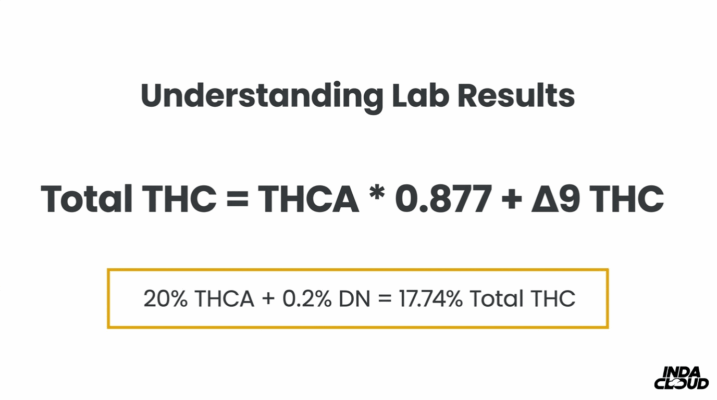
You calculate total THC from THCA content using this standard formula: Total THC = (THCA × 0.877) + Delta-9 THC. The 0.877 multiplier accounts for the molecular weight lost when the carboxylic acid group detaches as carbon dioxide during decarboxylation.
This calculation matters because THCA is non-psychoactive in its raw state. According to research published in the British Journal of Pharmacology, the large carboxylic acid group on THCA prevents it from effectively binding to CB1 receptors in the brain. Once heat removes that group, the resulting THC binds readily to those receptors.
For practical purposes, a product listing 20% THCA and 0.2% delta-9 THC yields a total THC of approximately 17.74%. Understanding this conversion helps consumers anticipate actual potency after smoking, vaping, or cooking with THCA products.
How Can You Choose Quality THCA Products Online?
You can choose quality THCA products online by verifying third-party lab results, checking for transparent sourcing, and selecting brands with proven compliance standards. The following sections cover a trusted hemp-derived option and summarize the essential takeaways about THCA.
Can IndaCloud’s Hemp-Derived Products Offer THCA?
Yes, IndaCloud’s hemp-derived products can offer THCA. IndaCloud carries premium THCa flower, pre-rolls, and other hemp-derived formats, all containing less than 0.3% delta-9 THC to maintain federal compliance. Every product undergoes comprehensive third-party testing for potency, pesticides, heavy metals, and microbials.
According to a Yahoo Finance market analysis, the global cannabis market is projected to grow from $39.1 billion in 2024 to over $151 billion by 2033, with THCA products representing a significant portion of the hemp-derived sector. IndaCloud is well positioned within this expanding market, backed by over 250,000 verified customers and a team of 35+ cannabis experts. For anyone exploring THCA, prioritizing brands that publish accessible Certificates of Analysis remains the single most reliable quality indicator.
What Are the Key Takeaways About THCA Benefits and Effects?
The key takeaways about THCA benefits and effects center on its unique non-psychoactive profile and versatile therapeutic potential. Essential points to remember include:
- THCA is the raw, acidic precursor to THC found naturally in cannabis trichomes.
- Its carboxylic acid group prevents CB1 receptor binding, so it does not produce a high unless heated.
- Preclinical research links THCA to anti-inflammatory, neuroprotective, and antiemetic properties.
- Decarboxylation through heat converts THCA into psychoactive THC.
- Lab results using HPLC testing preserve THCA content, while gas chromatography converts it during analysis.
- Legal status depends on delta-9 THC concentration under the 2018 Farm Bill, though state laws vary.
Understanding these fundamentals helps consumers make informed decisions when selecting THCA products from trusted sources like IndaCloud.