


Blogs

Are THC Gummies Legal? A 2026 State-by-State Guide
Yes, THC gummies are legal to buy in most of the United States right…
Learn more
You must be 21+ to enter this site
 FREE SHIPPING $89+
 FREE GIFT ON $120+
 100% FEDERALLY LEGAL
 LAB TESTED FOR PURITY
FREE SHIPPING $89+
FREE GIFT ON $120+
100% FEDERALLY LEGAL
LAB TESTED FOR PURITY
FREE SHIPPING $89+
FREE GIFT ON $120+
100% FEDERALLY LEGAL
LAB TESTED FOR PURITY
FREE SHIPPING $89+
FREE GIFT ON $120+
100% FEDERALLY LEGAL
LAB TESTED FOR PURITY
FREE SHIPPING $89+
FREE GIFT ON $120+
100% FEDERALLY LEGAL
LAB TESTED FOR PURITY
FREE SHIPPING $89+
FREE GIFT ON $120+
100% FEDERALLY LEGAL
LAB TESTED FOR PURITY
FREE SHIPPING $89+
FREE GIFT ON $120+
100% FEDERALLY LEGAL
LAB TESTED FOR PURITY
FREE SHIPPING $89+
FREE GIFT ON $120+
100% FEDERALLY LEGAL
LAB TESTED FOR PURITY
LAB TESTED FOR PURITY
FREE SHIPPING $89+
FREE GIFT ON $120+
100% FEDERALLY LEGAL
LAB TESTED FOR PURITY
FREE SHIPPING $89+
FREE GIFT ON $120+
100% FEDERALLY LEGAL
LAB TESTED FOR PURITY
FREE SHIPPING $89+
FREE GIFT ON $120+
100% FEDERALLY LEGAL
LAB TESTED FOR PURITY
FREE SHIPPING $89+
FREE GIFT ON $120+
100% FEDERALLY LEGAL
LAB TESTED FOR PURITY
FREE SHIPPING $89+
FREE GIFT ON $120+
100% FEDERALLY LEGAL
LAB TESTED FOR PURITY
FREE SHIPPING $89+
FREE GIFT ON $120+
100% FEDERALLY LEGAL
LAB TESTED FOR PURITY
FREE SHIPPING $89+
FREE GIFT ON $120+
100% FEDERALLY LEGAL
LAB TESTED FOR PURITY

THCA legality in 2026 is the legal status of tetrahydrocannabinolic acid, a non-intoxicating hemp cannabinoid, under federal and state laws that are undergoing their most significant overhaul since the 2018 Farm Bill.
This guide covers the science behind THCA and its regulatory significance, federal legal changes taking effect in November 2026, state-by-state legality across all 50 states, purchasing and possession rules, testing and labeling standards, product-type regulations, and future legislative trends.
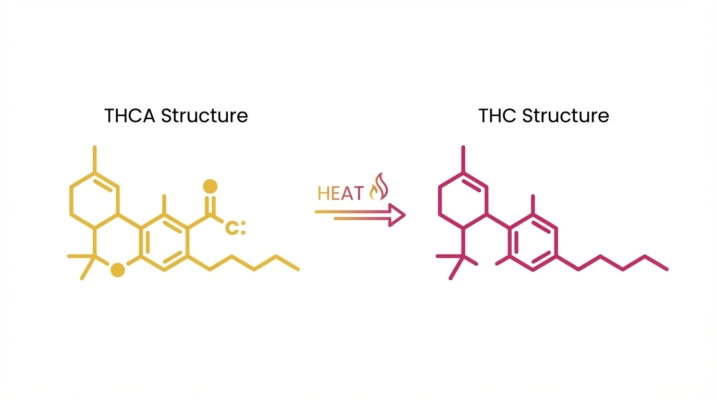
THCA is the acidic precursor to delta-9 THC, carrying an extra carboxyl group that prevents it from producing psychoactive effects in raw form. Heat converts THCA into active THC through decarboxylation, and this conversion potential is why regulators now treat THCA as more than an inert compound.
At the federal level, the 2018 Farm Bill’s delta-9-only testing standard currently keeps most THCA products legal. That changes on November 12, 2026, when Section 781 of the Continuing Appropriations and Extensions Act redefines hemp by total THC content, caps final consumer products at 0.4 mg total THC per container, and explicitly includes THCA in the calculation.
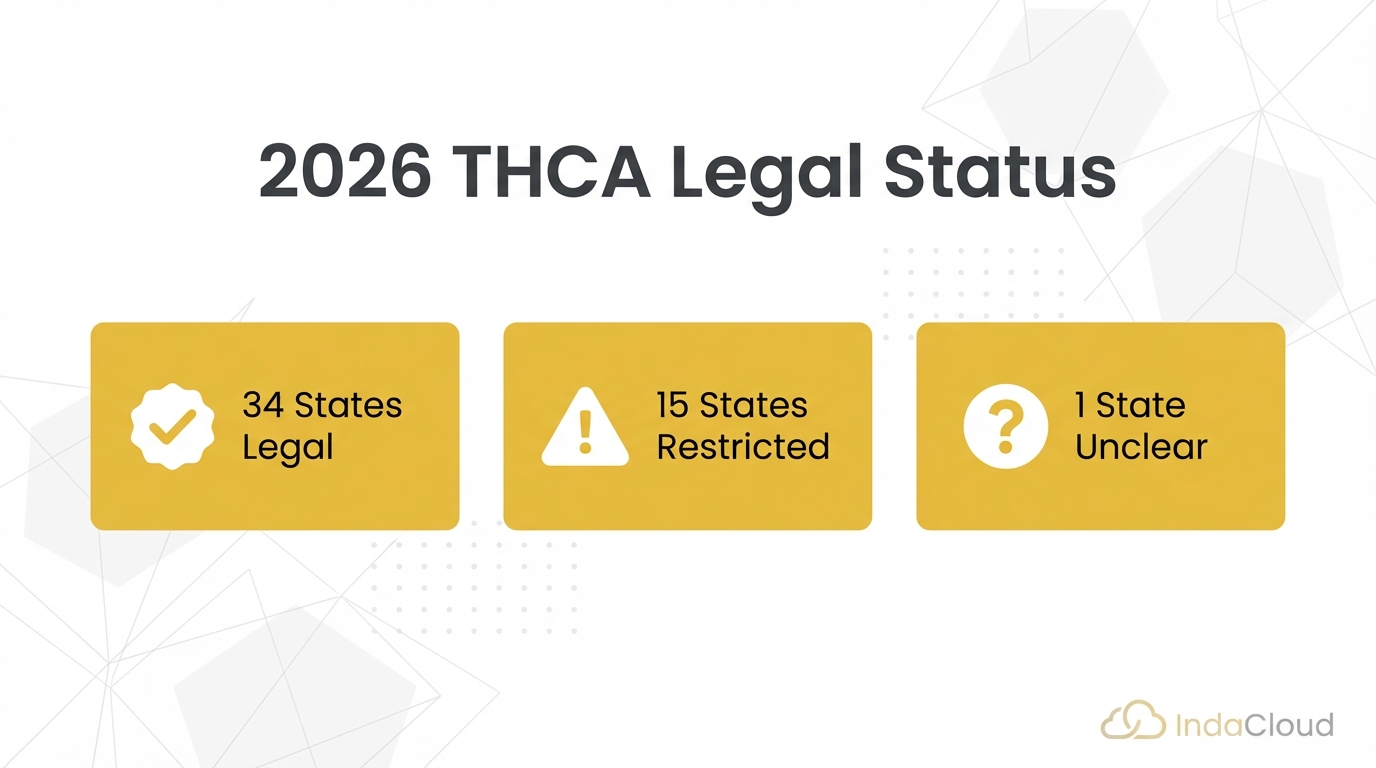
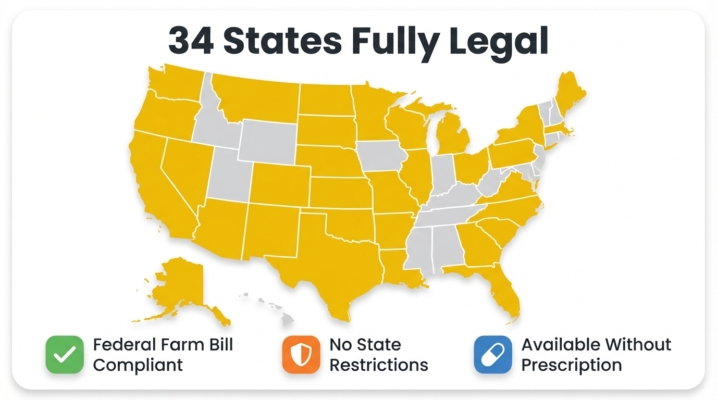
Every state breaks down into three categories: fully legal (34 states following the current delta-9 threshold), banned or restricted (15 states using total THC testing or controlled substance classifications), and conditional or ambiguous (states where enforcement interpretation remains unclear).
State laws also shape age requirements, possession limits, interstate travel risks, and how different product types like flower, edibles, vapes, and concentrates are regulated. Testing methodology varies between pre-decarb and post-decarb analysis, directly determining whether high-THCA products pass compliance in a given market.
THCA is a non-intoxicating cannabinoid found naturally in raw cannabis that converts into psychoactive THC when heated. Its legal status matters in 2026 because federal law is shifting from a delta-9-only THC threshold to a total THC standard that includes THCA.
The difference between THCA and THC is their chemical structure, receptor activity, and psychoactive potential. THCA (tetrahydrocannabinolic acid) is the acidic precursor of delta-9-THC, biosynthesized from cannabigerolic acid in cannabis plants. In its raw form, THCA carries an extra carboxyl group that prevents it from fitting efficiently into CB1 receptors in the brain.
According to research published in the NIH Cannabis and Cannabinoid Research Journal, THC shows 62-fold greater affinity at CB1 receptors and 125-fold greater affinity at CB2 receptors compared to THCA. THC produces psychoactive effects by activating those CB1 receptors, leading to perceptual alterations and cognitive changes. THCA, by contrast, does not produce euphoria or intoxication at typical doses. This molecular distinction is precisely what makes THCA’s legal classification so contentious; regulators must decide whether to treat it as a harmless precursor or as potential THC.
The 2018 Farm Bill still affects THCA legality because it established the federal legal framework that most THCA products currently rely on. The Agriculture Improvement Act of 2018 defined hemp as Cannabis sativa L. with a delta-9 THC concentration of not more than 0.3 percent on a dry weight basis, according to the USDA. This definition excluded hemp and its derivatives from the Controlled Substances Act.
Because that threshold measured only delta-9 THC, raw THCA flower containing minimal delta-9 qualified as legal hemp, even when total potential THC was far higher. This distinction created the regulatory gap that allowed THCA products to flourish nationwide. Until the Continuing Appropriations and Extensions Act takes effect on November 12, 2026, the 2018 Farm Bill’s delta-9-only standard remains the operative federal benchmark for hemp compliance.
THCA converts to THC through decarboxylation, a heat-driven chemical reaction that removes the carboxyl group from the THCA molecule. Smoking, vaping, or baking cannabis triggers this process. According to NIH research published in 2017, decarboxylation of THCA is complete at 160°C, with THCA converting approximately twice as fast as other acidic cannabinoids like CBDA or CBGA.
Even without direct heat, slow degradation occurs over time. THCA stored at room temperature in glass bottles dropped to 80% of initial levels after 25 months, while refrigerated samples retained 94.7% stability. This gradual conversion is why regulators increasingly favor total THC testing over delta-9-only analysis. Understanding decarboxylation is essential for evaluating how federal and state laws will measure THC content going forward.
THCA legality at the federal level in 2026 depends on which part of the year you are asking about. The subsections below cover the DEA’s current position, how the 0.3% delta-9 THC threshold applies, and the major legislation set to redefine hemp starting November 2026.
The DEA’s current stance on THCA means the compound remains legal when derived from hemp that meets the 2018 Farm Bill definition. Because the Agriculture Improvement Act of 2018 excluded hemp and its derivatives from the Controlled Substances Act, THCA in compliant hemp products is not a scheduled substance under existing enforcement. The DEA has not independently reclassified THCA as a controlled cannabinoid.
However, this position carries an expiration date. Once the Continuing Appropriations and Extensions Act, 2026 takes effect on November 12, 2026, total THC calculations will include THCA, fundamentally changing what qualifies as legal hemp. For consumers purchasing THCA products before that deadline, the current framework still applies; after it, most THCA products will exceed the new federal limits.
The 0.3% delta-9 THC threshold applies to THCA by technically excluding it from measurement. According to the USDA, the 2018 Farm Bill defined hemp as Cannabis sativa L. with a delta-9 THC concentration of not more than 0.3 percent on a dry weight basis. Because this standard measures only delta-9 THC, not total THC, raw THCA content does not count against the limit.
This distinction created a significant regulatory gap. Products containing high concentrations of THCA could test below 0.3% delta-9 THC in their raw form yet convert to psychoactive THC when heated. Understanding the chemical and regulatory distinctions between THCa and delta-9 THC is essential for evaluating how this loophole operates. For most of the hemp industry’s growth since 2018, this gap allowed THCA flower and concentrates to remain federally compliant despite their potential potency after decarboxylation..
Yes, federal legislation has changed THCA’s status since 2024. According to an Arnold & Porter advisory, Section 781 of the Continuing Appropriations and Extensions Act, 2026 (H.R. 5371), effective November 12, 2026, redefines hemp products by total THC content instead of solely delta-9 THC content, explicitly including THCA and any other cannabinoids with similar effects to THC.
Key changes under this law include:
The 2026 Farm Bill passed without a two-year delay for these provisions, confirming the November 12, 2026 implementation date will proceed as scheduled. This represents the most consequential shift in federal hemp regulation since the original 2018 Farm Bill, and it will directly determine which states can continue permitting THCA sales.
The states with fully legal THCA in 2026 are those that follow the 2018 Farm Bill’s 0.3% delta-9 THC threshold without imposing additional restrictions on THCA specifically. Below is a state-by-state breakdown covering legality, key conditions, and what consumers should know.
Alaska permits THCA products derived from hemp containing no more than 0.3% delta-9 THC on a dry weight basis. The state also operates a regulated adult-use cannabis market, so hemp-derived THCA products exist alongside dispensary offerings. Consumers 21 and older can purchase THCA flower, edibles, and concentrates without a medical card.
Arizona allows hemp-derived THCA under its alignment with the 2018 Farm Bill. The state legalized adult-use cannabis in 2020, creating a dual market where both hemp-derived and dispensary products coexist. THCA products must test below 0.3% delta-9 THC to qualify as legal hemp.
California permits hemp-derived THCA products that comply with the federal 0.3% delta-9 THC limit. However, Assembly Bill 45 established additional labeling and testing requirements for hemp-derived cannabinoid products sold in the state. Retailers must ensure products carry compliant labels and certificates of analysis.
Colorado allows hemp-derived THCA under its hemp program, though the state applies some of the nation’s stricter cannabinoid regulations. Senate Bill 23-271 imposed limits on certain intoxicating hemp products, particularly edibles and products marketed to younger consumers. THCA flower remains available, but product formulations face scrutiny.
Connecticut permits THCA derived from hemp that meets the 0.3% delta-9 THC standard. The state’s adult-use cannabis program operates separately from hemp sales. Consumers can legally purchase THCA products, though retailers must comply with state labeling and packaging requirements.
Florida allows hemp-derived THCA products under state law aligned with the 2018 Farm Bill. Senate Bill 1698 established a regulatory framework for hemp-derived consumables, including age verification requirements. Buyers must be 21 or older for inhalable products. Florida remains one of the largest markets for THCA flower and vapes. For a detailed breakdown of purchasing rules and pending legislation, explore our full guide on THCA legality in Florida.
Georgia permits hemp-derived THCA products containing no more than 0.3% delta-9 THC. The state’s hemp program, established under House Bill 213, legalized the production and sale of hemp products. Without a recreational cannabis market, hemp-derived THCA serves as the primary legal cannabinoid option for Georgia residents.
Illinois allows hemp-derived THCA under its 2018 Farm Bill alignment. The state also has a licensed adult-use cannabis market, creating two parallel legal pathways for THC-related products. Hemp-derived THCA products must meet federal delta-9 THC limits and comply with Illinois labeling standards.
Indiana permits THCA products derived from hemp that contains no more than 0.3% delta-9 THC. The state legalized hemp under Senate Enrolled Act 516. Without a medical or recreational cannabis program, hemp-derived THCA products represent one of the few legal cannabinoid options available to Indiana consumers.
Kansas allows hemp-derived THCA under its alignment with the federal hemp definition. The state passed the Alternative Crop Research Act and subsequent hemp legislation permitting the sale of compliant hemp products. Because Kansas has no medical or recreational cannabis program, THCA products fill a significant consumer demand.
Kentucky permits hemp-derived THCA products under its robust state hemp program. As one of the first states to embrace industrial hemp production, Kentucky’s regulatory framework supports the sale of THCA products meeting the 0.3% delta-9 THC threshold. The state has no recreational cannabis market, making hemp-derived THCA widely popular.
Louisiana allows hemp-derived THCA products that comply with the federal 0.3% delta-9 THC standard. The state enacted Act 164 to regulate consumable hemp products, including age restrictions requiring buyers to be 21 or older for certain product types. Retailers must display third-party lab results.
Maine permits THCA derived from hemp under both its state hemp program and adult-use cannabis framework. Hemp-derived THCA products must contain no more than 0.3% delta-9 THC. The state’s established cannabis market means consumers can access THCA through both hemp retailers and licensed dispensaries.
Maryland allows hemp-derived THCA products compliant with the 2018 Farm Bill. The state legalized adult-use cannabis in 2023, creating a regulated dual market. Hemp-derived THCA products remain available through online retailers and brick-and-mortar shops that meet state compliance requirements.
Massachusetts permits hemp-derived THCA under its alignment with federal hemp law. The Cannabis Control Commission oversees both cannabis and hemp-derived product regulations. THCA products must test below 0.3% delta-9 THC and comply with state packaging and labeling standards.
Michigan allows hemp-derived THCA products under its hemp program. The state’s well-established adult-use cannabis market operates alongside hemp product sales. THCA flower, vapes, and edibles derived from compliant hemp remain legal for consumers 21 and older.
Missouri permits THCA products derived from hemp meeting the 0.3% delta-9 THC threshold. Following the passage of Amendment 3 legalizing recreational cannabis, the state now has a dual market. Hemp-derived THCA products remain accessible without requiring a dispensary visit.
Montana allows hemp-derived THCA under its state hemp program and federal alignment. The state also legalized adult-use cannabis, providing multiple legal pathways for cannabinoid access. THCA products from hemp must comply with the 0.3% delta-9 THC limit.
Nebraska currently permits hemp-derived THCA products under the federal 0.3% delta-9 THC standard, but enforcement is shifting. According to the Office of Governor Jim Pillen, an executive order signed on January 27, 2026 directed state agencies to review laws regarding synthetic THC in consumable products, citing the upcoming federal redefinition effective November 2026. Consumers should expect tightening restrictions throughout the year.
Nevada permits hemp-derived THCA products that comply with federal hemp standards. The state operates a mature adult-use cannabis market alongside its hemp program. THCA products must contain no more than 0.3% delta-9 THC to be sold outside the licensed dispensary system.
New Hampshire allows hemp-derived THCA under its alignment with the 2018 Farm Bill. The state does not have a recreational cannabis market, so hemp-derived THCA products serve as a primary legal cannabinoid option. Products must meet the federal 0.3% delta-9 THC threshold.
New Jersey permits hemp-derived THCA products under federal hemp compliance. The state’s adult-use cannabis program, launched in 2022, exists alongside the hemp product market. Consumers can legally purchase THCA flower, edibles, and vapes from compliant retailers.
New Mexico allows THCA derived from hemp containing no more than 0.3% delta-9 THC. The state legalized adult-use cannabis in 2021, creating a regulated dual marketplace. Hemp-derived THCA products can be purchased without visiting a licensed dispensary.
New York permits hemp-derived THCA products, though the state has implemented cannabinoid hemp regulations through the Office of Cannabis Management. Products must comply with labeling, testing, and packaging standards. New York’s evolving regulatory environment means rules may tighten as the adult-use market matures.
North Carolina allows hemp-derived THCA products under its alignment with the 2018 Farm Bill. Senate Bill 352 established the state’s hemp program. Without a medical or recreational cannabis framework, THCA products represent the primary legal cannabinoid option for North Carolina residents.
Ohio permits hemp-derived THCA products that comply with the federal 0.3% delta-9 THC standard. The state passed Issue 2 legalizing recreational cannabis in 2023, which operates separately from its hemp program. THCA products from compliant hemp remain widely available.
Oklahoma allows hemp-derived THCA under both its hemp program and its expansive medical cannabis market. THCA products derived from hemp must meet the 0.3% delta-9 THC threshold. The state’s permissive approach to cannabinoids makes it one of the most accessible markets for THCA.
Pennsylvania permits THCA products derived from hemp containing no more than 0.3% delta-9 THC. The state has a medical cannabis program but no adult-use framework, making hemp-derived THCA one of the few legal cannabinoid options available without a medical card.
South Carolina allows hemp-derived THCA products under its alignment with the 2018 Farm Bill. The state has no medical or recreational cannabis program. Hemp-derived THCA products must meet the federal delta-9 THC limit, and they remain one of the only legal cannabinoid options for residents.
Tennessee permits hemp-derived THCA products that comply with the 0.3% delta-9 THC standard. The state’s hemp program supports the sale of THCA flower, edibles, and other products. Without recreational or comprehensive medical cannabis, THCA serves as a popular legal alternative.
Texas allows hemp-derived THCA products under House Bill 1325, which aligned the state with the 2018 Farm Bill. The Texas Department of State Health Services oversees hemp product compliance. THCA products must contain no more than 0.3% delta-9 THC. Legislative attempts to restrict these products have so far not passed.
Washington permits hemp-derived THCA products under federal compliance, though the state’s Liquor and Cannabis Board has explored additional oversight for intoxicating hemp products. Washington’s mature adult-use cannabis market operates alongside hemp sales. Consumers should monitor evolving state regulations closely.
West Virginia allows hemp-derived THCA products meeting the 0.3% delta-9 THC threshold. The state has a medical cannabis program but no recreational market. Hemp-derived THCA products provide an accessible alternative for consumers who do not hold a medical card.
Wisconsin permits THCA derived from hemp under its alignment with the 2018 Farm Bill. The state has no recreational cannabis program and a limited medical framework. Hemp-derived THCA products are widely available and represent the primary legal cannabinoid option for most Wisconsin residents.
With state-level access established, understanding how restrictions and outright bans apply in other states clarifies where THCA remains off-limits.
Several states have banned or restricted THCA through legislation that classifies all THC analogs as controlled substances or uses total THC testing. The following states have enacted the most significant restrictions.
Arkansas bans THCA by classifying all tetrahydrocannabinols, including their acids and isomers, as Schedule VI controlled substances. State law treats hemp-derived cannabinoids that convert to THC as equivalent to marijuana. Purchasing, possessing, or selling THCA flower and concentrates carries criminal penalties. Only patients enrolled in the Arkansas Medical Marijuana Amendment program can legally access THC products through licensed dispensaries. For consumers in restricted states like Arkansas, confirming local law before ordering any hemp cannabinoid product is essential.
Delaware restricts THCA through its updated Uniform Controlled Substances Act, which includes tetrahydrocannabinolic acids within its definition of prohibited THC compounds. The state legalized adult-use recreational cannabis in 2023, but retail sales infrastructure remains limited. Hemp-derived THCA products sold outside the regulated cannabis program fall into a legal gray area that state authorities have treated as non-compliant. Consumers should only purchase THC products through Delaware’s licensed dispensary system.
Hawaii restricts THCA by requiring total THC testing for all hemp products, which counts THCA content toward the legal threshold. According to an economic analysis by the State of Hawaii Department of Health, non-patient adult cannabis consumers older than 21 spend approximately $6.17 million monthly on hemp-derived products. Despite this demand, the state’s testing framework effectively prohibits most THCA-rich flower and concentrates from legal sale. Only medical cannabis patients with valid 329 cards can access regulated THC products.
Idaho bans THCA under one of the strictest cannabinoid laws in the country. State law defines any amount of THC or its analogs, including THCA, as a controlled substance with zero tolerance. Idaho does not distinguish between hemp-derived and marijuana-derived cannabinoids for enforcement purposes. The state has no medical or recreational cannabis program, making all THCA products illegal to buy, sell, or possess.
Iowa restricts THCA by classifying all tetrahydrocannabinols and their analogs as Schedule I controlled substances. The state’s hemp program permits only products with 0.3% delta-9 THC or less, but enforcement agencies have interpreted this to include THCA when total THC is calculated. Only patients in Iowa’s limited medical cannabidiol program can access restricted THC products. Retail sale of THCA flower, vapes, and edibles outside this program is prohibited.
Minnesota restricts THCA under its 2023 adult-use cannabis legalization framework, which brought hemp-derived intoxicating cannabinoids under the Office of Cannabis Management’s regulatory authority. THCA products cannot be sold outside the licensed cannabis retail system. The state applies total THC calculations to hemp products, meaning THCA content pushes most raw flower above the legal hemp threshold. Only licensed dispensaries and eventually state-approved retail stores can sell products containing THCA.
Mississippi bans THCA by classifying tetrahydrocannabinols and their chemical equivalents as Schedule I controlled substances. The state’s medical cannabis program, established in 2022, provides the only legal pathway to THC products. Hemp-derived THCA flower and concentrates are not distinguished from marijuana under Mississippi law. Possession outside the medical program carries criminal penalties, making this one of the more restrictive states for cannabinoid consumers.
North Dakota restricts THCA by applying total THC testing standards to its hemp program. State regulators count THCA toward total THC content, which disqualifies most THCA-rich flower from legal hemp classification. The state has a medical marijuana program, but hemp-derived THCA products sold in retail settings face enforcement action. Consumers seeking THCA must go through licensed medical dispensaries with a valid patient card.
Oregon restricts THCA through its regulated cannabis market framework, which requires all intoxicating hemp products to comply with the same rules as recreational marijuana. The Oregon Liquor and Cannabis Commission oversees enforcement, and hemp-derived THCA products sold outside licensed retailers violate state law. Although Oregon has a mature recreational cannabis market, the restriction specifically targets unregulated hemp-derived cannabinoid products. This approach prioritizes consumer safety through licensed supply chains.
Rhode Island restricts THCA by classifying synthetic and hemp-derived intoxicating cannabinoids under its controlled substances framework. The state applies total THC testing to hemp products, which effectively bans THCA-rich flower and concentrates from unregulated retail sale. Rhode Island’s adult-use cannabis program, which launched in late 2022, provides a licensed pathway for purchasing THC products. Hemp retailers cannot legally sell products that exceed total THC limits.
South Dakota bans THCA under its broad definition of THC, which encompasses all tetrahydrocannabinol isomers, acids, and salts. The state’s hemp program uses total THC testing, and THCA content counts toward the 0.3% threshold. South Dakota’s voters approved medical cannabis, but recreational use remains illegal. All THCA products sold outside the medical program are considered controlled substances.
Utah restricts THCA through its Industrial Hemp Act, which applies post-decarboxylation total THC testing to all hemp products. This methodology converts THCA to THC during analysis, and any product exceeding 0.3% total THC fails compliance. Utah also restricts the sale of inhalable hemp products. Only patients registered with the Utah Department of Health and Human Services can access THC products through the state’s medical cannabis pharmacy system.
Vermont restricts THCA by requiring hemp products to meet total THC limits that include THCA in the calculation. The state’s Cannabis Control Board regulates both hemp and adult-use cannabis markets, and hemp-derived THCA products must comply with the same potency and labeling standards as recreational marijuana. Products exceeding total THC thresholds cannot be sold through unregulated retail channels. Vermont’s integrated regulatory approach closes the gap between hemp and cannabis markets.
Virginia restricts THCA through legislation that brought hemp-derived intoxicating cannabinoids under tighter state control. The Virginia Cannabis Control Authority applies total THC standards that count THCA toward the legal limit. While Virginia decriminalized marijuana possession and authorized limited home cultivation, retail sale of adult-use cannabis has been repeatedly delayed. Hemp-derived THCA products sold at gas stations and convenience stores face increasing enforcement scrutiny.
Wyoming bans THCA under its Controlled Substances Act, which classifies all tetrahydrocannabinols, including their acids and optical isomers, as Schedule I substances. The state has no medical or recreational cannabis program. Wyoming does not distinguish between hemp-derived and marijuana-derived THCA for legal purposes, making possession and sale of any THCA product a criminal offense. Consumers traveling through Wyoming should exercise particular caution, as even federally compliant hemp products containing THCA face state-level enforcement.
With restrictions varying from total THC testing to outright bans, understanding each state’s specific approach helps consumers navigate where THCA products remain accessible. For a focused look at enforcement patterns and criminal penalties, see our detailed assessment of states where THCA is illegal.
States with conditional or ambiguous THCA laws in 2026 include Alabama, New Hampshire, and Wyoming. Each state presents unique regulatory gray areas that make THCA’s legal status uncertain for consumers and retailers.
Alabama permits hemp-derived products containing no more than 0.3% delta-9 THC under its state hemp program, which aligns with the 2018 Farm Bill framework. However, the state’s controlled substances statutes use broad language around “marijuana” and THC analogs that could encompass THCA depending on prosecutorial interpretation. No specific statute explicitly addresses THCA as a distinct compound. This gap between Alabama’s hemp program and its criminal code creates legal uncertainty, particularly for products with high THCA concentrations that remain below the delta-9 threshold. Consumers of THC and THCA products in Alabama should exercise caution, since enforcement may vary by county or jurisdiction.
New Hampshire follows the federal 0.3% delta-9 THC definition for legal hemp products, and the state has not enacted legislation that specifically bans THCA. Yet New Hampshire’s therapeutic cannabis program and existing drug statutes reference THC broadly without distinguishing between its acidic precursor and its active form. Because THCA converts to delta-9 THC through decarboxylation, law enforcement interpretation of “total THC” versus “delta-9 THC” remains inconsistent. According to Arnold & Porter’s advisory on the Continuing Appropriations and Extensions Act of 2026, the federal shift to total THC calculations effective November 12, 2026 will further complicate New Hampshire’s already ambiguous position on THCA-rich hemp products.
Wyoming classifies hemp-derived products as legal when they contain no more than 0.3% delta-9 THC on a dry weight basis. The state’s industrial hemp laws do not explicitly mention THCA, leaving its status in a regulatory gray zone. Wyoming’s controlled substances schedule broadly defines marijuana, and prosecutors could potentially argue that THCA-rich products are intended to produce THC upon consumption. Without legislative clarification distinguishing raw THCA from active THC, the legality of purchasing or possessing concentrated THCA products in Wyoming depends heavily on local enforcement priorities. For consumers navigating these ambiguities, verifying product lab results and staying current on state regulatory updates is essential before making any purchase.
State THCA laws affect purchasing and possession by setting age restrictions, quantity limits, and interstate transport rules that vary widely. The subsections below cover common age requirements, state-specific possession limits, and the legal risks of crossing state lines with THCA.
Common age requirements for buying THCA products are 21 years old in most states that permit hemp-derived cannabinoid sales. Some states set the minimum at 18, though this is less common for products containing THCA. Retailers operating in states without explicit hemp age laws often default to the 21-and-over standard as a compliance safeguard.
For example, IndaCloud requires age verification for all orders and only ships to customers 21 and older, ensuring compliance across all markets they serve. This verification happens both at checkout and upon delivery to maintain regulatory standards.
Age verification applies to both in-store and online purchases. Reputable online retailers require date-of-birth confirmation or ID verification at checkout and again upon delivery. States that have legalized adult-use cannabis typically align their hemp product age thresholds with the same 21-plus requirement applied to marijuana, creating a consistent purchasing floor across cannabinoid categories.
Possession limits for THCA vary by state and depend on whether the state classifies THCA products under hemp regulations or marijuana statutes. States that treat hemp-derived THCA as a legal hemp product generally impose no specific possession cap beyond the federal requirement that products contain no more than 0.3% delta-9 THC on a dry weight basis.
States with stricter frameworks take a different approach. According to an Arnold & Porter advisory, Section 781 of the Continuing Appropriations and Extensions Act, 2026, effective November 12, 2026, redefines hemp products by total THC content, including THCA, with final consumer products capped at 0.4 mg of total THC per container. States adopting total THC standards ahead of this federal deadline may impose even tighter possession thresholds. Always verify your specific state’s current limits before purchasing, since enforcement intensity and quantity thresholds can shift quickly as legislatures respond to the evolving federal framework.
No, you cannot legally travel across state lines with THCA without significant legal risk. Interstate transport falls under federal jurisdiction, and the legal status of your product must satisfy both the origin state and the destination state.
According to the TSA, officers do not search for marijuana or other illegal drugs; however, if any illegal substance is discovered during security screening, TSA will refer the matter to law enforcement. Even if your THCA product is legal where you purchased it, entering a state that bans or restricts THCA can result in criminal possession charges.
After November 12, 2026, the federal total THC standard will make most THCA products exceeding 0.4 mg per container federally illegal to transport. For anyone considering travel with hemp cannabinoids, the safest approach is purchasing compliant products at your destination rather than carrying them across jurisdictions.
THCA testing and labeling regulations vary by state based on whether a state measures only delta-9 THC or calculates total THC, which includes THCA. The two sub-sections below cover the critical distinction between pre-decarb and post-decarb testing and which states now mandate total THC analysis.
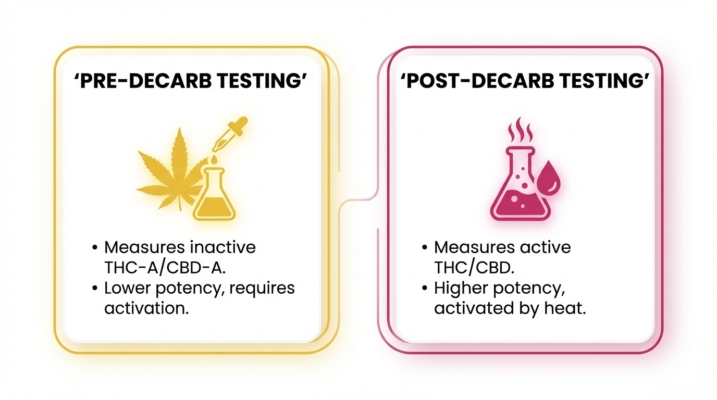
The difference between pre-decarb and post-decarb testing is the point at which a lab measures THC content in a hemp sample. Pre-decarb testing measures cannabinoids in their raw, acidic forms, reporting THCA and delta-9 THC as separate values. Post-decarb testing applies heat to convert THCA into delta-9 THC before measurement, producing a single “total THC” figure.
Consumers can verify which testing method was used by reviewing the Certificate of Analysis that reputable retailers provide with each product. IndaCloud provides third-party lab test results for all products, allowing customers to see exactly how THCA and delta-9 THC levels were measured.
The testing method chosen determines whether a product passes legal thresholds. According to a study published by the NIH National Center for Biotechnology Information, the most common cannabinoid quantification techniques include gas chromatography (GC) and high-performance liquid chromatography (HPLC), with GC requiring derivatization for acidic cannabinoids like THCA while HPLC can quantify both acidic and neutral forms without derivatization.
This distinction matters enormously for compliance. A hemp flower sample testing at 0.2% delta-9 THC pre-decarb could exceed 0.3% total THC post-decarb once its THCA content converts. For consumers, understanding which method a state requires reveals whether high-THCA products can legally exist in that market.
The states that require total THC testing for hemp products include Oregon, Minnesota, Hawaii, Idaho, and several others that have adopted post-decarboxylation analysis into their hemp compliance programs. These states use a formula that accounts for THCA’s conversion potential, typically calculated as: total THC = delta-9 THC + (THCA × 0.877).
States relying solely on the original 2018 Farm Bill’s delta-9 THC threshold of 0.3% on a dry weight basis, as defined by the USDA, have allowed high-THCA products to remain technically compliant. However, this gap is closing. According to Arnold & Porter Kaye Scholer LLP, Section 781 of the Continuing Appropriations and Extensions Act, 2026, effective November 12, 2026, redefines hemp products by total THC content instead of solely delta-9 THC content, including THCA in the calculation.
Once this federal standard takes effect, the distinction between pre-decarb and post-decarb state testing frameworks becomes largely academic for consumer products, since the 0.4 mg total THC per-container limit will override more permissive state approaches. Understanding your state’s current testing requirements helps you evaluate product labels and verify compliance before purchasing.
State laws affect THCA flower, edibles, concentrates, vapes, and cartridges, though regulations treat each product type differently based on form, THC concentration, and intended use method.
State laws apply to THCA flower primarily through THC testing standards and how regulators classify raw hemp biomass. THCA flower contains high concentrations of tetrahydrocannabinolic acid in its natural, unheated form. According to NIH research published in the National Center for Biotechnology Information, THCA accumulates in cannabis glandular trichomes at concentrations up to 90% of total THC content. States using total THC testing (which accounts for THCA’s potential conversion to delta-9 THC) effectively restrict most high-THCA flower, while states testing only for delta-9 THC have allowed it to circulate as legal hemp. For consumers who prefer raw flower, checking whether your state applies pre-decarb or post-decarb testing is the single most important compliance factor. Consumers in states where THCA remains legal can explore lab-tested, Farm Bill compliant THCA flower with verified Certificates of Analysis for full transparency.
State laws apply to THCA edibles and concentrates through potency caps, serving-size limits, and total THC calculations that vary significantly by jurisdiction. Edibles pose a unique regulatory challenge because consumption involves ingestion rather than combustion, meaning THCA in a raw edible may not fully convert to THC. Concentrates, however, are typically heated during use. According to Arnold & Porter’s legal advisory, Section 781 of the Continuing Appropriations and Extensions Act, 2026, caps final hemp products intended for ingestion at no more than 0.4 mg of total THC per container. This per-container limit effectively eliminates most THCA edibles and concentrates from legal sale at the federal level, making state-level rules the determining factor for current availability.
State laws apply to THCA vapes and cartridges through inhalation-specific regulations that often impose stricter controls than those governing other product types. Vaping heats THCA to temperatures that trigger rapid decarboxylation. Research published by the NIH confirms that decarboxylation of THCA is complete at 160°C, converting it fully into psychoactive delta-9 THC. Because vapes are designed for inhalation, states increasingly classify THCA cartridges alongside marijuana products rather than raw hemp derivatives. Several states have enacted vape-specific bans or age-verification requirements that apply regardless of the source cannabinoid. For anyone purchasing THCA vapes, this product category faces the highest regulatory scrutiny across nearly every state framework. Buyers in compliant states can access premium, lab-tested THCA vapes that meet federal hemp standards and ship with verified potency documentation.
With product-type distinctions clarified, upcoming legislative trends will shape how these categories are regulated beyond 2026.
THCA laws may continue to change after 2026 through pending federal legislation and evolving state-level hemp cannabinoid regulations. The following subsections cover key federal bills and state legislative trends shaping this landscape.
The pending federal bills that could affect THCA legality center on the 2026 Farm Bill and the implementation timeline of the Continuing Appropriations and Extensions Act, 2026. According to Cannabis Business Times, the 2026 Farm Bill passed without a two-year delay for the intoxicating hemp ban, meaning the November 12, 2026 implementation date for the new hemp definition changes will proceed as scheduled.
This outcome closes what many in the industry hoped would be a window for revised compromise language. The FDA’s pending cannabinoid classification lists, required within 90 days of passage, will further determine which compounds fall under the total THC umbrella. For consumers and businesses alike, monitoring congressional session activity and any amendment proposals remains essential through the remainder of the year.
State legislatures are trending toward stricter regulation of hemp cannabinoid products, with several states moving ahead of federal deadlines. Nebraska provides a clear example: Governor Jim Pillen signed an executive order on January 27, 2026, requiring state agencies to review laws regarding synthetic THC in food, beverages, and other consumer products.
This proactive enforcement pattern reflects a broader shift. States are increasingly adopting total THC testing standards, restricting product types available to consumers, and imposing tighter age verification requirements. The gap between permissive and restrictive states will likely widen as the November 2026 federal deadline approaches, creating a patchwork that demands careful attention from anyone purchasing or selling THCA products.
With federal and state regulations tightening simultaneously, staying informed about compliance requirements has never been more critical for THCA consumers.
You can buy federally legal THCA products online in 2026 by purchasing from retailers that comply with the current 0.3% delta-9 THC threshold and provide third-party lab verification. Below, learn how Inda Cloud ships tested products nationwide and review the key legality takeaways for this year.
Yes, IndaCloud ships lab-tested THCA products to most states across the continental United States. Every product is third-party tested, with Certificate of Analysis documentation provided and no medical card required. IndaCloud offers free shipping on orders over $89, with most orders shipping within 48 hours.
Before ordering, always verify your state’s specific THCA regulations, since state laws vary significantly. IndaCloud has served over 250,000 verified customers by maintaining strict federal compliance and full product transparency. For consumers navigating a shifting legal landscape, choosing a retailer that prioritizes independent lab testing is the single most important safeguard for both legality and product safety. Browse IndaCloud’s full collection of premium THCA products to find lab-verified flower, edibles, vapes, and concentrates that meet current federal compliance standards. Shop our latest THCa flower oz deals to stock up on premium THCa.
The key takeaways about THCA legality in 2026 center on a major federal shift arriving November 12, 2026. According to an advisory by Arnold & Porter Kaye Scholer LLP, Section 781 of the Continuing Appropriations and Extensions Act, 2026 redefines hemp products by total THC content, including THCA, replacing the previous delta-9-only standard.
The most critical points to remember are:
The window for purchasing THCA products under current federal rules is closing. Consumers who value access to these products should stay informed on both federal and state-level changes throughout 2026.
Yes, THC gummies are legal to buy in most of the United States right…
Learn more
Raw, unheated THCA clears your system in roughly 24 to 48 hours. Once you…
Learn more
Yes, edibles show up on drug tests. Standard panels detect THC edibles exactly the…
Learn more
THCP binds cannabinoid receptors roughly 33 times harder than THC in lab testing. THCA,…
Learn more
